Unknown's avatar

About sarahfitzgerald1984

Hi there! My name is Sarah Fitzgerald. I'm a mother to a beautiful daughter and a wife. I've always loved writing and recently found the courage to start again. I'm nervous but excited and I hope I can create some interesting and thought-provoking posts here.

Delicate Scent of Summer Dusk

I really shouldn’t be blogging tonight. I’m lucky enough to have a bit of work to do, work that I might actually get paid for. But I can’t concentrate.

I don’t know whether it’s because I’m ‘overdoing it’ as my two friends and husband protest that I am, or whether it’s this lovely weather distracting me and giving me an intense dislike for my desk at the moment. It’s been gorgeous these last few days, and my mantra is to make the most of life before it disappears through your fingers as fast as dry grains of sand. So I’ve been in the park, going for walks and trying to clear my head. And then I sit at my desk, and nothing happens.

Just half an hour ago, I took a break from my desk to bring out the bins, and as I stood there absorbing the fresh air and fanning away the midges, the smell of the warm air brought back memories: memories of having barbecues growing up that lasted until it got dark; memories of walking to the shop with a single pound coin in my pocket to buy sweets for all four of us; memories of having cycling competitions with my two younger sisters (in my younger, fitter days) around our estate, only coming back in when the other kids were called home too.

I really hope that one day, Ali will enjoy this freedom, but right now I don’t think she’ll ever be as free as we were. The dangers that were there when we were kids are still there now, and coupled with social media (I get the irony, believe me), you really can’t tell who is watching your kids and what images they have of them. Ali is only five and I’ve already taught her my address and phone number in case we ever get separated for whatever reason. We’ve done stranger danger, although how much of it she really understands I don’t know, and I worry irrationally all the time. This is normal, right?

I remember after the terrorist attack in Paris in 2015, I didn’t sleep for about two weeks. I got paranoid about every little noise in the night, about being in crowded spaces, about helicopters and planes overhead. And I’m not sure why it worried me so much, because I remember going to Coalisland (In Co. Tyrone, Northern Ireland) every weekend with my parents as a child and being stopped by soldiers at the border. Both of my parents worried about their Southern Reg car – it was dangerous at the time and it certainly made you stand out as an outsider and in the wrong area, a prime target for petrol bombs. As kids we were terrified, but mum and dad seemed to take it in their stride. They were used to it, it didn’t faze them. And if it did, they never let it show.

What  were they supposed to do, never go north? Or move back up and never go south? They did neither. We continue to travel back and forth to see our family, and will always do so, even if Brexit does mean tighter borders between the UK and Ireland (and after the attack at the Ariana Grande concert in Manchester this week, it’s looking like a possibility).

Our world is not safe, yet it has been reported that never before in history has it been safer to be alive. Polio, the plague and other diseases are almost entirely eradicated. Vaccinations against deadly diseases such as measles and malaria are widely available. Life expectancy is now into the seventies at least. And we will be spending the rest of our lives worrying about terrorism, bogeymen, rapists and the likes.

Listen, I’m not suggesting for one second that we should let our guard down and ignore what’s going on in the world. Nor am I saying ‘oh well, the world is an evil place, sure what can we do?’ Of course we must be seen to be strong in the face of barbarity. But our children deserve to live free of fear, because they are going to spend enough time worrying about things. Our children deserve to live, and to try and carve out a legacy to leave behind them for their own kids. They deserve the freedom to make their own mistakes and the freedom to recover from them.

They should be free to ride their bikes into the sunset, embracing the sweet smelling fragrance of a summer dusk.

RIP to those who were killed in Manchester 22.5.17, and condolences to your families.

Enda the Line


Finally, after what seems like an inappropriately long wait, Enda Kenny stepped down as party Leader of Fine Gael at midnight on Thursday 18 May, and a new party Leader will be announced by the 2 June.  And predictably, many people in this country, including myself, are reflecting on the work (or damage, depending on who you’re talking to) he’s done over the course of his time as Taoiseach. Many of us will not be sad to see him go, especially the many people with disabilities that he’s let down so badly over his term.

Now, I am not saying that by any means that Enda had an easy job. Nor am I denying the fact that his predecessors, Bertie Ahern in particular, left a massive mess behind that Enda would have to clean up. However, during Enda’s time as Taoiseach, I have witnessed a frightening change in the narrative of disability in this country. Perhaps it’s merely age-acquired wisdom, because I don’t remember feeling this trapped as a disabled person during the early noughties. I went to college, I found it easy enough to find summer work and for a very brief period, I was even naïve enough to view myself as equal: willing to contribute to society and worthy of respect for it as a result.

I was just watching an interview activist Joanne O’Riordan had with Gay Byrne’s RTE series The Meaning of Life, in which Joanne discussed her experience with Enda Kenny. Kenny had promised her that the funding for P.A. (Personal Assistant) Services would remain untouched, and then turned around and delivered the blow that a whopping €130million would have to be taken from the HSE Budget, including a €10m cut to the P.A. budget. This soul-shattering announcement demonstrated how little our Taoiseach thought of our lives. This announcement drove activists with disabilities to sleep out in the cold for three days outside Leinster House until these cuts were reversed. It was both a victory and a slap in the face for people with disabilities, because although we were listened to, we realised that we would always have to take drastic measures to have our voices heard.

I worked in the area of Independent Living for seven years, and Enda Kenny was Taoiseach for four of those (since 9 March, 2011). Part of the reason I made the tough decision to leave my job in 2015 was because I found it too difficult to watch, as I saw it, the degeneration of the Independent Living Philosophy. When I joined Offaly CIL first, I was told to have passion. I was encouraged to get excited about equality for people with disabilities, to see the Personal Assistant Service as the key to achieving this equality. I was told that Independent Living was about freedom, control, choice. It was a liberating service with its own unique history and philosophy.

For me, Enda Kenny’s government destroyed all of that. Suddenly, service provision was about a hierarchy of needs, and the service became more about covering the basics rather than encouraging ability and individuality. When I spoke to people about this great ‘philosophy,’ I felt I was lying to them. I would ring my fellow Leaders and ask them to come into the office for a coffee and a chat, and they would tentatively ask me ‘are my hours going to be cut?’ I have to hand it to Offaly CIL, they did and still do resist cutbacks and they go above and beyond to protect Leader’s hours. But it infuriates me that because of Enda Kenny’s nonchalant attitude towards disability that my fellow Leaders continue to live in fear.

I’ll never forget reading the coverage of the three-day protest Martin Naughton led outside the Dáil in 2015 (unfortunately, I was out of the country at the time – yes, I really am just an armchair activist). Martin was asking for the opportunity for people with disabilities to have more control over their own lives by allowing money normally paid directly to service providers to be redirected to the experts, the person with the disability. The protest bore little results apart from a lot of negative press about Enda Kenny, with people by now being so annoyed with him that the focus from the public was more about what a complete tool he is as opposed to what Martin Naughton was asking for (the right for people with disabilities to truly experience Independent Living, in case you’re in doubt). And yet, even after talking to Martin and other disability activists, the future of our lifeline – the Personal Assistant Service – is constantly in jeopardy.

Oh, one more thing – some of you out there think that Leo Varadkar should take over as Taoiseach. And perhaps he should, but I’m personally a bit wary. Aside from the fact that our health system is currently a shambles, a report entitled ‘Make Work Pay for People with Disabilities’ recommends that people with disabilities keep their medical card, as well as raising the current cut-off point of €120 before they start to lose their Disability Allowance. Now, don’t misinterpret me – this is great progress – but given that a report from Inclusion Ireland in 2014 estimates the weekly cost of disability to be €207, it seems that there is a long way to go before people with disabilities can expect a decent quality of life. Also, there is a fear that this system could force people into work that they are genuinely incapable of, a bit like what’s happening in the UK at the moment.

So goodbye, Enda Kenny. Undoubtedly you did many great things for many people across Ireland during your time. You’ll have to forgive the disabled population of Ireland for struggling to remember exactly what they were.

And a quick message for your replacement, whoever you may be: We as people with disabilities have put up with enough shit over the last nine years to last a lifetime. We definitely are not in the mood to tolerate any more. Just thought you should know that.

Night off work


Me: I think I’ll take the night off.
My conscience: But you’ve got so much work to do.
Me: I’m tired, and not in the mood to work.
My conscience: You’re not going to get far with that attitude are you?
Me: I’ll feel better in the morning, and I’ll work twice as hard tomorrow.
My conscience: Hmmm, sure. And you have the cheek to wonder why your novel isn’t finished yet?
Me: Hey, I deserve a night off. I have a kid, kids aren’t easy, you know.
My conscience: You have one kid, she’s five and let’s face it, she’s far from a handful. (Pause) You know, you’d get so much more done if you deleted your facebook account.
Me: I only check it to see how my blog is doing.
My conscience: Hmmm-hmmm. Yeah, sure. Not to randomly scroll through photos.
Me: Oh here, forget it now, I’m definitely taking the night off. I need this.
My conscience: Ah, go on. You might as well. And if you want, we can even call this conversation work, if it makes you feel better.
Me: (eyes misting) Thank you.
And that’s Tuesday’s work done and dusted.

Memories of Mum

As the most loyal of my followers know by now, May 7th marks two completely separate events: my little sister’s birthday and my mum’s (now eighth) anniversary. Of course they’re not separate at all; every year until the end of time (or of our family’s time anyway) we will think of the joy that Laura Ann Maye brought into our lives while weeping for our beloved mother who we miss more than words can describe.

Laura is twenty-eight this year, but it’s hard for me to think of her as older than eighteen, getting two birthday cakes at her birthday dinner and screaming as her hair caught fire from the candles. She’s in Helsinki now, working as a Postdoctorate Research Fellow at Aalto University (I double-checked this on Facebook), and yet I still think of her as my ‘little’ sister even though in many ways, she’s more of a grown-up than I’ll ever be.

Every year, memories come flooding back to me, and as I’ve already extensively spoken about my grieving process, I thought I would instead share some of them with you to show you what an amazing, quirky, and often downright inappropriate lady my mother was.

  • ‘Girls! Oh my God girls, get up quick, it’s 8.15! You’ll be late for school!’ I jolt awake, not even thinking about how dark it is and turn on the sitting room light to discover that it’s not 8.15, it’s 3.45am and mum has looked at the clock backwards.
  • Interesting fact – mum handmade all of our communion dresses as she disapproved of the ‘poofy’ look. Everyone thought mum had bought mine in Laura Ashley. Mum also handmade a lot of her own clothes – jackets, dresses, skirts, waistcoats.
  • Mum was the worst at accumulating shite (no other word for it), collecting keyrings, little notebooks, Harrod’s beanie babies, candles, little pebbles. That was fun after she died, trying to decide which collection meant more to her! Not.
  • Mum was an artist. In her early days she did a lot of portraits, then she went through a phase of drawing violins, then front doors surrounded by pretty flowers. She made her own Christmas cards. She even painted designs on the little doorknobs on the kitchen presses. She loved bright, bold, primary colours. She did an interior design night class in Portabello College. If she had pursued this line of work. she’d be famous now. Beyond a doubt.
  • I have a ridiculously sweet tooth, something I inherit from my mother. It was her that introduced us to sticky toffee pavlova and knickerbocker glories. Honestly, I don’t know how we’re all stick thin either. Think that my siblings and I should donate our bodies to medical science.
  • I wouldn’t classify my mum as a scary person, but by God – the day she found out I’d told Sr Concepta in fifth class that my computer at home was broken and I had to write everything down (which was a lie, I just hated the computer) she called into the school, marched up to my class and said ‘Sarah Maye, get your ass out here right now!’ She ate me. Till the day she died she never lived it down.
  • We did get to spend some quality time together though, like all the times we went for various appointments, first in the CRC and then in Musgrave Park in Belfast. I remember walking up and down corridors and halls with these bobbly things all over my thin little legs and mum telling me I was modelling these special diamonds. I also remember falling in love with the doctor in Belfast (I was ten) and mum telling him all about it. Morto.
  • I also remember coming home from a respite holiday in Roscommon when I was eighteen and walking in the front door. The first thing my mother said was ‘What the hell is that thing around your neck? (It was a new chain, from JP) Who is he?’ After explaining to her that I’d met a boy and we were now an item, she smirked, took up the A4 pad that was on the coffee table and started explaining the birds and the bees, with explanatory diagrams. Lads, I’m not joking – she knew what she was doing because it was the best contraceptive ever. A year later and JP and I were still nervous of leaving the ‘holding hands’ stage. All I could picture was that bloody diagram.
  • I’ll never forget the day that Laura came home for the first time, and mum saying I couldn’t hold her until I fastened my dungarees on my own. The fact that I remember this should illustrate how real the struggle was. She placed her in my arms and I remember thinking how tiny she was and more to the point, how unexciting she was. For a while all she did was snooze in her Moses basket and lie there waiting to be fed and changed (lazy git). I couldn’t wait for her to grow up and play with me. And to be fair she, Stephen and Alex were the best siblings ever.

    But Laura and I are close too. I’ve been privileged to watch her through school and attend both her college graduations. Laura, I’ve no doubt that mum is immensely proud of you and what you’ve achieved. And it’s so unfortunate that your birthday is also her anniversary, but you know what? She wouldn’t want you to be miserable on your special day.

So have a lovely day and don’t feel one bit guilty about it, because the 7th May may have taken Mum from us, but it also brought you, and we are all so lucky and grateful that it did xx

1-7 May: Maternal Mental Health Week

I was just scrolling through Facebook this evening, you know, doing some important web-based research, when I saw a post saying that it was Maternal Mental Health Week this week (May 1-7). According to talkingmums.com, up to one in five women experience mental health issues either during pregnancy or in the year following birth. Yet, out of these women, only 7% of them are typically referred for specialist help.

How many of you, like me, have suffered from PND, yet never admitted it to a doctor or health professional? How many of you out there are still suffering?

I’ll never forget the moment I knew for sure I was suffering from PND. Alison was only three months old and we had just discovered (or rather, the Public health nurse finally believed me) that she had a cow’s milk allergy. We had Ali put on special formula. She started gaining weight and became the happiest baby ever, sleeping through the night and everything.

I should’ve been happy, but I wasn’t. Relieved, yes. Happy? No.

All I wanted to do is disappear. I was just waiting for the right time.

I had this vision of having PND as standing over your baby’s cot with a pillow in your hand or wanting to throw your baby down a flight of stairs. While I appreciate that some women feel like that (and this doesn’t make you a bad person – you’re unwell and need help), I didn’t. I felt that my daughter was the most perfect person in the world and that she must have done something truly horrible in life to end up with a mother like me.

I didn’t know that PND meant looking in the mirror and being repulsed by the pathetic specimen staring back.

I didn’t realise that ignoring it wouldn’t make it go away. I ended up in the doctor with chest pains, shoulder pains, stomach aches and yet the doctor couldn’t find physiological reasons for any of them. She prescribed painkillers which didn’t seem to help. I always denied feeling down or depressed. Big smile on my face. Sure what would I have to be depressed about?

By May 2014, I could barely get out of bed. I wasn’t eating properly. I was crying all the time; it was all  I seemed to want to do. In order to get from one end of the day to the other, I had to measure my time in hourly units. Then half-hourly, and towards the end, minute by minute. If I can hold myself together for ten more minutes I’ll be grand, I would think to myself. But of course, I wasn’t grand – far from it.

When I took time off work, I considered my treatment options. I know it sounds ridiculous and shallow, but the thought of going on antidepressants filled me with dread. I wasn’t too keen on counselling either as my previous experiences were quite negative. But I knew I had to do something, so I started writing. Writing how I felt. Writing about my flaws. Writing about my talents. Suddenly, I felt liberated. I’m not recommending this course of action over medication or counselling, but writing was my saviour. It’s something I enjoy, am (reasonably) good at and writing my thoughts and feelings down helped me to own them, and then let them go.

Postnatal Depression has changed me into someone different to who I used to be. I am more sensitive now, and I hate myself for it. I’m still conscious of how people perceive me as a mother. In addition, I now have to make a conscious effort to look after my mental health, to recognise the signs of feeling sad or overwhelmed and act on them before they take over. I also have to be careful. I love helping people, but I have a tendency to internalise their problems to the point where they become my own problems. Sometimes I need to step back, say no and this is hard. I hate doing it.  But I have to remind myself that if I don’t mind myself, I can’t help others.

This week is National Maternal Mental Health Week, and while it’s great to have a platform to write about PND and mental health, the issue of maternal health shouldn’t be confined to a mere seven days of the year. We need to open up the conversation to all mothers, make them feel supported and not feel alone. When I published my long preamble about my experience with PND, I was convinced that either no-one would read it or that it would be dismissed as being a tad melodramatic. What I didn’t expect was the hordes of girlfriends, as well as women I’d never met, emailing me their stories and reminding me that I was not alone. Thanks to those women for validating my story and for making me feel that my depression was completely normal.

And if you are reading this, and you are silently suffering from pre- or post-natal depression, you are not alone either. Look after yourself and get the help you need. Trust me – even mothers who appear to be perfect can suffer silently.

You are worth the help. And after the fog lifts, life becomes so much simpler.

You are wonderful. You are beautiful. You are everything to your children, and they deserve you just as much as you deserve them.

But you can’t pour from an empty cup, so look after yourself.

I’m only human, after all…

TMI alert, people: I’m currently in the middle of my, shall we say, ’emotional’ time of the month. And as every woman out there knows, during this period (pun intended) we can become irrationally angry or overwhelmingly emotional for no apparent reason (but hey, isn’t that what chocolate is made for?) Anyway, there is a point to this, I promise. Stay with me.

My husband, my daughter and I were travelling in the car on Monday when ‘Human’ by Rag’n’Bone Man came on the radio. Of course, being an emotionally unstable female, I was instantly in floods of tears, much to the surprise of my husband who nearly crashed his car in shock.

‘What’s wrong with you?’ he blurted out, while I wiped my tears. I shook my head.

‘It’s crazy time again,’ I joked as I tried to compose myself. But there was more to it than that, and he knew it too. And I didn’t have the words to explain. I do now, though.

The energy of the song and the repetitive line ‘I’m only human after all’ brings to mind what’s been going on in the media over the last few months with the remains found in the septic tank at the Mother and Baby Home in Tuam. Like many of us I feel sick as I think about all those women, both young and old, who gave birth to their babies and never knew what became of them. It’s likely that some, if not most of these pregnancies were unplanned, and instead of being supported these women were disgraced, disowned by their families, and left in the hands of the nuns. You’ve read some of the stories, I’m sure. It’s truly harrowing stuff, and it’s been playing on my mind for the last two months.

How can we claim to be compassionate when we don’t even allow people to be human?

I live in a country where my rights as a person with a disability are not protected. This is because something called the United Nations Convention on the Rights of People with Disabilities (or the UNCRPD) hasn’t been ratified by the Irish government. In theory, this Convention guarantees that no person with a disability should be forced to live in an institutional setting against their will. It guarantees access to Personal Assistance as a right, not a privilege. Those who have ratified the Convention (and Ireland is the only EU country that hasn’t) are answerable to the UN if human rights are breached. With constant threats of cuts to PA hours and people with disabilities having to give twenty four hours to use public transport, Ireland would certainly have a lot to answer for.

What upsets me the most is when you have a disability, you’re not allowed to make mistakes. Everyone makes mistakes, takes wrong turns and yet, when you have a disability you’re either expected to be some kind of Superwoman, or an utter failure. If you make a mistake, well, obviously you’re not cut out for education or parenthood or whatever it was you were trying to do. People judge each other; I’m no different. But this pressure to live up to an arbitrary standard, set by people who may have no experience of disability, is overwhelming. As my loyal followers are aware by now, I came up against intense pressure to prove myself when I had my baby girl. And as you may be aware, I never sought help for my postnatal depression which lasted two and a half years because I was afraid that, combined with my disability, it would give the HSE the authority to take my daughter.

And my overwhelmed, hormonal, PMSing self thinks this is truly unfair. I feel frustrated and tired with it all, and I only wish there was more I could do to challenge this injustice, to stop history from repeating itself. Sometimes I wonder if life would be easier if I wasn’t so sensitive, so stubborn, if I just didn’t care. But the truth is, I do care. A lot. Too much.

But there isn’t much I can do at  eleven at night, and I’m pretty stuffed from that Easter Egg I’ve just polished off…

Hey, don’t judge me, I’m PMSing.

…and I’m only human, after all…

Cripping Up: Useful Exercise, or a load of Crap?

Earlier today my daughter, who is growing increasingly aware that her mummy is different to other mummies, asked me if I could walk properly when I was a little girl. ‘Nope,’ I told her, ‘My walking was pretty rubbish when I was a child too, but I didn’t need a wheelchair.’ She was silent for a second, then she said, a tint of sadness coming into her otherwise unblemished face:

‘Some of the girls in my class make fun of you. They say “ha ha, your mummy can’t walk properly.”‘ For a second, my heart stopped. This is the conversation I’d dreaded having with my daughter since the day she was born.

As nonchalantly as possible, I prodded. ‘And what did you say?’

Alison shrugged. ‘I said “don’t make fun of my mummy, it hurts her feelings” but they didn’t stop. I didn’t like it mummy. I would never do that to anyone.’ She was so absolute in her defence of my that it made me want to cry. ‘Mummy,’ she continued. ‘You know I don’t care if you can’t walk properly, or you’re in a wheelchair. I love you and you’re the best mummy.’ I sat, reeling. Where the hell had all this come out of, all of a sudden?

‘School,’ my friend said when I told her the story. ‘Kids learn all sorts from each other at school. They learn to see things differently, to question things, and most worryingly of all, they trust what each other says.’ This isn’t my first encounter with schoolkids of course; once upon a time, in the very same school in fact, I had the honour of dealing with this sort of thing first hand. And while some of the comments hurt (and they did, because I was an impressionable child, just as Ali is now), others were downright hilarious. One particular time I caused grievous injury to a classmate who was enjoying imitating my walking and consequently whacked herself off a door. ‘I never do that,‘ I laughed. And bingo, humour became my new method of self-defence. To be fair, it’s lasted pretty well.

But what has always interested me, even from my prepubescent years, is how people tend to be so fixated on my impairment and how they see it as problematic. ‘Do you ever wish you didn’t have Cerebral Palsy?’ is a question I’ve been asked more times than I’ve had hot dinners. My answer has always been the same, but it’s only in recent years that I understand why I’ve always said no. Cerebral Palsy, and any other disability for that matter, only becomes problematic when others are uncomfortable with it. Impairment and disability are different things. Impairment is a condition or diagnosis, and disability is the collective term for physical and attitudinal barriers facing people in society. I’ve lost you now, haven’t I? Allow me to explain.

My impairment wasn’t the reason why gaining entry to mainstream school was a battle, but the lack of supports available was.

My impairment didn’t stop me reaching third level education because I was enabled through Assistive Technology and Personal Assistance to do so. I used these as tools to unlock my potential.

I built a ramp on both sides of my home so  that I could consequently get a wheelchair to enable me to be independent and get out of the house. A lack of ramps would hamper my freedom, not my impairment.

My heart always sinks whenever I hear the words ‘disability awareness training’ because it often involves so-called ‘able-bodied’ people ‘cripping up’ to try and get a feel for what the world is like for a wheelchair user. With all due respect to those  of you who think this is a good idea, it’s not. Often, it involves able-bodied people using oversized or unsuitable wheelchairs and trying to navigate a physical environment. It’s an unrealistic portrayal because wheelchairs for full-time wheelchair users are designed for their specific needs. While doing something like this, you get a flavour of what it’s like to use a wheelchair to get around and the physical challenges involved. However, you cannot possibly be expected to know what it’s like to carry the burden of a history of hundreds of years of neglect, discrimination and degradation.

It creates awareness, as Kathryn Thomas did on The Late Late Show on Friday 7 April. Everyone knows her face. She was selected to create awareness of the barriers facing wheelchair users in Dublin. It got a great response from many people, saying that it was great to see this issue being highlighted at last. The reality is that people with disabilities have been saying these things for years. And yet, many wheelchair users, including Louise Bruton, who reviews access in Dublin for her blog, Legless in Dublin, was not asked to participate. She wrote an article for the Irish Times before the Late Late aired in which she said: ‘These pieces are a gimmick and if they help change the minds of a few people, then that is great, but they remove us from the discussion. By doing this, we are passing the baton and the opportunity to go deep into the experiences of a wheelchair user is missed.’

Blogger John Doyle was more direct in his criticism of this approach, saying in his blog: ‘Would your celebs paint themselves black and claim the understand racism? No they would not. Did John F Kennedy mimic being a different ethnicity to highlight racism? No he did not. He acted with legislation because he lived in a country that had one rule equality for one section and a rule of inequality for others’. We still haven’t ratified the United Nations Convention of Rights for People with Disabilities, which would mean so much more than a celebrity endorsement.

And why do we need celebrities to highlight the issues that we disabled  people have been discussing for years? The answer is simply we don’t – but for some reason our voices seem to only matter when they’re endorsed by politicians, celebrities and the likes. I wonder is this because people don’t want to know about the nitty-gritty of the discrimination disabled people face, or is it because they feel they can relate to an able-bodied person better? If that’s the case, will our voices, our own voices, ever be heard?

Because I don’t want my daughter answering questions about her ‘different’ mummy forever. I hope that one day she will be wise enough to say ‘You have a question about my mummy? You ask her yourself. I don’t speak on behalf of her, or anyone else.’

Mother’s Day Hunger

Tomorrow is Mother’s Day. Normally I’d anticipate it coming but this year it just hit me out of the blue. ‘Happy Mother’s Day!’ shrieked Alison on the way out of school on Friday afternoon, waving yet another piece of brilliant artwork. And it is brilliant; you can see the improvements in the detail of the people she draws. They’re no longer stick people, they have trousers and dresses, eyelashes and even bracelets. She’s growing up every day, because of me, or in spite of me – I’m never sure which.

We spent the whole day in town together, and after the two hours in the park decided to pick out something for her two nanas’ graves. We eventually found something vaguely acceptable, but as I surveyed them, something sank in my stomach. It’s not only the feeling of loss that comes with every Mother’s Day when your mum passes away. This was a very real but unreasonable sensation. I’ll try to explain.

Every Saturday if the weather’s good, Ali and I will go for lunch, a kind of mother/daughter bonding activity. It’s become a habit, a ritual, one I used to look forward to (I love cooking  but hate the clean-up after). Now, however, the novelty has worn off and I’ve started making dinner at home more. My cooking is nice, but also there’s nowhere in the world that will ever serve food the way mum used to make it. Sausage stew, roast pork, ‘twice-baked’ spuds filled with ham, onion and cheese, cheesy veg, lasagne (I’m salivating here and it has nothing to do with my Cerebral Palsy). I know it sounds ridiculous but even if I followed recipes the thought of never eating her food as she cooked it hurts. I’m hungry for the nice food.

And as with every Mother’s Day, I’m hungry for her.

I’m hungry for the ridiculous fights we had on countless Mother’s Days when she used to insist  on cooking dinner (probably for the same reasons that I can’t seem to find a nice restaurant these days – she liked her own food) after which she would moan incessantly about how nobody helped her even though she liked doing things her own way and she had previously insisted on cooking alone.

I’m hungry for the ridiculous squeals of appreciation at presents we got in the Pound Shop that she’d probably given us money to buy (wow, just what I need! A stuffed penguin!) and the feeling that no matter what you got her it would never compensate for the job she did as a mother. And her smiles as she opened the cards and cooed over our artwork.

I’m hungry for who she could’ve been, whether that might’ve been a famous interior designer, a ‘hip’ nana or a grumpy curmudgeon and I often wonder what she would have made of JP and I having Ali, and whether she would’ve insisted that she wasn’t an on-call babysitter with one breath and threatened to adopt my daughter with another. I wonder if she would approve of my choice to leave a paid job and enter the murky world of freelancing, or if she’d be embarrassed by my seeming laziness. She certainly wouldn’t approve of the wheelchair, but I also know that she kind of, sort of, trusted my ability to make sensible decisions.

I’ll never know what she did and didn’t approve of. I only have one regret, and that is how hard I was on her, how much I expected of her. Being a mother is hard work and scary sometimes, and sometimes she had bad days like us all, which she tried to hide from us. When I was small, I thought my mum was invincible, and even when I was told at the age of twenty-five that she had passed away, I said ‘no, sure try waking her again, she’s just a very heavy sleeper(!!!) (She slept through a bomb which demolished some of her house in Cookstown at the age of fourteen).  I, like all of us, took her death hard, and when my own daughter was born three years later, I panicked. How was I going to do this without the support of the woman who had such a major role in who I am today? And yet, I did, sort of. Call me crazy but during that time I had to believe she was close by otherwise I would have crumbled altogether.

Now, my grief is more reserved, but it won’t stop the tears on a day like tomorrow. Yet tomorrow too will come and go, feelings of happiness and sadness intertwined with begrudging acceptance. I think one of Mum’s favourite country and western singers, Kathy Mattea, puts it more eloquently than I ever could:

‘We’ll never know what could have been, but looking back we see
What could have been, and never was, was never meant to be.’

Now there you go mum, your own Mother’s Day blog! No ‘I wish heaven had a phone’ memes for you! xxx


Wheel Independence


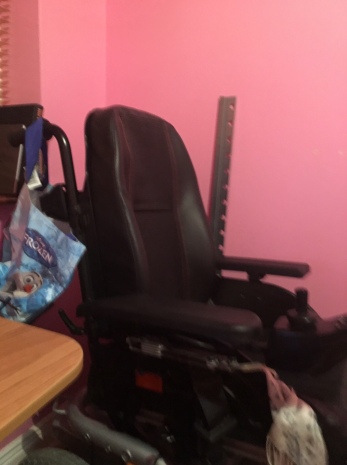
wheelchair.JPG

My poor, sad, neglected wheelchair (sad face)


I have really missed blogging here for the last two weeks (I’m back, yay), but to be honest, I just needed a break. I felt wiped, depleted and I know from hard  experience that when I feel like this it’s better to take a breather rather than having a meltdown and sobbing in my jammies at the side of the canal at 4.30am (ahem, apparently). I have been busy though with activism, and I got my submission in to Date With An Agent (I hope – I never enclosed an SAE to acknowledge my entry but I know my  future award winning novel will totally be selected), so that could account for why I’m that little bit more tired.

Or maybe it’s because for the last month and a half, I’ve been without my electric wheelchair, and the extra physical effort of walking everywhere is taking its toll. And thank God it is finally getting fixed tomorrow, because I am wiped.

My dear mother, who spent the first five years of my life doing physio with me every morning, was dead set against me using a wheelchair. We lived in a two-storey house when most of my disabled friends lived in bungalows. She wasn’t too keen on me having a wheelchair in college, although she understood the reasoning behind it. Growing up in a mainstream world led me to believe that one’s value was largely based on their physical ability to do things and to get around.

When I had Alison, my friend advised me that I wouldn’t want to miss out on doing things with my daughter, and so I got myself an electric wheelchair. Being ambulant I don’t think I’d have any chance getting one off the HSE. And for the first time since becoming a mother, I wasn’t housebound. I could take Alison for walks whenever I wanted, long walks and still have the energy to come home and do some housewifey things, and write my masterpiece. This is why the phrase ‘confined to a wheelchair’ annoys me so much. A wheelchair doesn’t confine, it liberates! Without it, I feel confined, trapped within the limitations of my body.

I firmly believe that when we are given access to tools like wheelchairs, technological aids and Personal Assistance, we are enabled to become the best us we can be. There is great strength in acknowledging that your physical impairments are not the problem, that society needs to address the needs of people with disabilities and be more inclusive. Above all, I believe that people with disabilities need to drive this change themselves.

It came to my attention over the weekend that student Kathleen McNamee, senior editor of the University Times, ‘cripped up’ or explored Trinity College campus in a wheelchair. What’s wrong with this, you might ask. Isn’t it great that people without impairments are trying to see the world through the eyes of a wheelchair user? Well firstly, Kathleen is not a wheelchair user; at the end of her article she wrote: ‘While I will be happy to hand my chair back tomorrow morning, I am also aware that not everyone is afforded this opportunity’. To me this implies that she sees the ‘problem’ as the wheelchair,  not the inaccessible environment. Also, why did she have to ‘crip up’? Why didn’t she look for the experiences of full-time wheelchair users who navigate the campus on a daily basis?

Secondly, I felt that the article was a little unfair on Trinity. When I carried out an access audit in 2004, we identified all of the problem areas and efforts have been made to fix things: the pathway through Front Square, there’s now a lift up to the Pav (the on-campus watering hole) and ramps to the buildings in Front Square. Things are far from perfect, but they’re improving.

Irish Rail, however, seems to be getting worse. A friend of mine told me recently that on principle she refuses to give any train station 24 hours’ notice of her intention to travel because she sees herself as equal. Today I had to travel by train (I had no wheelchair, just my rollator) and didn’t give notice, so I had no reason to be disgusted when assistance didn’t appear in Tullamore (even though I rang an hour beforehand), leaving me no choice but to fling my rollator and myself off the train. Had I been in my wheelchair I’d probably be writing this from Galway!

So to summarise, I’m looking forward to my wheelchair being repaired in the morning and to getting my independence and energy levels back. My normal life back. I know I should make more of an effort to get fit, and some might think I shouldn’t be so lazy. Feck that. My daughter needs a mummy who has the energy to do things and go places with her, and I need the energy to write, and that’s exactly what my wheelchair offers. It doesn’t matter how you get there, as long as you do!

Apologies for absence!

Hello to my adoring fans! I hope you are all well.

Hoping to get my blogging mojo back soon (probably will as soon as I’ve posted this, lol) but may not be around for a week or two owing to other projects like my first commission of the year (Watch this space), trying to submit something for A Date With An Agent (for which I fully expect to be selected of course) and another blog in progress for an activist group called By Us With Us. We’re a new group made up of  people looking back on the history of the Independent Living Movement and joining together to face the future. You can visit our blog here.

But don’t worry: as Arnie says, I’ll be back…….