Unknown's avatar

About sarahfitzgerald1984

Hi there! My name is Sarah Fitzgerald. I'm a mother to a beautiful daughter and a wife. I've always loved writing and recently found the courage to start again. I'm nervous but excited and I hope I can create some interesting and thought-provoking posts here.

Poem: For Leigh

We went travelling in Australia for the summer and, while we were there, a month to the date today, in fact, our friend Leigh passed away. Even though I was devastated, I don’t think it really hit me until I came home to Ireland.

I met Leigh by chance at a meeting in Dublin in 2014. We knew each other by reputation, and a friendship developed and blossomed over the years. Leigh reminded me of my mum so much, not because she was older(!!) but because she was from Newry and had a way about her that I ascribe to so many of my Northern Irish relatives: she had a wicked sense of humour; she said it as it was; and she was well accustomed to fighting for what she believed in. I tried scrolling back through our masses of Facebook conversations, to see when we first started messaging each other. After an hour, I was only as far back as 2018. Reams and reams of exchanged words of encouragement, anger, hope and fear.

Leigh was a religious reader of this blog and rarely neglected to leave an encouraging comment whenever I shared the latest instalment. During lockdown in 2020, she took up painting and sent me a canvas of two brown and white puppies, which I will treasure forever.

This hackneyed effort of a poem below won’t do Leigh any justice, but I can only hope she knew how much her friendship meant to me.

My condolences to Eugene, Karl and Aisling. You guys were her everything; that I know for sure xx

My grief-scarred heart 
Oozes gunge 
While I try to lend words
To articulate the loss
Of a headstrong woman,
Mother,
Wife,
Activist,
Friend.
Many times she wrapped me
Close to her heart
With her shortened arms
and endless patience,
Venturing across divides
Of land, time and attitudes,
Tough, but never hard,
Fearless, but not unfeeling.
The lullaby of her Newry accent
Luring those who tried to take advantage 
Into the searing, fiery ball
Of her passion for justice.
No longer will my phone ping
With requests to read presentations,
Or maybe just for a listening ear,
To ease her soul, though just for a moment.
And as long as I live, I will never forget
The woman who travelled to Texas and Pallaskenry,
Chasing dreams that were almost denied,
Crying tears she never should have cried,
To find the right man to stay by her side.
Nerves of steel, and a marshmallow heart
Ever present, yet too far apart. Xxx

Tuesday Thoughts: The Baby Book

Even though I have my own swanky writing office, I’m currently sitting in my kitchen typing this, the back door open so that the breeze on my face keeps me awake, and so that the dogs can potter in and out without scratching at the door every five minutes. In front of me, on the wall over this dining table, are two black frames full of baby pictures of Alison with her aunties, her uncle, her grandad. It seems as though my love for her is splashed across the walls of our house. Her playschool graduation photos hang in the hall; her communion photos are in the sitting room. 

I’ve always loved photos. When I moved to college, the inside of my tiny wardrobe was covered in photos of family and friends. Until I got my first camera phone, I would bring these photos with me to remind myself that I was part of something bigger.

I didn’t own a camera phone in 2012, when our daughter was born. I didn’t have a whole lot, in fact. But life goes on, and incidentally, people who try to tell you that you should wait until you can financially support a child are talking nonsense. You will never be financially ready, or ready full stop. We were both working part-time, and juggling childcare between us, and a lovely lady called Sharon. And because we were both working, neither of us had medical cards. When Alison was diagnosed with cow’s milk allergy in June 2012, she was prescribed Nutramigen, which was €12.33 a tin at the time, so three tins was nearly €40. Camera phones were the last thing on my shopping list.

When I look back now, I wonder if I should have tried to savour it all a bit more. It wasn’t as though I wasn’t warned about this. People warned me that the days would drag but the years would fly. Advised me to treasure every moment, because she’d be gone before I knew it. To really make the most of it. And to be honest, now that Alison is entering her teen years and I’m trying to figure out what my new role is, I feel awful for having taken it for granted. 

As Alison and I enter a new and trickier phase in our mother-daughter relationship, once again I’ve found myself questioning my parenting ability. I know my parenting was scrutinised by professionals in the early days, but these days I find myself to be a harsher critic than any nurse, doctor or social worker. I need to be more delicate. No, more direct. No, more lenient. No, stricter. I give her too much independence. I need to let go more. Come nine o’clock, I will have a pain in my head, as I’m sure all parents of teenagers do. And this is without the traditional worries of sex, drugs and rock’n’roll, which I know are only around the corner.

And I see now that I should’ve captured her a bit better. I didn’t keep the first lock of hair that was cut. Nor did I keep any of her teeth. I have videos of school concerts, blurry ones that were taken by my shaky hand. I have incoherent handprints, futile efforts to capture her at a certain age. I didn’t mark the wall every year as she grew taller – this is the one that I regret most. I haven’t even made a baby book. A book recording her first words, the first time she crawled, her first steps. I don’t have the hair from her first haircut. These things weren’t priorities at the time. My main focus was on surviving and giving her as much of myself as possible.

Yet, I have such lovely memories that are mine alone and I don’t need to share with anybody.

Memories of teddy bear cinemas on Sunday mornings. Of tea parties and picnics on the kitchen floor. Of doing all the things I’d swore I’d never allow my child to do; Play-doh, sandboxes, art involving glitter and paint. I remember midterm breaks that involved me bringing her to Mr. Price to buy a few bits for a Pinterest-inspired art project, especially around Easter, Halloween or Christmas. Clay figurines, lollipop stick houses. It was a joy to watch, as she got older, the improvement in her colouring or the increasing time she’d give to painting decorations. She would design our Christmas cards and handmake birthday cards for family and friends, projects that were thinly disguised activities to get us both from one day to another on days where I struggled to hold everything together. 

Or we’d walk down the canal and pick flowers (weeds), again killing time while she looked for “rare” flowers. I used to love these walks. We’d find conkers and helicopters, all of which were pocketed of course, then caused problems in the washing machine when they were undiscovered. I remember the long days we spent in the town park, chasing birds or looking for butterflies or ladybirds.

I remember teaching her how to read, making cards with words like “table”, “chair”, and “fridge”, and watching in awe as she stuck them to the correct objects around the house. I remember the first book she “read” on her own: Angelica Sprocket’s Pockets by Quentin Blake. I remember her first day of school, how lost she looked in her uniform, yet how enthusiastic she was. In fact, until last year, Alison rarely missed a day of school, such was her love of learning.

On the sad day when she decides to fly the nest, I will have copious amounts of artwork, stories and photos to look back on. But the most precious will always be my memories, of a happy, intelligent and truly unique child, which will live in my psyche until I take my last breath. I know that I did my best. And I have a loveable girl to show for it.

Tuesday Thoughts: Empty Batteries

(written Wednesday, 20 March 2024)

There’s nothing more annoying than when your day is scuppered by a minor inconvenience. I can’t speak for anyone else’s kid, but I know mine is tired. It’s been a busy term with schoolwork and projects, bake sales and fashion shows, football matches and National Slow Down Day, mingled with visits to her new secondary school, weekend basketball matches, meeting up with friends and sleepovers. And as much as I want to sit on top of her sometimes to slow her down, I restrain myself, reminding myself she was practically locked up for six months of her childhood. No wonder she wants to do everything and make up for lost time.

Anyway, back to my day. Wednesday mornings are always slow, because of basketball training on Tuesdays, so I wasn’t surprised that the sprog ran out the door this morning with no lunch and, more importantly, to her mind at least, no mouthguard, without which she wouldn’t be allowed to play in her school football match. Luckily, we live ten minutes away so I hopped into my wheelchair and flew down to the school to drop it off. Now, the school is a kilometre away, which makes it a two k-round-trip, which is nothing to my wheelchair, an Invacare Storm. However, coming back into my driveway, I noticed that one of the “bars” had disappeared. One bar of five. 

So, logically, you might think, well that means you could get ten kilometres from a full charge. And you would be correct, if it wasn’t for the fact that my wheelchair is long overdue a service. Any seasoned powerchair user will tell you that four bars left doesn’t necessarily mean your battery capacity’s at eighty percent. If you’re a gobshite like me, you might even try to push the limits of your wheelchair battery, a dangerous game. You know in your heart, as you set out to the shop a mere four hundred metres away, that the sodding thing could stop dead without warning at any time. You know it, and yet you still take the risk, trying to ignore what the universe tells you.

Because the world goes on, right? Who has time to wait for parts to come when there’s dogs to walk, basketball training, shopping to do? My front tyres are beyond bald, and my back tyres aren’t far behind. You can actually see the rubber underneath, which I’ve never seen before. Beyond threadbare. Realistically I shouldn’t be using it at all. 

And it made me think about how we push ourselves to keep going, even when all the signs are telling us to stop. Resting and taking time off have become dirty words in our culture. I read somewhere recently that, thanks to the convenience of remote working, some of us are working sixty/seventy-hour weeks, for no increase in wages. We live in precarious and stressful times. The cost of living has become untenable. (I read a 1984-esque article the other day, which said that the cost of living was starting to come down. Sure, coming down from a twenty-year high). We’re working harder than ever, with little extra to show for it. 

In addition, this winter (in my unqualified opinion) has been one of the worst for bugs and viruses. Alison has missed eleven days of school this year. This is a child who was never sick; who, until COVID, had near-perfect attendance records. Now I find myself trying to ply her with vitamins and tonics in the hope of keeping her well. The obvious reason is that because we were locked up for so long, we weren’t exposed to any viruses and now our immune systems have gone to pot. And it isn’t just children, either; so many adults I know have been wiped out in the last few months by various complaints. 

The saddest part of this is that lockdown taught us some valuable lessons that we seem to have forgotten. Many adored the slower pace of life and swore that they’d never go back to normal. People started exercising more, cooking healthier meals, pursuing the hobbies they’d never found time for. We promised we’d always make time for our loved ones, and for ourselves. Now, we’re busier than ever, desperate to make up for lost time. Coupled with the barrage of news about Gaza and Ukraine (and as I write this, Leo Varadkar has just stepped down as Taoiseach. Never liked him; he never did answer my open letter), we continue to live in uncertain times. Then, haven’t we always lived in uncertain times? The Troubles, 9/11, the London bombing, Paris and so on. Such is the nature of the world we live in: it doesn’t stop.

That doesn’t mean that we shouldn’t, as I was reminded a few months ago when I hit a wall. Funny how it’s only when the battery has fully drained do I acknowledge that there might be a problem. I won’t go into the boring details of what caused it, but I will admit that I ignored all the warning signs. My chronic pain was flaring because of the cold weather, and I was wrecked from lack of sleep. But I was still able to keep house and parent, so it wasn’t serious, right? Wrong. Nonetheless, I completed the first stage of my editing course, but at a cost. I was like a zombie, with a chip – the slightest thing made me either angry, or cry like a baby. The more I tried to push through, the harder it got. It felt as though a force from beneath was trying to suck me into the ground.

When did you start feeling like this? My husband asked.

October, I sheepishly admitted. 

This was the end of January, after Alison’s confirmation. I was so exhausted, and I didn’t know why. I don’t have a taxing life. I don’t work 9-5, my child is now a preteen and I get help around the house. Yet, I ignored the warning signs. My chronic pain was through the roof, and instead of taking note and putting on my TENS machine, I was pretending it didn’t exist. Instead of napping to make up for the broken sleep, I was sitting in front of the laptop writing gibberish. I was officially empty. It was scary, but I’m slowly coming out of it now.

My wheelchair needs a full service, having not had one in nearly four years. Chances are I might have to apply for a new one, because at the moment I don’t trust it, and even the best wheelchairs have a shelf life. And we humans also have a shelf life. I am a huge fan of Mel Robbins, motivational speaker, (I wish I could apply all her advice to my life; I think I’d be on my tenth bestseller now), and in one of her podcasts, she pointed out that we have not taken time to heal from the collective trauma that COVID has triggered, and that as we rush back to normal, we need to find ways of processing that, as well as looking after ourselves physically and mentally. Coupled with international unrest and whispers of another economic crisis, we have not allowed ourselves to heal. So how can we be our best selves?

At the end of the day, my wheelchair is a tool, which can be repaired or replaced. But we are not tools. Our sole purpose is not to produce, but to live, love, and experience the world. In the grand trajectory of the lifespan of the universe, we are here but for a few short seconds. And in order to make a difference, we have to be in tip-top condition.

Tuesday Thoughts: Too Close for Comfort

Do you ever find yourself looking at a date and trying to figure out why it’s important? That was me, squinting at my phone this morning. March 12. Holy crap. Why this suffocating feeling of dread? Have I missed a writing deadline? (I’ve missed several, thanks to my unpredictable mental health). Do I have some medical appointment? An important birthday? I checked my physical and digital diaries. No entries.

Some dates are just etched into the fabric of your psyche forever. And as I sat in the shower, a jolt of electricity awakened me, and suddenly I remembered. Funny, because there was a time that I never thought I’d forget. I can’t believe it’s been fourteen years since my life changed in many ways.

It was Friday, 12 March 2010. It was just under five months to D-Day, the day when my fiancé and I were due to declare our eternal love for each other. Our fathers had both made generous contributions to the proceedings earlier that week, and JP and I had decided that, rather than trusting ourselves to save the money, we would immediately pay off the entire wedding to alleviate the financial strain. To celebrate, we’d arranged to meet in Caffe Latte in Portlaoise for lunch, a rare treat after months of careful saving. I withdrew the money from my account and he brought it to the Credit Union to be made into various cheques. 

While I waited, I beckoned the waitress and ordered. As I watched her retreat behind the counter, I noticed two men at the next table, staring at me. Now, as a disabled fascination, I’m well used to being stared at, but this felt different.  Uncomfortable. I stared back to let him know that I’d clocked him. Usually whenever I do this, the offender looks away in embarrassment, but this guy didn’t. In fact, he seemed to stare harder.

When JP arrived, he started explaining what he did with the money and I told him to shut up, something I never do. I was worried that these guys were earwigging. He sensed my discomfort and asked what was wrong, but I couldn’t explain. Caffe Latte was bijou, and there wasn’t much space between tables. I just shook my head and wolfed down my lunch, mumbling “I’ll tell you later.”

After a rushed lunch, far from the relaxed affair that I’d been looking forward to, I decided that I needed to go for a cycle, to clear my head. I’d cycled from our house on Harpurs Lane to Lyster Square, the perfect distance for a quick workout. John Paul’s car was at home, so he could have easily walked beside me, but I insisted that I wanted a few minutes to myself. I darted in front of JP, calling “Hee-hee, I will be home first.” I cycled out of Bull Lane onto Main Street, stopping at Shaw’s to see if he was behind me. JP wasn’t. However, one of the men from the café was. And he was watching me. Following me.

At first I laughed at myself. What notions I had, that this lad was following me! Wasn’t I just full of myself? After all, I’d lived in Dublin for four years. Caught Luases back to Trinity on Sunday evenings. Caught 14As on summer evenings from Trinity out to Halls in Rathmines at 7, 8 o’clock. I’d never had hassle. So why would some random guy follow me home on a Friday evening, at 3pm in broad daylight? Yet, this was what appeared to be happening. The faster I cycled, the quicker he walked. At one point, I glanced down at the odometer on my tricycle. Fifteen miles an hour. That’s how anxious I was to escape. And he was still only a matter of metres behind me.

I darted under the railway bridge towards Harpurs Lane. Suddenly, I had the bright idea of cycling into the middle of the road, trying to stop someone to help. No-one did. Two cars pulled out around me, leaving me at the mercy of this stranger. By now, he was annoyed; he obviously hadn’t expected the speed. For months afterwards, I thanked God on a daily basis that I had the good sense to stay on that tricycle. If I had been walking, or even in my wheelchair, this story would’ve ended differently. I have no doubt about this. Later, when I learned who he was and what he was reportedly capable of, I no longer felt victimised. I escaped lightly. 

I stopped outside my house. My legs felt as though they would fall off. Then came the barrage of questions, with his face in mine. That’s why I will never forget what he looked like.

“Do you have money? Fags? A phone? Is this your house? Where are your keys?” He motioned towards my house.

At the time, my tricycle had a mechanism which meant I could cycle backwards. When I went to do so, a young girl who must have been following us was holding onto the basket so I couldn’t move. She wasn’t any older than twenty. I cycled into her and wriggled free, cycling back up towards the Mountmellick Road.  No sign of John Paul, and why would there be? As far as he was concerned, I was at home, tidying up so that we could take off to Tullamore and start paying off the wedding. Not wrestling with a stranger in broad daylight. I couldn’t go into my house. At least out in the open, there was a chance of someone spotting us.

I cycled up towards the Mountmellick Road again, my two would-be attackers following me closely. This time, John Paul walked around the corner to be blasted with my shrieks. The man slinked past us, not saying a word. Apparently, the girl said “I’m sorry” to John Paul as she walked past him.

It took until we were in the car to Tullamore to calm down and explain to JP what had happened. By the end of the evening, despite being shaken, I resolved not to let it define my life. I had a right to live in Portlaoise, and that was what I was going to do.

The next morning, back at home in Harpurs Lane, I heard a knock on the door. JP had already gone to work, and I was resting in bed. At the time, our house could easily be broken into, with old doors and single-pane windows, so I knew it wasn’t my would-be attacker. Still, I looked out the window before answering the door. It was a Garda who’d received no less than five calls about what had happened the day before, from people who had driven by. My attacker had been identified. He was known to the guards, a notorious heroin addict. But I was not to worry. The guards had warned him to stay away. He wouldn’t be bothering me again.

I wasn’t filled with confidence, but I was stubborn. No-one was going to dictate how I lived my life, and certainly not a stranger. So, I got onto my tricycle, and cycled into town. And I saw him. He diverted his eyes, but I know he saw me, too. And I saw him again as I cycled home. JP was with me; I’d met him after work. My legs were frozen with shock, and he pushed me home.

As I sat at home that evening, my mind went into overdrive. Was he watching the house? After all, he knew where I lived. He’d also be able to tell when I was alone, if JP took the car to work. After a full week of no sleep, we decided that the only thing we could do, to guarantee my safety, was move back to Tullamore, moving out of our cheap council house back into expensive rented accommodation. And with the wedding paid off, that’s what we did. We had family and friends here, who we could ring in an emergency. I’d never had to consider that before, and it felt so horrible and disappointing. Now, don’t get me wrong – we were going to move to Tullamore anyway, after the wedding. Our house was damp and I was constantly sick with chest infections. But it hurt that the decision was taken out of our hands.

I hadn’t thought about this incident for years, but it all came flooding back last autumn as I listened to Jozef Puska’s trial, for the murder of Ashling Murphy. Like many women across the country. I think of her often. She was only two years younger than I was when I was followed home. She, too, was planning a wedding with her soulmate. A beautiful young lady, going about her everyday routine in broad daylight. And although there was uproar after her murder, not much has changed and I doubt it will in my lifetime. At the time, there was much uproar about Jozef Puska’s nationality, but I believe that human decency – and indecency – are universal. My attacker was local, an Irish white male. He’d no reason to pursue me, just as that monster had no reason to brutally murder Ashling. And as I listened to that farce of a trial, it triggered memories of that March day. It’s not the same thing, I know. I wasn’t physically attacked. I wasn’t murdered.

That was down to nothing else but luck. And the women of Ireland deserve more than that.

Our Fallen Comrades

(In tribute to Selina Bonnie)

“…and those who once paved the way for us

Are dying, one by one…”

This is a quote from my own poem, Fight, Fight, Fight, which I wrote in November 2017. John Doyle had just passed away, and I was upset and extremely pissed off. Bereavement and death is a fact of life; we all deal with it at some point. Many of us spend our lives grieving a grandparent, parent, friend or, unthinkably, a child. Death is a natural part of life; yet it doesn’t feel right to say that I can list, off the top of my head, at least thirty people who have died in the last ten years. Perhaps more than thirty. Disabled people, that is. Peers. Companions. Life-long friends. And no matter how many times we lose a friend, the sting is always acute.

I have been trying for the last ten years to understand the unique bond that holds disabled people together. It may be that organisations such as Independent Living Movement Ireland and the Irish Wheelchair Association created spaces over the years for disabled people to come together. Maybe it’s because only we, with our wealth of lived experience, can truly understand the exclusion and discrimination that we face on a daily basis.  When we share our experiences, we come to understand that it’s not “just us” and, over time, we realise that we are not the “problem”. And when one of us decides to challenge the system, we all do. As difficult as it can be, we understand that our personal must become political, in order to help those coming behind us. Of course this isn’t fair, but knowing that you’re supported by a unique movement, motivated by a genuine thirst for social justice and a desire to make life easier for everyone, makes the life of activism a lot more bearable. People who look out for you and genuinely care about you.

When we were born, our parents were told not to have high expectations. That we would never amount to anything. And that we wouldn’t live long. That speech seemed to have been given to parents of disabled children everywhere; I have heard and read those exact words, verbatim, so many times in my life. Thereafter comes the next part of the story: we proved them wrong. We earned our place in the mainstream. We progressed in life, despite the low expectations. Then we became examples, beacons of hope for the generations coming behind us. And as disabled people, we bonded through our victories and shared disappointments and became stronger. We became family. A modern-day family, with favourite brothers and sisters, and pains-in-our-arses that we begrudgingly admire, sometimes even partners and soulmates.

Very often, disabled people came together for a common cause, but as we began to open up to one another, we realised that our commonalities went much deeper. We shared the trauma of overmedicalised childhoods, and as we became more comfortable with each other, we started to wonder if we could, in fact, have a better quality of life. With our peers behind us, we felt emboldened to take risks, to reject the pity of strangers in search of equal rights. As children, or newly disabled people, no-one told us that we didn’t have to put up with injustice. Through getting to know our peers, we figured that out for ourselves.

That’s why it’s always such a bitter pill to swallow when one of our precious family members is taken from us, far too quickly. As a collective, we have broken through so many glass ceilings, but in a personal sense, disabled people have become my closest friends, the people I trust most. If I need advice on parenting, on adjusting to life with chronic pain, or even on what kind of dress would suit me, it just so happens, without me thinking twice about it, that I will seek out a fellow disabled person. I have bonded with people over finding the right Personal Assistant, the pros and cons of working freelance, how to pace myself during pain flares, how to eat a healthy diet on a budget and with minimal effort – all things that, with the greatest of respect, a non-disabled person may never have to think about. I have friends who’ve taught me parenting tips; how to maintain my wheelchair; how to apply for benefits and council housing. Sometimes, after writing a disability-related blog, a friend will share it with an organisation or a new group of people, and I in turn return that favour. We’re not all happy-clappy all the time, but we do help each other, and we know we have only to ask.

It sounds terrible, but I’ve developed a sort of “death fatigue”. I’m so tired of bad news, of funerals, of grief. This thought floods my mind as I try to comprehend the loss of Selina Bonnie, who was one of Ireland’s fiercest activists. It still feels wrong to speak of her in the past tense. Not only did Selina fiercely believe in the importance of accessibility, so much so that she worked as an Access Officer in South Dublin County Council for twenty-two years, as a proud Indian-Irish woman, she embodied the meaning of intersectionality, supporting LGBTQI+ rights, as well as becoming heavily involved in campaigning for the reproductive rights of disabled people. 

In fact, she was a proud Ambassador of the (Re)al Productive Justice initiative, a project which is the brainchild of the Centre of Disability Law and Policy (CDLP) in NUI Galway. Through this project, Selina was generous in sharing the physical and attitudinal obstacles she faced in accessing fertility treatment and, subsequently, maternity care, and in doing so has made a real contribution to the advancement of reproductive rights for disabled people. I had the honour of working with her on this project, and I was floored by her boundless energy, her tireless mission to educate others on the importance of a rights-based approach, and her willingness to become vulnerable by allowing her story to be used as an educational tool.

Selina also contributed to Conversations about Activism and Change, and in recent days, I’ve felt simultaneously grateful for and awful about this. When I pitched the idea to Independent Living Movement Ireland, I stressed the importance of capturing a history of disability rights, in our own words. The unspoken insinuation was that over the years, so many stories have been left unwritten and are now lost, with many of those involved in the early days of the movement passed away. In promoting the book, Selina herself acknowledged the loss of these stories, and was adamant that we begin documenting our own history. I only hope that she was happy with how her story was captured, and that Selina’s words inspire future activists for generations to come.

The only thing left is to offer my condolences to Selina’s family and all who knew her and to offer them a virtual hug. I also extend arms around my own disabled family, who have endured too many losses over the years. May we always speak about them, may we live the lives they fought for us to have, and may we continue the fight. Selina, and indeed all the disability activists who have sadly left this world, will never be forgotten, for their activism and their friendship. 

Tuesday Thoughts: Life is But a Dream…

Getting up at six isn’t easy, but I know I’ll feel better afterwards. While my husband snores beside me after coming home late from work, I pull on the tracksuit that I’ve laid out the night before. I always hate this part, and find myself questioning the auld sanity, but I know I’ll feel better afterwards. I always do.

Down the hall, I can hear the familiar sound of the front door opening, the clinking of my favourite bowl being extracted from the cupboard and the shaking of a cereal box. I look at my watch: 6.30. Right on time. I sit into my wheelchair and go down to my kitchen, where Mary* is waiting for me. She’s poured me exactly a third of a pint glass of orange juice and half a bowl of Bran Flakes, though she’s waited for me before pouring the milk; she knows I don’t like soggy cereal. She also knows I don’t like too much milk. As I munch it down, she clears the breakfast things away, wipes the counter and sweeps the floor. Then it’s 6.45. Time to go.

As always, Mary has started the car so that the windscreen is clear and, of course, so that it’s nice and toasty on this frosty morning. She lowers the ramp and I drive into the car, waiting for Mary to secure the chair with the clamps, just as I’ve trained her to do. Then I’m whisked to Aura, our local gym, for my morning workout session. Mary has sat in on my physio sessions, so she knows exactly what I should be doing. She sets up the equipment for me, making sure that I’m seated correctly so that I don’t strain myself, and so the physical torture begins. Mary laughs, saying that the only weight she’s lifting will be her cup of coffee to her mouth. Too early for this shite, she says.

Afterwards, it’s back to the car and a quick stop at the shop for milk and bread. I give Mary my card so that she doesn’t have to undo the clamps for the sake of a few minutes. She returns with my card, a receipt and the groceries, standard procedure although I’ve trusted her with far more important and delicate things. Then it’s a quarter to eight and back home, where the preteen has just risen. I put on two slices of toast. Mary takes out the plate and the butter. The preteen is unusually chatty today. She’s used to Mary; she knows what Mary’s purpose is, and more importantly, what it is not. Mary never comments on my child’s behaviour. She knows that it’s not her place.

After the child leaves, Mary leaves too. Everything is tidy, meaning that nothing will distract me from my work (apart from my dogs barking at each other, or at random birds flitting past the window). It’s nine o’clock, and I normally have my first thousand words completed by eleven. By that stage, I’m fit to drop, and typically at this time, depending on what household chores await me, I take a forty-five minute nap, just to keep myself right. Then it’s dogs on leads and we go for a short walk, to clear the cobwebs from my brain.

When I return home, Emma* is waiting for me. We cook the evening meal together: she chops the veg and preps the meat, I fry it up. She also cleans as we go, so that we don’t have a big job ahead of us later. My favourite is homecooked lasagne, or chicken stir fry. I’ve taught Emma how to marinade the chicken in garlic and soy sauce. It’s the young’un’s favourite meal.

No two days are the same. Sometimes I might need Emma or Mary to accompany me to Dublin for medical appointments. Other days, I might need help in organising the materials for the Creative Writing Classes that I teach across Laois and Offaly, or the grinds I give to Leaving Cert English Students. We also tour the country a couple of times a month in my accessible van, giving disability awareness training to secondary school students. On those days, a Personal Assistant might have to work longer hours, and so I allow them to take time in lieu on a less busy day to compensate. After all, it is their dedication and attention to detail that allows me to live the life I do, a life entirely of my own choosing.

I jest.

This is not my life. Well, it is and it isn’t. I wish I was motivated enough to get up at six in the morning, but alas, here we are. It’s certainly the one I aspire to, the one I try to fulfil. And, to be fair, I have a good life. I’m married, I have a child, I work as much as I can freelance. And I do have three dedicated, hard-working Personal Assistants, who are always willing to go the extra mile for me. They are simply wonderful people and I love them to bits.

However, I don’t necessarily have a service that offers the freedom and control that I might like. Nor can I choose my own times, owing to the demand on the service. I cannot emphasise enough how dedicated my PAs are, and how much pride they take in their work. It is nothing short of remarkable, considering how exhausted they must be; all of them are required to work with multiple clients on any given day. It takes a special kind of person to remember the preferences of each individual Leader, to try and fulfil somebody’s needs in a limited space of time, and to do all of this with a smile and not a hint of a complaint. For this, I am truly grateful.

That said, this style of service provision does not do the Leader or PA justice. For the Leader, it offers no opportunities of spontaneity and, depending on the nature of their impairment, leaves them at risk of isolation from their communities, especially in this post-covid world where everyone (rightfully) is sick of online meetings, and in-person events are becoming more prevalent. Remember during the height of Covid, when we weren’t “allowed” to meet each other, go for coffees or even take our time looking around the shops? For some disabled people, this continues to be their reality. During lockdown, I found it interesting, and admittedly amusing, to hear that some people couldn’t hack it, and yet for some reason, it’s okay to imprison disabled people in their homes as long as they have access to the internet (or not, as the case may be).

For the PA, this style of work – hopping from client to client – is more lucrative, but exhausting. At the moment, there is little distinction between PA and home help. Typically, a home help is given approximately forty-five minutes to help a client out of bed, get them washed, dressed and have breakfast. Then off that person goes to do the same for somebody else. Home help agencies have high turnover of staff, and it’s not difficult to see why. Often, they might have to drive from one end of the county to the other, just to do an hour’s work. I’ve heard of home helps working twelve-to-fourteen hour shifts, visiting six or seven different people in this time. Six or seven people, with different needs and care plans, who may only be allocated enough time to be washed and fed, if that. What kind of life is that, I ask you? Could you live like that and not lose your brain? A study conducted by Pauline Conroy found that a Leader who is lucky enough to receive a service has a PA for about 45 minutes per day. How is it possible to squeeze a meaningful life into less than an hour a day?

This is why I find myself writing about the same thing over and over again. I’m sick of reading about the “poor, vulnerable disabled people, suffering at the hands of cutbacks.” I know hundreds of disabled people, and I cannot think of a single one that I would classify as “vulnerable.” Those I consider “my tribe”, in the words of artist Mary Duffy, are intelligent, strong, confident, capable and willing to contribute. Willing to fight for the quality of life that they deserve, and always have deserved. Committed to ensuring that the authentic voices of disabled people are heard and taken seriously by the powers that be. But they are also tired. Tired of having to fight for every little thing. Tired of the excuses “there’s no staff”, “we don’t have that kind of money.” Tired of being made to feel guilty for their lack of gratitude: “There’s so many people who don’t have what you do.”

As a collective, disabled people have achieved so much in their lifetime for the advancement of their human rights. But wouldn’t it be lovely to be able to focus on the minutiae of everyday life instead, such as “I want to go for a coffee with friends at one o’clock” or “I think I’ll have a lie-in in the morning”?

Independent Living Movement Ireland (ILMI) are committed to making this a reality. Formerly known as the Center for Independent Living, ILMI have been working since 2018 on their #PASNow Campaign, which calls for the legislation of the Personal Assistant Service (PAS). This would have many benefits. Firstly, it would offer some protection against the savage cutbacks that the service has endured since 2008 onwards, as ideally, the funding for PAS would be ringfenced. Secondly, it would be a step towards recognising that the PA service should be rights-based, not just something given on the basis of an impersonal, medical assessment. This would mean that Ireland could fulfil their obligations under Article 19 of the UNCRPD, which details the right to independent living. Thirdly, and perhaps most significantly, disabled people would be independent of their families and loved ones, absolving them from labels such as “burden” or “object of care”.

On Wednesday, 22 November 2023, ILMI launched their research paper “Not in the Driving Seat: Reliance on family for supports and the impact it has on disabled people.” The reference to “driving seat” comes directly from Martin Naughton, who is internationally recognised as being one of the main figures behind bringing Independent Living to Ireland. The report offers a counternarrative to the traditional spiel of disabled people as vulnerable. The struggles of family carers experiencing burnout has begun to be recognised over the last few years, but this is the first study focusing on the physical and psychological impact that relying on family has on the disabled person themselves. Des Kenny, close friend and ILMI Chairperson notes: “Investment in supports that liberate disabled people will also liberate family members to move from roles where they provide support for their partners, children, or siblings and can focus solely on their family relationships.” I would like to personally commend all involved in this work and to thank ILMI for continuing to push its #PASNow Campaign.

I know I have written about this many times before; this blog might as well be called “The fight for independent living.” And I’m sorry if you’re sick of reading it; trust me, I’m sick of writing it. Yes, we have made great progress in shifting the thinking around disability from pity and oppression to empowerment and rights, but even after thirty-one years, there is still so much to do. It’s tiring, and easy to lose heart, but the only way we can counteract the narrative of pity is to keep pushing our own, in the hope that one day, it will be universally understood. In the hope that one day, in the not-too-distant future, disabled people will have the freedom and choice to do what they want, whenever they want to do it.

*Mary and Emma are entirely fictional, similar to the right to Independent Living in 2023

Tuesday Thoughts: The Friends Experience

The. Boys’ Apartment with hockey stick through entertainment unit

It’s nearly been a month since Matthew Perry, best known for his role as Chandler Bing in Friends, was found unresponsive in his hot-tub. I admit that I felt a sense of loss, as if I’d really known him. Like most teens of my generation (the late nineties), I was obsessed with Friends. We aspired to be like them, with high-powered jobs, sitting around drinking coffee while we poked gentle fun at each other. We had posters of them on our bedroom walls, we slipped Friends quotes into everyday conversations (“How you doin’?”); as girls, we dreamed of looking like Pheobe, Rachel or Monica. And we rooted for them, as if we knew them personally. We always wanted Monica to find Mr Right (which she did of course in the sweet Chandler), we wanted Rachel to have her dream career (should she have got off the plane? I’m not convinced any more), and we wanted Joey to be offered THE lifechanging acting job that sadly never materialised (unlike Matt LeBlanc himself, who is said to have had thirteen dollars to his name before he landed the role). And of course, Phoebe found her stable influence and life partner in Mike. Friends was a massive part of our teen years; they really were there for us when we needed them.

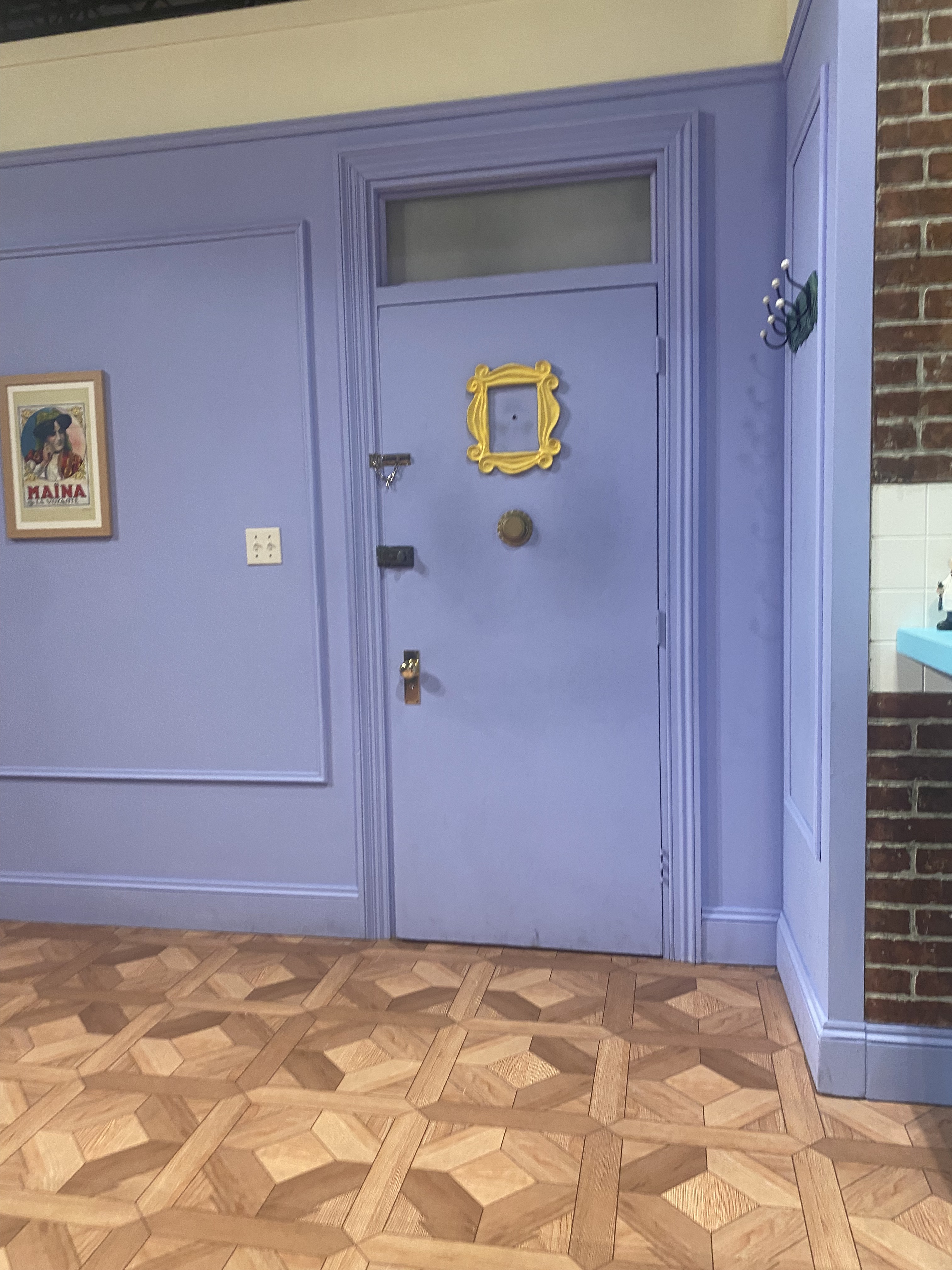
Purple door inside girls’ apartment

With this in mind, as a surprise for our preteen daughter who is also a huge Friends fan, we booked tickets for the Friends experience in Dublin last Saturday 18 November. Location-wise, it’s ideal; a Luas ride to the Point and the Odeon is straight in front of you, next to the Gibson hotel. Both the venue and the exhibit were completely wheelchair accessible, with discreet ramps up to each set. 

Eighteen pages – front and back!

There are lots of photo ops to be had: at the iconic purple door in the girl’s apartment, playing guitar against the backdrop of Central Perk’s window, “pivoting” Ross’ couch up the stairs. It’s an exercise in nostalgia, with some Easter Eggs thrown in: a hurl through Joey’s entertainment centre (after the boys’ apartment was robbed, Joey was locked into the entertainment centre by someone he thought wanted to buy it); two little ornaments of a chicken and a duck in the entertainment centre as a nod to the boys’ illicit barnyard pets); Rachel’s famous “trifle” in the fridge of the girl’s apartment, and of course, The Famous Letter (eighteen pages, front and back!). And in case you haven’t caught the repeats lately, there are episodes playing in the background throughout the exhibit, which I’m sure many of us know off by heart thanks to the repeats on E4 and Comedy Central over the years.

Rachel’s famous trifle

Was it worth it? Yes, and no. A lot of detail went into the recreation of the sets. It was surreal to sit in Central Perk, on the infamous orange couch or standing at the counter that Rachel and Gunther worked at, or holding Phoebe’s guitar against the backdrop of the Central Perk window. I enjoyed the experience, but once you’ve seen it, I don’t think you’d go a second time. I also felt that it could have been more interactive (maybe a boys versus girls quiz, for example). We walked through it slowly, trying to savour everything, but we were still skulking around the gift shop at the end of the tour within forty-five minutes.

Pheobe’s first bike

I was also surprised that there was no mention of the recent tragic loss of Matthew Perry. Given how beloved Chandler was (he was always my favourite, as I found hís innate awkwardness so relatable), it might have been nice if there was a display or slideshow dedicated to Matthew’s (not necessarily Chandler’s) memory. It was sad to think of how Matthew tried to hide his inner demons from us in his mission to make us laugh (he admitted at the “Friends Reunion” that his need for audience validation was borderline unhealthy at times), and for me, knowing how human the actor behind the “funny man” was connected me to Chandler in a way that I didn’t connect with the others. I know I’m not the only one who feels that way. Matthew once said that he would rather be remembered for helping other addicts than for his role as Chandler. His passing on 28 October 2023 was a tragic event for many of us. Die-hard fans have said it’s like losing a real-life friend.

Menu in Central Perk

Overall, the exhibit was a lovely way to pass an hour, and kudos to the organisers for putting together such a detailed display. That said, Friends fans know what the show means to them, and it goes beyond the sets and memorabilia. It’s about following these characters on the journey of life, about keeping a sense of humour in the face of adversity, about finding a soulmate who is also your best friend and, above all, it’s about looking after each other. The Friends actors have a genuine love for each other, and I think that’s what made the show feel so authentic. Hashtag real friendship goals.

Tuesday Thoughts: Dropping the Ball

Okay folks, forgive me for I have sinned. I know that when I initially committed to this Tuesday Thoughts malarkey, I thought I’d have something ready every Tuesday morning, and that no matter what life threw at me, no matter how busy things got, that surely I would find an hour or two to jot down a few thoughts and keep a regular writing habit going. I mean, journalists and columnists do it all the time, and that’s what I aspire to define myself as one of these days. How hard could it be?!

Turns out, life has different plans. Firstly, the sprog went back to school and caught every bug and head cold going, scuppering her plans to get to June with perfect attendance. Then, I got caught up with this editing course I’m doing which is not difficult, but is certainly time consuming. After school activities and friends coming over to “hang out” (I don’t think they’re called playdates anymore when you’re a preteen), along with work and domestic obligations nearly left me for dead in September. Okay, I exaggerate slightly. But I was pretty bloody tired.

And then my beloved husband spent a week in the hospital, and I just thought, oh my God, I think I’m going to crumble now. A week of worrying, of not knowing what was wrong or where it would end. Don’t worry, reader, he is on the mend now. He’s picked up a ball that he can’t afford to drop: the ball of self-care. A ball that I’m not even sure I own.

I’ve always been useless at self-care. I don’t mean that New-Age stuff of spas and weekend breaks. I mean really basic things like sleeping, exercising and eating right. I am absolutely useless. My friends (I hope) will vouch for me: Give me your problems, no matter how big, and I will always find a solution for you. Even if it means putting myself out, I would rather do that than disappoint someone. It’s people pleasing to the highest degree. But it was only when my beloved was in hospital that I realised how unhealthy this is.

In the past, I have suffered in silence rather than said no to something. I’ve agreed to some ludicrous things that I wouldn’t agree to now. I’m so willing to please that it’s sickening. To some degree, it’s because I consider myself a Christian, and it is the Christian thing to help people who need it. But it’s only recently that I’ve come to truly understand the meaning of “you can’t pour from an empty cup.”

And so, while my husband recuperated in hospital, I took my foot off the gas for a little while. Rather than succumbing to a mini nervous breakdown as I might have done in the past, I pressed pause on coursework and work. I did as much housework as I could manage, but no more. I went to bed at 9.30 every night with my daughter. I didn’t blog. I didn’t even attend my online writing group, which I have always moved around my plans so I could attend. The dogs weren’t walked every day – in fact, they were only walked once in the week JP was in hospital. I didn’t write. I watched Netflix and listened to podcasts. And while I felt awful about it, I also had a revelation as I watched those proverbial balls drop:

If I drop, none of this stuff will be done anyway. None of it will really matter, if I’m not here.

Now, this is obvious to most people, but applying it to real life is easier said than done. After all, we live in a society where productivity is a measured of one’s worth, and burnout is seen as a prestigious accolade. In addition, we live in a wretchedly connected world where it’s normal to send and receive work emails on a Sunday evening. Messages must be answered straightaway. A quick text is less time consuming than a phone call. It leaves more time to do all the stuff we perceive to be important.

And it occurred to me, only I can truly define what “important” means. I thought to myself, if I drop dead in the morning, will they mention my Marie Kondo folding technique in my eulogy? My ironing skills? That I’m a dab hand with a Shark? (the hoover, not the man-eating, ocean dwelling mammal). I said to hell with all this, and snuggled up with my preteen in bed and watched Derry Girls.

The patient is home, and we’re all hoping for a smooth recovery. Hopefully, as things settle down, I will be more productive. I might even start writing my novel again. Maybe not today though, and I’m learning to be okay with that.

Tuesday Thoughts: Doggone Days

It’s Sunday evening again, and like a bold secondary school student, I’m sitting down after a weekend of slacking off to try and make my self-imposed Tuesday deadline. This heat, I’m sure every writer will agree, hasn’t been conducive to bursts of creativity. Yet, you might be impressed to read that I’m typing this from my brand-new office! I got a new desk, and have now moved in most of my paraphernalia: the computer and printer, my paltry collection of articles and short stories, and my trusty office chair. And this evening, I added the finishing flourish: a crate with a bed for two of my most loyal friends, Troy and Rupert. As I type, Rupert has made himself at home, whereas Troy is more suspicious of this new layout. (That’s what old age will do to you. Troy turned four on Saturday, 9 September). 

These two furballs are pains in both my arsecheeks, and yet, I can’t imagine life without them now. I had always wanted a dog. We didn’t have one at home until I left for university. He was a sparky Jack Russell. My then-boyfriend, now husband, suggested the name Fred as we already had a cat called Ginger (an homage to Fred Astaire and Ginger Roberts). Fred was an absolute lunatic. He loved his walks, but he was an absolute nightmare, as he would rather drag you around the neighbourhood than walk like a sane dog. Fred was also petrified of the Hoover – it didn’t even need to be turned on, as I discovered when his beloved ball landed within inches of it, and he refused point blank to retrieve it. Instead, he would jump behind the couch, occasionally peering over to make sure the hoover was nowhere near him.  

In 2008, JP and I had a Labrador for two weeks, who we called Lady and, after a visit to the vet’s, Laddie (the woman we adopted him from had told us that she had a pack of female puppies. Obviously, she needed to brush up on her biology!) The same week, I was offered a job with Offaly CIL, which meant that I’d be out of the house for seven hours a day. After many tears, we decided to do what was best for the dog, and so Laddie was rehomed with a lady who loved dogs and had lots of land for him to run around on. It wasn’t easy, and my heart broke doing it. I hadn’t realised it was possible to love a dog so much. I decided that I could never put myself through that pain again. 

Fast forward eleven years, to November 2019. My husband and I had been talking about taking the plunge again for the guts of two years. Our friend recommended a lady who treated her puppies like babies, and so Troy made his entrance into our world. He loved his walks, he housetrained quickly, and soon, we couldn’t remember what our lives had been like before he came along. Troy was our saving grace when the Covid pandemic hit, when everyone was scrambling to get a dog. My husband did four walking challenges (unfortunately, it gave him a bunion the size of a pingpong ball), which kept him going through these lonely times. Troy loves the sun, and relishes the sunny days stretched out in the heat. Thankfully, he outgrew his unpleasant marking phase (my side of the bed was his target of choice), although he will still climb onto the table after meals to see if we “forgot” any remnants of dinner (some of the things he’s eaten include an entire chicken roll, a Crème Egg, an entire bolognese and, most recently, a bowl of porridge).  

Troy as a baby

Troy is a gentleman. Like most dogs, he instinctively knows when you are sad and will curl up on your lap, hoping to distract you. He’ll lick your tears, he’ll jump up to greet you when you come into the house, and he’ll do everything possible to ensure that you know how much he loves you. He’s the biggest softie going. If I’m scolding Alison, he will stand between us to protect her – cute and irritating in equal measure! 

In 2021, we decided to adapt the house to make it more accessible, and thank God we did, given that both JP and I are shuffling around the place like a pair of old crocks at the moment. This meant that we had to give Troy to two dogsitters over a seven-week period. The first lady could only mind one dog at a time, and Troy didn’t know himself, being the centre of attention for the first three weeks. The second dogsitter also minds dogs in her own home, and so Troy spent the rest of the summer with his new best friend, Brid, who loved him so much that she didn’t want to give him back!  

After coming home from Brid’s place, Troy was seriously depressed. He spent the days lying in his crate like a lovesick teenager, and it suddenly seemed cruel to leave him without some canine company. I must admit I wasn’t thrilled at first by the prospect of another dog. Double the cost, double the walking, double the poo. Then my friend sent me a picture of a little ball of ginger fur with enormous brown eyes. I thought he was kinda cute, but my husband had decided that he was ours. His name was Rupert, and he was Troy’s (and our) new best friend. Double the trouble, and double the love. 

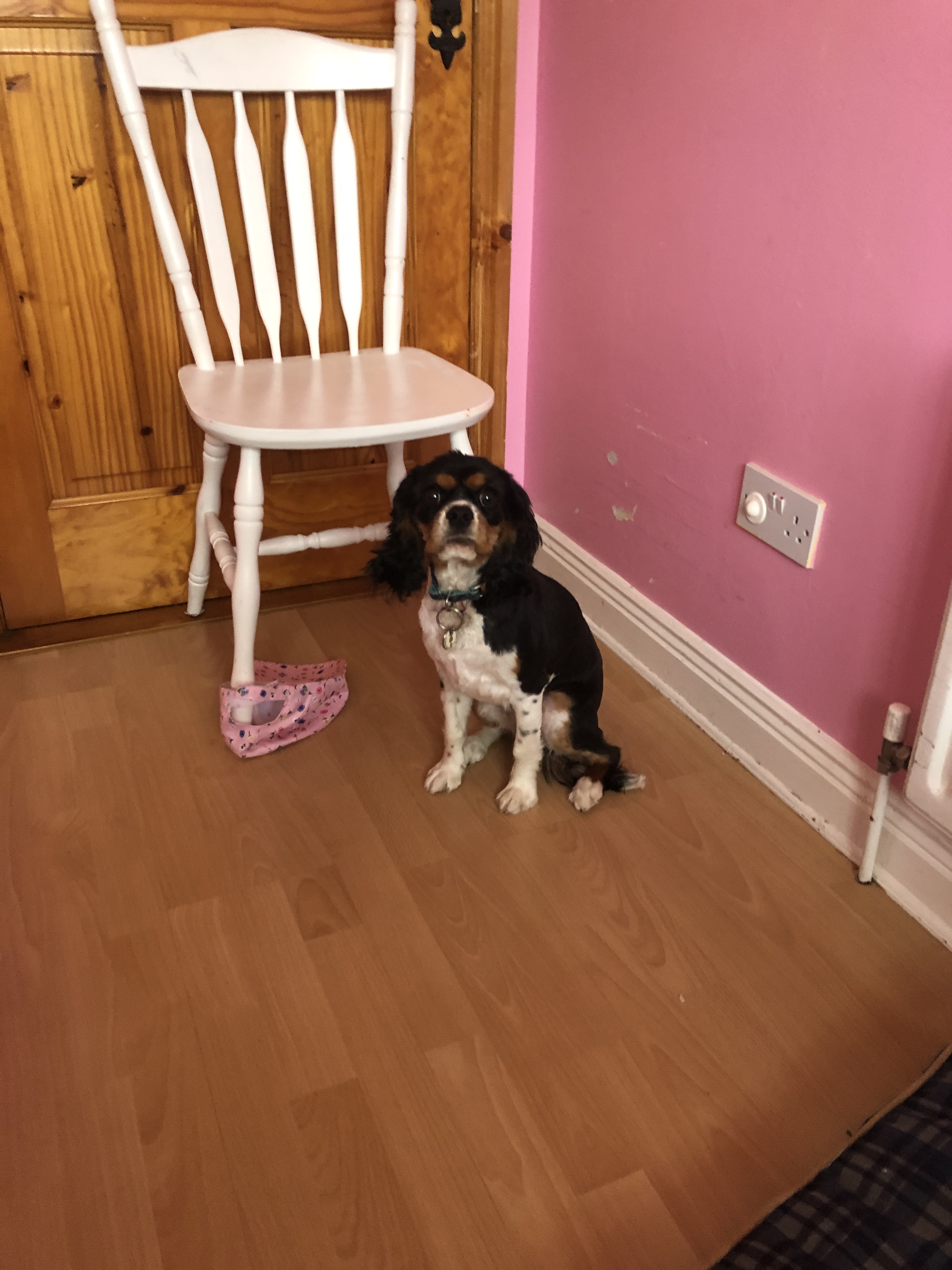
Rupert as a puppy

I’d always heard that dogs had their own little personalities, but I didn’t quite believe it until I met Rupert. He’s a nervous little thing, and highly strung. He also loves the sound of his own voice, and barks on walks for no reason whatsoever (although, through training, he is improving). Like Troy, Rupert is a King Charles, but he can run like a greyhound, as we have discovered on the occasions he’s managed to escape from the garden. Because of the barking, passer-bys are often afraid of him, but he is the sweetest thing and rarely sleeps alone, choosing instead to plop his arse on Troy’s head or bury into my knee in the evenings. He also encourages Troy to eat his food. Before Rupert came along, Troy would only eat a bite or two a day, but now, it’s a race to the feeding bowls, which are always empty by twelve noon. 

I know it sounds cliché, but Troy and Rupert are my friends. When I’m sitting here during the day tapping on my keyboard, their antics keep me amused, and I secretly envy their endless napping. We go for regular walks, and after barking at everything that moves for the first kilometre or so, Rupert trots beside his brother, taking in the sights and smells. When he finally quietens down, I enjoy those moments: when I’m alone but at the same time, not alone. 

Rupert lies everywhere that Troy does – Troy has the patience of a saint!

I honestly think my heart would rip in two if anything were to happen to either of my precious furballs. They’re not just pets – they’re family (Alison refers to them as my naughty sons). I love them to bits. And for all the words I’ve written here, everything I feel can be tied up in just two lines of poetry, by Richard A Bilby: 

“So the next time you hear the phrase ‘just a dog,’ 

Just smile, because they ‘just don’t understand’.” 

Tuesday Thoughts – A Successful Writer

Today is Sunday, and I’m finding it difficult to find the motivation to do anything. Truth is, I’m tired and have fallen into slovenly habits of late: not writing, choosing instead to watch reruns of Taskmaster on Netflix. Is this what award-winning authors spend their time doing? Of course it isn’t. That’s why they’re more successful than you. 

Success. Let’s ponder that concept for a moment. It’s something that many of us thrive to achieve, yet it’s a tricky thing to define. It depends on how you measure it, for a start. For some of us, namely writers, it’s about holding our precious words in our hands, and sharing them with those we love best (or our sworn enemies, depending on the mood). For other writers, success is landing that regular writing gig in a newspaper column or magazine. The most dedicated writers, those who are decidedly disciplined, toss out a book or so every year, leaving me seething with jealousy. Jealousy is not a healthy emotion for a writer. In the past two years, especially since being on the Play It Forward programme, I’ve come to understand what being a writer truly means. 

One major shift in my thinking was how I define myself as a writer. While I must admit that publishing Conversations about Activism and Change was the most validating moment in my career, now I feel the pressure to brush myself off and ask, “What’s next?” Logically, that would be finishing my novel, having the courage to share Rachel’s story, but somehow, I still don’t feel qualified. When will I feel good enough? What will it take to be able to work through the relentless torture of imposter syndrome? 

When the public thinks about writers, they might think of the likes of Stephen King or JK Rowling, whose work has been quite successful commercially. The rest of us know that writing isn’t a lucrative career choice. Many of us, including yours truly, are constantly hustling for side gigs such as proofreading or teaching a creative writing course, just so we have enough money to live on. Others must take on work that is completely unrelated to their true passions.  

I started back writing in 2014 because, in my view at the time, it was the only way I could see of salvaging my fragile mental health. My mind swam with a thousand intrusive thoughts that I knew I could never have the courage to vocalise to anyone. Yet, if I didn’t find some way of getting those intrusive thoughts out of my head, they would eventually have destroyed me. As I typed out those first awkward words, I was reminded of my Leaving Cert English class, and how I felt a warm glow inside every time I wrote a personal essay. That feeling of accomplishment, of pride, was how I wanted to feel every day. (One of my many writing mentors, Maria McHale, has said that this feeling is fundamental to a writer’s mental health). 

When I decided to forge a career in writing, I had visions of several books, penned by me, piling up on my desk. I thought it was as easy as sitting down every morning and playing around with words on a screen. In truth, it’s that easy, and that hard. Joanne Harris says that the first thing you need to do as a writer is to give yourself the permission to be one. It’s a difficult thing for me, as I often feel guilty for my life choices. A few years ago, while in the midst of a midlife-crisis-type thing, I studied for the Certificate in Disability Studies, aiming to get a better job in the sector. Turns out, that wasn’t what I wanted. And after spending a few years in a job that made me miserable, my husband told me in no uncertain terms that I couldn’t do that to myself again. 

Writing is not a glamorous choice. It’s a hard old slog. It’s solitary, with only a keyboard or a pen and paper for company. At least, that’s how it must appear to people looking in from the outside. Those who understand know that it’s so much more than the desire to communicate. It’s about making a difference, touching your readers in ways that they never thought possible. Writing means always being true to your real self which sounds romantic. but in reality can be messy, painful and heartbreaking. For every one of these blogs that I’ve penned, there are another five or six attempts languishing on my hard drive, never to be seen by a soul. I’ve written two whole drafts of my novel. And, as much as I strongly believe in sharing my authentic self, my desktop folder is crammed with stories, musings and draft posts that I could never have the courage to share. 

Therefore, my view of success in writing is so much more than having my name on a byline or printed on the spine of my own book. It’s being able to write crap and accept that not every creation is destined to be a masterpiece. It’s having the courage to come back to the screen, stare at that blinking cursor and say with confidence, “You’re not getting the better of me.” It’s finding the strength to stare yourself down, to say that you are worthy of praise and respect, that you truly deserve the title of writer. I believe that any writer who doesn’t feel the need to do this every once in a while is either a robot, or a psychopath, or a liar. 

Finally, as I reflect on my career cholce, I must admit to feeling a little sad that I and other writers must suffer at the hands of this wretched imposter syndrome. Many of the ways in which we unwind (or procrastinate writing), from reading books and newspapers, to listening to ‘90s classics or bingeing on Derry Girls, simply wouldn’t be possible without the work and genius of the writers who created them. The Arts is the foundation of our very existence, and this has always been the case, from those early cavemen etchings to Ogham (a form of communication in Irish during the fourth century, chiselled on stones). During the pandemic, books and boxsets became our lifebuoys, offering us solace and respite from the relentless negativity of the media. There are so many options available that didn’t even exist twenty years ago: audiobooks, podcasts and of course, personal blogs (the best place to go to for a quick read in my unbiased opinion). 

In my darkest days, I cling to the fact that my words bring comfort, even if it’s only to one person. And if that is the case, then I think I’m as successful as I ever need to be.