(aka JP’s affectionate term for me. Just kidding)
(This post was inspired by Julie Helen’s column about her quest for a new wheelchair. I strongly encourage you to read her weekly column on EchoLive, where she writes about a wide variety of topics from a personal perspective.)
It was the weekend of my mother’s fifteenth anniversary that I discovered the letter in my postbox outside, and I took this as a sign. I opened it excitedly, knowing exactly what it was. At last, after fighting for the guts of three years, I had an appointment to administer a pain injection into the buttock of my right leg. This couldn’t come at a better time. The appointment was for Friday, 7 June 2024, and we were due to go to Australia on 1 July. I shivered in excitement at the thought of running around after my sister Alex’s little ones, Cathal and Grace, playing with them on the floor. For the first time in four years, I might sleep for more than two hours straight! Imagine waking up refreshed! Thus, I’d have more energy to write, and do courses, maybe even start cycling on the trike again (I do 2/3 45 minutes sessions on the exercise bike a week, but it’s not the same).
As the day drew nearer, I did an extra physio session every day, as I dreamt about my pain-free life, smiling as I imagined folding up the wheelchair and throwing it into the spare room. I was tired, but I didn’t care. All of my hard work would be worth it when I was back wobbling around the place.
I don’t know what I was expecting from a little pain injection but suffice to say I will never know. Friday, 7 June was a sunny morning, and I beamed broadly as JP drove us up the M50 towards Tallaght. It seemed the universe was working in my favour; there was hardly any traffic, we didn’t miss our turn-off, and we were parking outside Tallaght University Hospital at 9.15am for our 10am appointment. JP was excited too; I’m sure I wake him often, tossing and turning all night. We found our waiting area quickly, and at 10.20am my name was called. When we reached the room, everything was waiting: the team of doctors, the ultrasound machine, the bed covered in tissue. It was a moment of triumph. I’d been fighting for this moment since November 2022, when they told me that there was nothing they could do for me. And now my recovery was about to start at last.
I was helped onto the bed and a team of doctors carefully pulled down my trousers and started the scan. Suddenly, one of the doctors asked for the head of department to come down. Apparently, even though I maintained that he was rubbing his scanner over the painful area, they couldn’t see my sciatic nerve. Now, I’m crap at biology – my Junior Cert teacher regularly read out my test answers to entertain the rest of the class for the comedy effect – but I do know the sciatic nerve is the main nerve, and if they couldn’t find it, I wasn’t sure I wanted them anywhere near my ass with a needle.
I was asked to sit up and I was helped back into my wheelchair. I tried to act like a professional patient, but I couldn’t stop the stinging tears rolling down my face. Your injury is probably just a contusion, they told me. You couldn’t stay still enough for the scan, and we can’t really see any damage. We’re sorry.
This has gone on for four years, I said. So you’re saying this pain is all in my head?
No, no, of course not. We’re saying there’s no silver bullet (Martin Naughton might say “No Magic Pill.”) Keep up the physio, painkillers, TENS etc. Pain management must be a priority in the long term.
Dammit. They warned me that would happen, but I’d pushed for the injection anyway. I have never felt more stupid. Driving home in the car, I saw my fantasy of getting my twenty-year-old body back disappear. More importantly, my dream of walking around Australia on my holidays vanished into thin air.
I never used a wheelchair in my life until I was nineteen years old. Day after day, I pushed through pain and tiredness as I trudged around the Sacred Heart School, going up and down stairs, navigating through the crowd. This was on top of cycling to and from school, every day, for six years. I was pretty darn proud of myself, I won’t lie. I developed an irritating superiority complex where I thought I was better than other disabled people. I was integrating myself like a fridge into a kitchen, becoming invisible in the process.
I have never felt more valuable as I did in my younger days, and now I can see how problematic that is. I’ve written before about my experience of internalised oppression, and even at the ripe age of forty, I struggle to shake it completely. The truth is, I am ashamed of how my mobility has deteriorated. I tend to view it as a personal failure to push myself, to take care of myself, rather than the result of years of trying to make my body do things it’s not designed to do. Sure, I made a choice to use a wheelchair so that I could have energy to write these blogs and hopefully, with Ali in secondary school now, re-enter the workforce and get involved again with the Independent Living Movement. I know the reasoning behind my decision was sound, and yet I haven’t fully dismantled the years of internalised oppression, so let’s face it – I’m an awful hypocrite.
The realisation that I wouldn’t be walking around by the time we went to Australia hit home like a sledgehammer. However, when we stayed with my baby sister in Australia this summer, I was determined to show her that I was still the same active rogue I’d always been. She’d sourced a steel walking frame from her neighbour Dell, and not having the heart to explain that I don’t really walk too far anymore, I accepted it with a grateful smile, while loading up on painkillers. For the first week or two of the holiday, I hobbled around the house, knowing what I wanted to do, but too ashamed to say anything. The second weekend we were in Oz, we all took a road trip up to Jurien Bay. Our accommodation was accessible, so I could use my wheelchair the entire weekend.
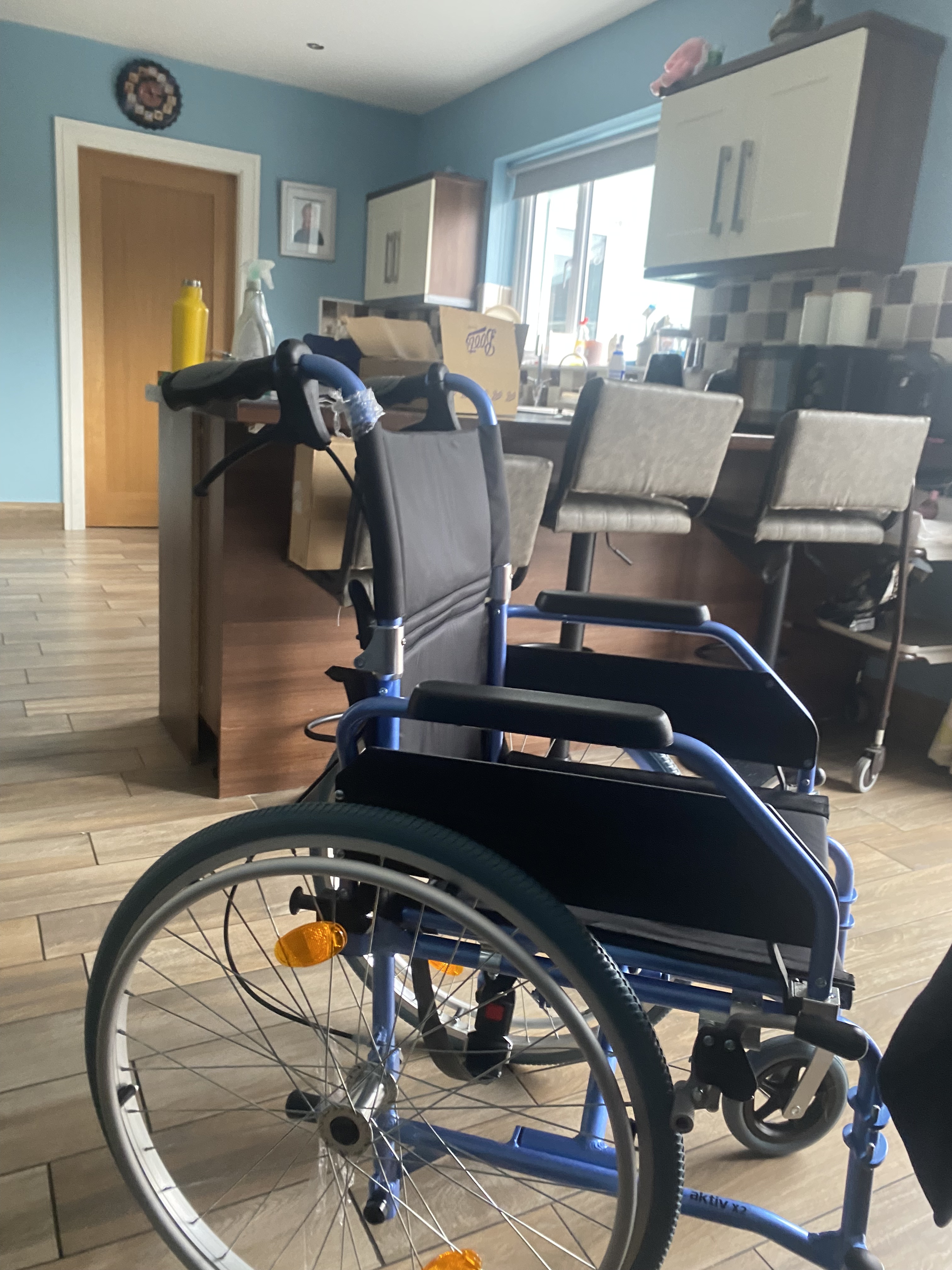
When we got back to my sister’s house in Clarkson, without prompting or any pre-discussion, my sister Alex greeted me at the car door with my manual wheelchair. No words, no “I know you need this”, not even “I think this is a good idea.” That evening, I set the table, unloaded the dishwasher and hoovered, and I know my sister was struck by the difference in my independence and energy levels. Not having to pretend was a relief for both of us, and I was surprised by how easily she accepted my need to use the chair – without question. She didn’t say she was sad, or disappointed, or ashamed – that was purely the narrative I’d woven in my own head, a stick I was using to beat myself up with.
It got me thinking about the wider issues of equality and acceptance which, if you’ve read any of my other blogs, you’ll have gathered is something that I’m passionate about. But how can I expect other people to subscribe to the idea that disability is located outside the self, if I don’t? If I continue to connect my self-worth to my body’s ability to adapt within a society which, directly or otherwise, serves to exclude me, my self-esteem will plummet through the floor! More pertinently, I am handing the systems that discriminate against me a viable excuse to do so, on a silver platter. And whether I like it or not, I am not just an “I”. I am a “we”, a part of a wider collective trying to change attitudes and remove barriers, something I will not be able to do until I change my own attitude towards myself and accept myself in all its wobbly entirety.
Being underemployed at the moment, I cancelled a load of my subscriptions, but one I held onto was an affirmation app, which sends me random affirmations during the day. I admit I don’t always read them when my phone pings, but this morning I just happened to flick through them on my watch, as I sat on the toilet. “I am allowed to take up space,” “It is okay to have a hard day,” “I am patient with myself”, and “I have the motivation to create change,”” are just snippets of the messages that come through hourly. We need to change the messages that we as Disabled People are absorbing and, consequently, sending back out into the world. Most importantly, we need to change the stories we tell ourselves, about ourselves.
I often feel like a right pain in the ass when I write this kind of blog, but this – along with other authentic voices of Disabled People – is the only way to change the narrative around disability, for ourselves as well as within wider society. When we take control of the narrative, we can write our own endings, hopefully depicting a fairer world of acceptance and inclusion.

 Wobbly Yummy Mummy