Tuesday Thoughts: Life is But a Dream…

Getting up at six isn’t easy, but I know I’ll feel better afterwards. While my husband snores beside me after coming home late from work, I pull on the tracksuit that I’ve laid out the night before. I always hate this part, and find myself questioning the auld sanity, but I know I’ll feel better afterwards. I always do.

Down the hall, I can hear the familiar sound of the front door opening, the clinking of my favourite bowl being extracted from the cupboard and the shaking of a cereal box. I look at my watch: 6.30. Right on time. I sit into my wheelchair and go down to my kitchen, where Mary* is waiting for me. She’s poured me exactly a third of a pint glass of orange juice and half a bowl of Bran Flakes, though she’s waited for me before pouring the milk; she knows I don’t like soggy cereal. She also knows I don’t like too much milk. As I munch it down, she clears the breakfast things away, wipes the counter and sweeps the floor. Then it’s 6.45. Time to go.

As always, Mary has started the car so that the windscreen is clear and, of course, so that it’s nice and toasty on this frosty morning. She lowers the ramp and I drive into the car, waiting for Mary to secure the chair with the clamps, just as I’ve trained her to do. Then I’m whisked to Aura, our local gym, for my morning workout session. Mary has sat in on my physio sessions, so she knows exactly what I should be doing. She sets up the equipment for me, making sure that I’m seated correctly so that I don’t strain myself, and so the physical torture begins. Mary laughs, saying that the only weight she’s lifting will be her cup of coffee to her mouth. Too early for this shite, she says.

Afterwards, it’s back to the car and a quick stop at the shop for milk and bread. I give Mary my card so that she doesn’t have to undo the clamps for the sake of a few minutes. She returns with my card, a receipt and the groceries, standard procedure although I’ve trusted her with far more important and delicate things. Then it’s a quarter to eight and back home, where the preteen has just risen. I put on two slices of toast. Mary takes out the plate and the butter. The preteen is unusually chatty today. She’s used to Mary; she knows what Mary’s purpose is, and more importantly, what it is not. Mary never comments on my child’s behaviour. She knows that it’s not her place.

After the child leaves, Mary leaves too. Everything is tidy, meaning that nothing will distract me from my work (apart from my dogs barking at each other, or at random birds flitting past the window). It’s nine o’clock, and I normally have my first thousand words completed by eleven. By that stage, I’m fit to drop, and typically at this time, depending on what household chores await me, I take a forty-five minute nap, just to keep myself right. Then it’s dogs on leads and we go for a short walk, to clear the cobwebs from my brain.

When I return home, Emma* is waiting for me. We cook the evening meal together: she chops the veg and preps the meat, I fry it up. She also cleans as we go, so that we don’t have a big job ahead of us later. My favourite is homecooked lasagne, or chicken stir fry. I’ve taught Emma how to marinade the chicken in garlic and soy sauce. It’s the young’un’s favourite meal.

No two days are the same. Sometimes I might need Emma or Mary to accompany me to Dublin for medical appointments. Other days, I might need help in organising the materials for the Creative Writing Classes that I teach across Laois and Offaly, or the grinds I give to Leaving Cert English Students. We also tour the country a couple of times a month in my accessible van, giving disability awareness training to secondary school students. On those days, a Personal Assistant might have to work longer hours, and so I allow them to take time in lieu on a less busy day to compensate. After all, it is their dedication and attention to detail that allows me to live the life I do, a life entirely of my own choosing.

I jest.

This is not my life. Well, it is and it isn’t. I wish I was motivated enough to get up at six in the morning, but alas, here we are. It’s certainly the one I aspire to, the one I try to fulfil. And, to be fair, I have a good life. I’m married, I have a child, I work as much as I can freelance. And I do have three dedicated, hard-working Personal Assistants, who are always willing to go the extra mile for me. They are simply wonderful people and I love them to bits.

However, I don’t necessarily have a service that offers the freedom and control that I might like. Nor can I choose my own times, owing to the demand on the service. I cannot emphasise enough how dedicated my PAs are, and how much pride they take in their work. It is nothing short of remarkable, considering how exhausted they must be; all of them are required to work with multiple clients on any given day. It takes a special kind of person to remember the preferences of each individual Leader, to try and fulfil somebody’s needs in a limited space of time, and to do all of this with a smile and not a hint of a complaint. For this, I am truly grateful.

That said, this style of service provision does not do the Leader or PA justice. For the Leader, it offers no opportunities of spontaneity and, depending on the nature of their impairment, leaves them at risk of isolation from their communities, especially in this post-covid world where everyone (rightfully) is sick of online meetings, and in-person events are becoming more prevalent. Remember during the height of Covid, when we weren’t “allowed” to meet each other, go for coffees or even take our time looking around the shops? For some disabled people, this continues to be their reality. During lockdown, I found it interesting, and admittedly amusing, to hear that some people couldn’t hack it, and yet for some reason, it’s okay to imprison disabled people in their homes as long as they have access to the internet (or not, as the case may be).

For the PA, this style of work – hopping from client to client – is more lucrative, but exhausting. At the moment, there is little distinction between PA and home help. Typically, a home help is given approximately forty-five minutes to help a client out of bed, get them washed, dressed and have breakfast. Then off that person goes to do the same for somebody else. Home help agencies have high turnover of staff, and it’s not difficult to see why. Often, they might have to drive from one end of the county to the other, just to do an hour’s work. I’ve heard of home helps working twelve-to-fourteen hour shifts, visiting six or seven different people in this time. Six or seven people, with different needs and care plans, who may only be allocated enough time to be washed and fed, if that. What kind of life is that, I ask you? Could you live like that and not lose your brain? A study conducted by Pauline Conroy found that a Leader who is lucky enough to receive a service has a PA for about 45 minutes per day. How is it possible to squeeze a meaningful life into less than an hour a day?

This is why I find myself writing about the same thing over and over again. I’m sick of reading about the “poor, vulnerable disabled people, suffering at the hands of cutbacks.” I know hundreds of disabled people, and I cannot think of a single one that I would classify as “vulnerable.” Those I consider “my tribe”, in the words of artist Mary Duffy, are intelligent, strong, confident, capable and willing to contribute. Willing to fight for the quality of life that they deserve, and always have deserved. Committed to ensuring that the authentic voices of disabled people are heard and taken seriously by the powers that be. But they are also tired. Tired of having to fight for every little thing. Tired of the excuses “there’s no staff”, “we don’t have that kind of money.” Tired of being made to feel guilty for their lack of gratitude: “There’s so many people who don’t have what you do.”

As a collective, disabled people have achieved so much in their lifetime for the advancement of their human rights. But wouldn’t it be lovely to be able to focus on the minutiae of everyday life instead, such as “I want to go for a coffee with friends at one o’clock” or “I think I’ll have a lie-in in the morning”?

Independent Living Movement Ireland (ILMI) are committed to making this a reality. Formerly known as the Center for Independent Living, ILMI have been working since 2018 on their #PASNow Campaign, which calls for the legislation of the Personal Assistant Service (PAS). This would have many benefits. Firstly, it would offer some protection against the savage cutbacks that the service has endured since 2008 onwards, as ideally, the funding for PAS would be ringfenced. Secondly, it would be a step towards recognising that the PA service should be rights-based, not just something given on the basis of an impersonal, medical assessment. This would mean that Ireland could fulfil their obligations under Article 19 of the UNCRPD, which details the right to independent living. Thirdly, and perhaps most significantly, disabled people would be independent of their families and loved ones, absolving them from labels such as “burden” or “object of care”.

On Wednesday, 22 November 2023, ILMI launched their research paper “Not in the Driving Seat: Reliance on family for supports and the impact it has on disabled people.” The reference to “driving seat” comes directly from Martin Naughton, who is internationally recognised as being one of the main figures behind bringing Independent Living to Ireland. The report offers a counternarrative to the traditional spiel of disabled people as vulnerable. The struggles of family carers experiencing burnout has begun to be recognised over the last few years, but this is the first study focusing on the physical and psychological impact that relying on family has on the disabled person themselves. Des Kenny, close friend and ILMI Chairperson notes: “Investment in supports that liberate disabled people will also liberate family members to move from roles where they provide support for their partners, children, or siblings and can focus solely on their family relationships.” I would like to personally commend all involved in this work and to thank ILMI for continuing to push its #PASNow Campaign.

I know I have written about this many times before; this blog might as well be called “The fight for independent living.” And I’m sorry if you’re sick of reading it; trust me, I’m sick of writing it. Yes, we have made great progress in shifting the thinking around disability from pity and oppression to empowerment and rights, but even after thirty-one years, there is still so much to do. It’s tiring, and easy to lose heart, but the only way we can counteract the narrative of pity is to keep pushing our own, in the hope that one day, it will be universally understood. In the hope that one day, in the not-too-distant future, disabled people will have the freedom and choice to do what they want, whenever they want to do it.

*Mary and Emma are entirely fictional, similar to the right to Independent Living in 2023

Tuesday Thoughts: The Friends Experience

The. Boys’ Apartment with hockey stick through entertainment unit

It’s nearly been a month since Matthew Perry, best known for his role as Chandler Bing in Friends, was found unresponsive in his hot-tub. I admit that I felt a sense of loss, as if I’d really known him. Like most teens of my generation (the late nineties), I was obsessed with Friends. We aspired to be like them, with high-powered jobs, sitting around drinking coffee while we poked gentle fun at each other. We had posters of them on our bedroom walls, we slipped Friends quotes into everyday conversations (“How you doin’?”); as girls, we dreamed of looking like Pheobe, Rachel or Monica. And we rooted for them, as if we knew them personally. We always wanted Monica to find Mr Right (which she did of course in the sweet Chandler), we wanted Rachel to have her dream career (should she have got off the plane? I’m not convinced any more), and we wanted Joey to be offered THE lifechanging acting job that sadly never materialised (unlike Matt LeBlanc himself, who is said to have had thirteen dollars to his name before he landed the role). And of course, Phoebe found her stable influence and life partner in Mike. Friends was a massive part of our teen years; they really were there for us when we needed them.

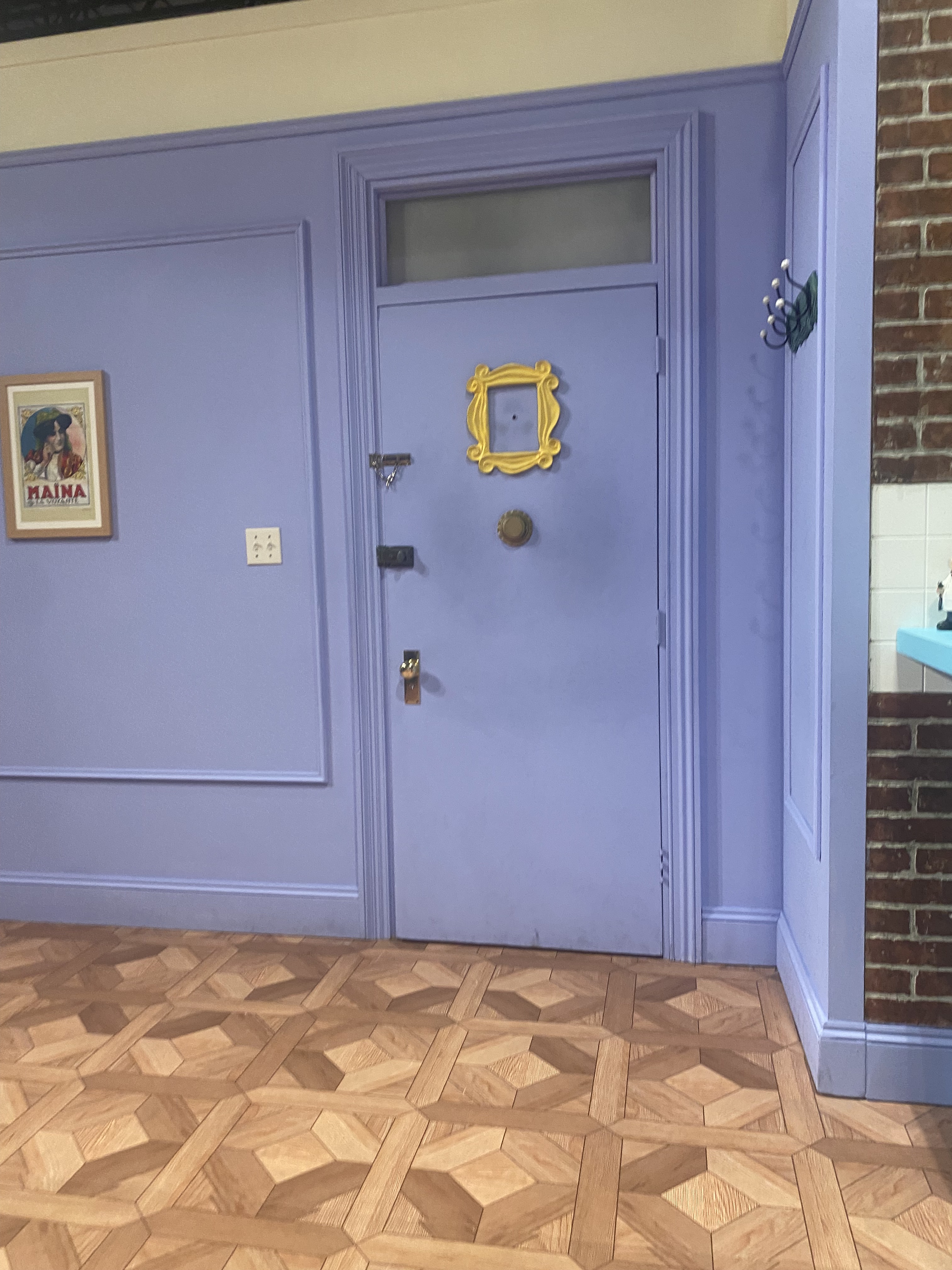
Purple door inside girls’ apartment

With this in mind, as a surprise for our preteen daughter who is also a huge Friends fan, we booked tickets for the Friends experience in Dublin last Saturday 18 November. Location-wise, it’s ideal; a Luas ride to the Point and the Odeon is straight in front of you, next to the Gibson hotel. Both the venue and the exhibit were completely wheelchair accessible, with discreet ramps up to each set. 

Eighteen pages – front and back!

There are lots of photo ops to be had: at the iconic purple door in the girl’s apartment, playing guitar against the backdrop of Central Perk’s window, “pivoting” Ross’ couch up the stairs. It’s an exercise in nostalgia, with some Easter Eggs thrown in: a hurl through Joey’s entertainment centre (after the boys’ apartment was robbed, Joey was locked into the entertainment centre by someone he thought wanted to buy it); two little ornaments of a chicken and a duck in the entertainment centre as a nod to the boys’ illicit barnyard pets); Rachel’s famous “trifle” in the fridge of the girl’s apartment, and of course, The Famous Letter (eighteen pages, front and back!). And in case you haven’t caught the repeats lately, there are episodes playing in the background throughout the exhibit, which I’m sure many of us know off by heart thanks to the repeats on E4 and Comedy Central over the years.

Rachel’s famous trifle

Was it worth it? Yes, and no. A lot of detail went into the recreation of the sets. It was surreal to sit in Central Perk, on the infamous orange couch or standing at the counter that Rachel and Gunther worked at, or holding Phoebe’s guitar against the backdrop of the Central Perk window. I enjoyed the experience, but once you’ve seen it, I don’t think you’d go a second time. I also felt that it could have been more interactive (maybe a boys versus girls quiz, for example). We walked through it slowly, trying to savour everything, but we were still skulking around the gift shop at the end of the tour within forty-five minutes.

Pheobe’s first bike

I was also surprised that there was no mention of the recent tragic loss of Matthew Perry. Given how beloved Chandler was (he was always my favourite, as I found hís innate awkwardness so relatable), it might have been nice if there was a display or slideshow dedicated to Matthew’s (not necessarily Chandler’s) memory. It was sad to think of how Matthew tried to hide his inner demons from us in his mission to make us laugh (he admitted at the “Friends Reunion” that his need for audience validation was borderline unhealthy at times), and for me, knowing how human the actor behind the “funny man” was connected me to Chandler in a way that I didn’t connect with the others. I know I’m not the only one who feels that way. Matthew once said that he would rather be remembered for helping other addicts than for his role as Chandler. His passing on 28 October 2023 was a tragic event for many of us. Die-hard fans have said it’s like losing a real-life friend.

Menu in Central Perk

Overall, the exhibit was a lovely way to pass an hour, and kudos to the organisers for putting together such a detailed display. That said, Friends fans know what the show means to them, and it goes beyond the sets and memorabilia. It’s about following these characters on the journey of life, about keeping a sense of humour in the face of adversity, about finding a soulmate who is also your best friend and, above all, it’s about looking after each other. The Friends actors have a genuine love for each other, and I think that’s what made the show feel so authentic. Hashtag real friendship goals.

Tuesday Thoughts: Dropping the Ball

Okay folks, forgive me for I have sinned. I know that when I initially committed to this Tuesday Thoughts malarkey, I thought I’d have something ready every Tuesday morning, and that no matter what life threw at me, no matter how busy things got, that surely I would find an hour or two to jot down a few thoughts and keep a regular writing habit going. I mean, journalists and columnists do it all the time, and that’s what I aspire to define myself as one of these days. How hard could it be?!

Turns out, life has different plans. Firstly, the sprog went back to school and caught every bug and head cold going, scuppering her plans to get to June with perfect attendance. Then, I got caught up with this editing course I’m doing which is not difficult, but is certainly time consuming. After school activities and friends coming over to “hang out” (I don’t think they’re called playdates anymore when you’re a preteen), along with work and domestic obligations nearly left me for dead in September. Okay, I exaggerate slightly. But I was pretty bloody tired.

And then my beloved husband spent a week in the hospital, and I just thought, oh my God, I think I’m going to crumble now. A week of worrying, of not knowing what was wrong or where it would end. Don’t worry, reader, he is on the mend now. He’s picked up a ball that he can’t afford to drop: the ball of self-care. A ball that I’m not even sure I own.

I’ve always been useless at self-care. I don’t mean that New-Age stuff of spas and weekend breaks. I mean really basic things like sleeping, exercising and eating right. I am absolutely useless. My friends (I hope) will vouch for me: Give me your problems, no matter how big, and I will always find a solution for you. Even if it means putting myself out, I would rather do that than disappoint someone. It’s people pleasing to the highest degree. But it was only when my beloved was in hospital that I realised how unhealthy this is.

In the past, I have suffered in silence rather than said no to something. I’ve agreed to some ludicrous things that I wouldn’t agree to now. I’m so willing to please that it’s sickening. To some degree, it’s because I consider myself a Christian, and it is the Christian thing to help people who need it. But it’s only recently that I’ve come to truly understand the meaning of “you can’t pour from an empty cup.”

And so, while my husband recuperated in hospital, I took my foot off the gas for a little while. Rather than succumbing to a mini nervous breakdown as I might have done in the past, I pressed pause on coursework and work. I did as much housework as I could manage, but no more. I went to bed at 9.30 every night with my daughter. I didn’t blog. I didn’t even attend my online writing group, which I have always moved around my plans so I could attend. The dogs weren’t walked every day – in fact, they were only walked once in the week JP was in hospital. I didn’t write. I watched Netflix and listened to podcasts. And while I felt awful about it, I also had a revelation as I watched those proverbial balls drop:

If I drop, none of this stuff will be done anyway. None of it will really matter, if I’m not here.

Now, this is obvious to most people, but applying it to real life is easier said than done. After all, we live in a society where productivity is a measured of one’s worth, and burnout is seen as a prestigious accolade. In addition, we live in a wretchedly connected world where it’s normal to send and receive work emails on a Sunday evening. Messages must be answered straightaway. A quick text is less time consuming than a phone call. It leaves more time to do all the stuff we perceive to be important.

And it occurred to me, only I can truly define what “important” means. I thought to myself, if I drop dead in the morning, will they mention my Marie Kondo folding technique in my eulogy? My ironing skills? That I’m a dab hand with a Shark? (the hoover, not the man-eating, ocean dwelling mammal). I said to hell with all this, and snuggled up with my preteen in bed and watched Derry Girls.

The patient is home, and we’re all hoping for a smooth recovery. Hopefully, as things settle down, I will be more productive. I might even start writing my novel again. Maybe not today though, and I’m learning to be okay with that.

Tuesday Thoughts: Doggone Days

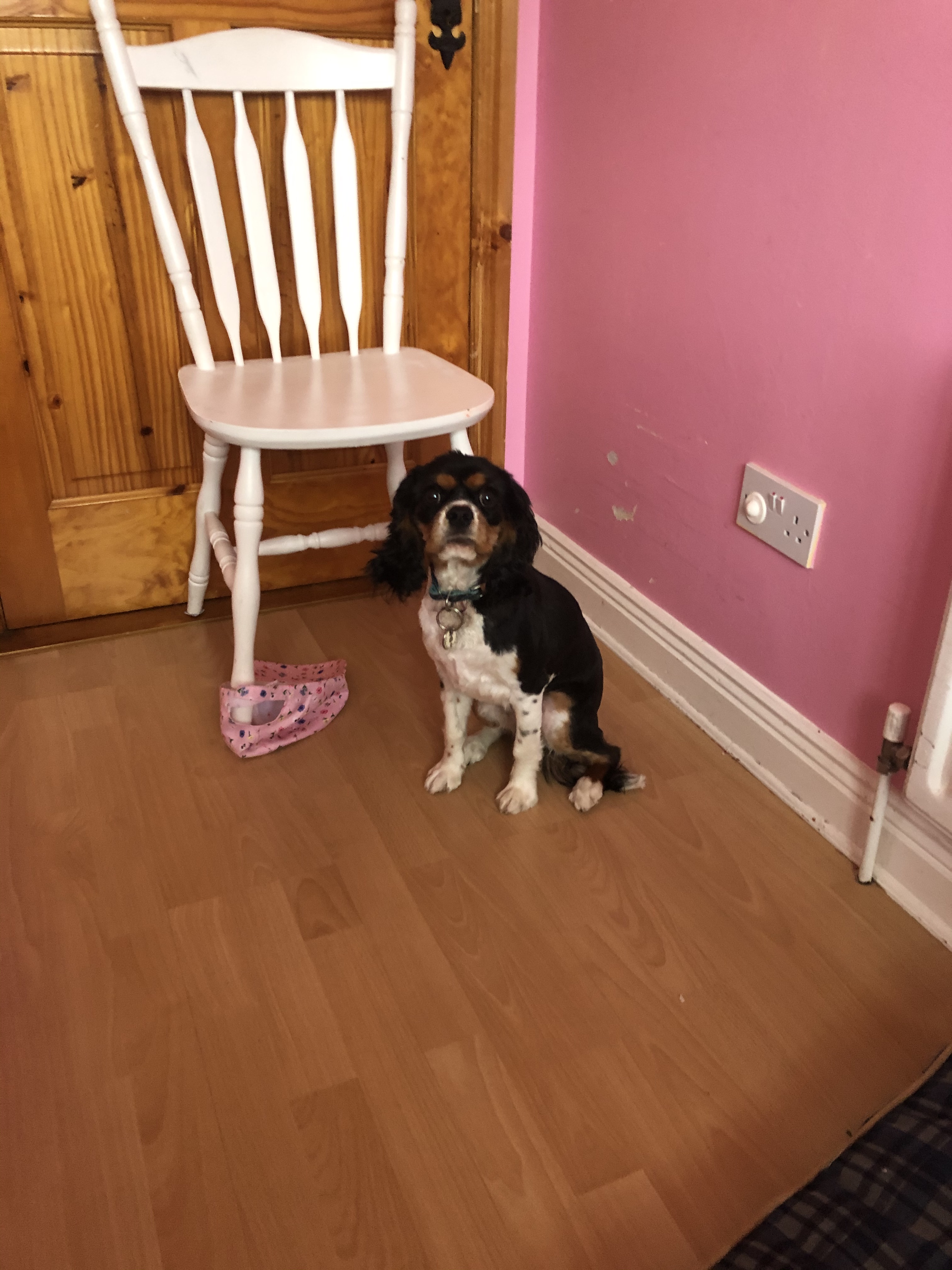
It’s Sunday evening again, and like a bold secondary school student, I’m sitting down after a weekend of slacking off to try and make my self-imposed Tuesday deadline. This heat, I’m sure every writer will agree, hasn’t been conducive to bursts of creativity. Yet, you might be impressed to read that I’m typing this from my brand-new office! I got a new desk, and have now moved in most of my paraphernalia: the computer and printer, my paltry collection of articles and short stories, and my trusty office chair. And this evening, I added the finishing flourish: a crate with a bed for two of my most loyal friends, Troy and Rupert. As I type, Rupert has made himself at home, whereas Troy is more suspicious of this new layout. (That’s what old age will do to you. Troy turned four on Saturday, 9 September). 

These two furballs are pains in both my arsecheeks, and yet, I can’t imagine life without them now. I had always wanted a dog. We didn’t have one at home until I left for university. He was a sparky Jack Russell. My then-boyfriend, now husband, suggested the name Fred as we already had a cat called Ginger (an homage to Fred Astaire and Ginger Roberts). Fred was an absolute lunatic. He loved his walks, but he was an absolute nightmare, as he would rather drag you around the neighbourhood than walk like a sane dog. Fred was also petrified of the Hoover – it didn’t even need to be turned on, as I discovered when his beloved ball landed within inches of it, and he refused point blank to retrieve it. Instead, he would jump behind the couch, occasionally peering over to make sure the hoover was nowhere near him.  

In 2008, JP and I had a Labrador for two weeks, who we called Lady and, after a visit to the vet’s, Laddie (the woman we adopted him from had told us that she had a pack of female puppies. Obviously, she needed to brush up on her biology!) The same week, I was offered a job with Offaly CIL, which meant that I’d be out of the house for seven hours a day. After many tears, we decided to do what was best for the dog, and so Laddie was rehomed with a lady who loved dogs and had lots of land for him to run around on. It wasn’t easy, and my heart broke doing it. I hadn’t realised it was possible to love a dog so much. I decided that I could never put myself through that pain again. 

Fast forward eleven years, to November 2019. My husband and I had been talking about taking the plunge again for the guts of two years. Our friend recommended a lady who treated her puppies like babies, and so Troy made his entrance into our world. He loved his walks, he housetrained quickly, and soon, we couldn’t remember what our lives had been like before he came along. Troy was our saving grace when the Covid pandemic hit, when everyone was scrambling to get a dog. My husband did four walking challenges (unfortunately, it gave him a bunion the size of a pingpong ball), which kept him going through these lonely times. Troy loves the sun, and relishes the sunny days stretched out in the heat. Thankfully, he outgrew his unpleasant marking phase (my side of the bed was his target of choice), although he will still climb onto the table after meals to see if we “forgot” any remnants of dinner (some of the things he’s eaten include an entire chicken roll, a Crème Egg, an entire bolognese and, most recently, a bowl of porridge).  

Troy as a baby

Troy is a gentleman. Like most dogs, he instinctively knows when you are sad and will curl up on your lap, hoping to distract you. He’ll lick your tears, he’ll jump up to greet you when you come into the house, and he’ll do everything possible to ensure that you know how much he loves you. He’s the biggest softie going. If I’m scolding Alison, he will stand between us to protect her – cute and irritating in equal measure! 

In 2021, we decided to adapt the house to make it more accessible, and thank God we did, given that both JP and I are shuffling around the place like a pair of old crocks at the moment. This meant that we had to give Troy to two dogsitters over a seven-week period. The first lady could only mind one dog at a time, and Troy didn’t know himself, being the centre of attention for the first three weeks. The second dogsitter also minds dogs in her own home, and so Troy spent the rest of the summer with his new best friend, Brid, who loved him so much that she didn’t want to give him back!  

After coming home from Brid’s place, Troy was seriously depressed. He spent the days lying in his crate like a lovesick teenager, and it suddenly seemed cruel to leave him without some canine company. I must admit I wasn’t thrilled at first by the prospect of another dog. Double the cost, double the walking, double the poo. Then my friend sent me a picture of a little ball of ginger fur with enormous brown eyes. I thought he was kinda cute, but my husband had decided that he was ours. His name was Rupert, and he was Troy’s (and our) new best friend. Double the trouble, and double the love. 

Rupert as a puppy

I’d always heard that dogs had their own little personalities, but I didn’t quite believe it until I met Rupert. He’s a nervous little thing, and highly strung. He also loves the sound of his own voice, and barks on walks for no reason whatsoever (although, through training, he is improving). Like Troy, Rupert is a King Charles, but he can run like a greyhound, as we have discovered on the occasions he’s managed to escape from the garden. Because of the barking, passer-bys are often afraid of him, but he is the sweetest thing and rarely sleeps alone, choosing instead to plop his arse on Troy’s head or bury into my knee in the evenings. He also encourages Troy to eat his food. Before Rupert came along, Troy would only eat a bite or two a day, but now, it’s a race to the feeding bowls, which are always empty by twelve noon. 

I know it sounds cliché, but Troy and Rupert are my friends. When I’m sitting here during the day tapping on my keyboard, their antics keep me amused, and I secretly envy their endless napping. We go for regular walks, and after barking at everything that moves for the first kilometre or so, Rupert trots beside his brother, taking in the sights and smells. When he finally quietens down, I enjoy those moments: when I’m alone but at the same time, not alone. 

Rupert lies everywhere that Troy does – Troy has the patience of a saint!

I honestly think my heart would rip in two if anything were to happen to either of my precious furballs. They’re not just pets – they’re family (Alison refers to them as my naughty sons). I love them to bits. And for all the words I’ve written here, everything I feel can be tied up in just two lines of poetry, by Richard A Bilby: 

“So the next time you hear the phrase ‘just a dog,’ 

Just smile, because they ‘just don’t understand’.” 

Tuesday Thoughts – A Successful Writer

Today is Sunday, and I’m finding it difficult to find the motivation to do anything. Truth is, I’m tired and have fallen into slovenly habits of late: not writing, choosing instead to watch reruns of Taskmaster on Netflix. Is this what award-winning authors spend their time doing? Of course it isn’t. That’s why they’re more successful than you. 

Success. Let’s ponder that concept for a moment. It’s something that many of us thrive to achieve, yet it’s a tricky thing to define. It depends on how you measure it, for a start. For some of us, namely writers, it’s about holding our precious words in our hands, and sharing them with those we love best (or our sworn enemies, depending on the mood). For other writers, success is landing that regular writing gig in a newspaper column or magazine. The most dedicated writers, those who are decidedly disciplined, toss out a book or so every year, leaving me seething with jealousy. Jealousy is not a healthy emotion for a writer. In the past two years, especially since being on the Play It Forward programme, I’ve come to understand what being a writer truly means. 

One major shift in my thinking was how I define myself as a writer. While I must admit that publishing Conversations about Activism and Change was the most validating moment in my career, now I feel the pressure to brush myself off and ask, “What’s next?” Logically, that would be finishing my novel, having the courage to share Rachel’s story, but somehow, I still don’t feel qualified. When will I feel good enough? What will it take to be able to work through the relentless torture of imposter syndrome? 

When the public thinks about writers, they might think of the likes of Stephen King or JK Rowling, whose work has been quite successful commercially. The rest of us know that writing isn’t a lucrative career choice. Many of us, including yours truly, are constantly hustling for side gigs such as proofreading or teaching a creative writing course, just so we have enough money to live on. Others must take on work that is completely unrelated to their true passions.  

I started back writing in 2014 because, in my view at the time, it was the only way I could see of salvaging my fragile mental health. My mind swam with a thousand intrusive thoughts that I knew I could never have the courage to vocalise to anyone. Yet, if I didn’t find some way of getting those intrusive thoughts out of my head, they would eventually have destroyed me. As I typed out those first awkward words, I was reminded of my Leaving Cert English class, and how I felt a warm glow inside every time I wrote a personal essay. That feeling of accomplishment, of pride, was how I wanted to feel every day. (One of my many writing mentors, Maria McHale, has said that this feeling is fundamental to a writer’s mental health). 

When I decided to forge a career in writing, I had visions of several books, penned by me, piling up on my desk. I thought it was as easy as sitting down every morning and playing around with words on a screen. In truth, it’s that easy, and that hard. Joanne Harris says that the first thing you need to do as a writer is to give yourself the permission to be one. It’s a difficult thing for me, as I often feel guilty for my life choices. A few years ago, while in the midst of a midlife-crisis-type thing, I studied for the Certificate in Disability Studies, aiming to get a better job in the sector. Turns out, that wasn’t what I wanted. And after spending a few years in a job that made me miserable, my husband told me in no uncertain terms that I couldn’t do that to myself again. 

Writing is not a glamorous choice. It’s a hard old slog. It’s solitary, with only a keyboard or a pen and paper for company. At least, that’s how it must appear to people looking in from the outside. Those who understand know that it’s so much more than the desire to communicate. It’s about making a difference, touching your readers in ways that they never thought possible. Writing means always being true to your real self which sounds romantic. but in reality can be messy, painful and heartbreaking. For every one of these blogs that I’ve penned, there are another five or six attempts languishing on my hard drive, never to be seen by a soul. I’ve written two whole drafts of my novel. And, as much as I strongly believe in sharing my authentic self, my desktop folder is crammed with stories, musings and draft posts that I could never have the courage to share. 

Therefore, my view of success in writing is so much more than having my name on a byline or printed on the spine of my own book. It’s being able to write crap and accept that not every creation is destined to be a masterpiece. It’s having the courage to come back to the screen, stare at that blinking cursor and say with confidence, “You’re not getting the better of me.” It’s finding the strength to stare yourself down, to say that you are worthy of praise and respect, that you truly deserve the title of writer. I believe that any writer who doesn’t feel the need to do this every once in a while is either a robot, or a psychopath, or a liar. 

Finally, as I reflect on my career cholce, I must admit to feeling a little sad that I and other writers must suffer at the hands of this wretched imposter syndrome. Many of the ways in which we unwind (or procrastinate writing), from reading books and newspapers, to listening to ‘90s classics or bingeing on Derry Girls, simply wouldn’t be possible without the work and genius of the writers who created them. The Arts is the foundation of our very existence, and this has always been the case, from those early cavemen etchings to Ogham (a form of communication in Irish during the fourth century, chiselled on stones). During the pandemic, books and boxsets became our lifebuoys, offering us solace and respite from the relentless negativity of the media. There are so many options available that didn’t even exist twenty years ago: audiobooks, podcasts and of course, personal blogs (the best place to go to for a quick read in my unbiased opinion). 

In my darkest days, I cling to the fact that my words bring comfort, even if it’s only to one person. And if that is the case, then I think I’m as successful as I ever need to be. 

A Letter to my Sixteen Year Old Self – Tuesday Thoughts 5

Dear sixteen-year-old Sarah,

You don’t know me, but I am you, writing this from the year 2023 (no, you have not died alone at the age of 25, as you thought you would!) In fact, you’re due to turn the big four-oh next year, and life is even better than you could ever imagine, though I know it’s hard to see it now.

Right now, Sarah, you’re the “swot”, the misfit, and you don’t have that many friends. You’re lanky, clumsy and awkward, and no matter what you do, you just can’t seem to blend in. Maybe you don’t realise it now, but it’s not your destiny to fit in, and that’s not a bad thing. My dear, you’re not a stick of foundation, existing only to cover over the cracks. You were born to stand out, and as cringeworthy as it may seem now, in time you will embrace it. You will be a rock of support for so many of your peers, disabled people who, like you, yearn to live independently. You know that you’re good at looking out for other people.

Unfortunately, you’ll always be stubborn and you’ll never really take your mother’s advice, and learn to truly look after yourself. This will always leave your mental health a little fragile, something you will struggle with over the years. However, your future is so much brighter than you could ever imagine, and contrary to what you believe, you will find someone to share your life with. In fact, you will meet the love of your life on the first of November this year, the year 2000. Where? Clochan bloody House. I swear to God, this isn’t a word of a lie. You are going to be so glad your mother forced you into respite, at the ripe auld age of sixteen?! His name’s John Paul and he’s perfect (okay, not exactly; he’s from Laois, but sadly some things cannot be helped). You think you don’t believe in love? Well, this guy is going to shatter all your illusions.

You two need each other it’ll be you and JP against the world. Against the advice of well-wishers, JP and yourself become will rather close and in fact, he will be the only partner you’ll ever need. You’ll attend your grad with your boyfriend, and he will come up to Trinity College to visit you at weekends. Yes, you read right – you’re going to university. You’re a hard worker, and you’ll study English in Trinity with the intention of pursuing a career in writer (and God bless, you’re still trying). You will live independently from your parents and after burning a few pizzas, you’ll learn that you’re actually a proficient cook, able to whisk up meals out of the measliest tins. You’ll meet Brendan Kennelly and exchange pleasantries with him in Front Square, sit in lectures given by Seamus Heaney, and write essays about Shakespearean plays, all while feeling like the biggest imposter to walk through through that wooden Front Gate. I promise you that your classmates all feel like imposters too, and how I wish I could go back and whack your heads together!

Anyway, back to JP. I know you’re baulking at the idea of marrying a disabled person for the sake of it, but that’s not what’s going on here. This guy is super supportive of your dreams, as you are of his. You want what’s best for each other, you constantly encourage each other to embrace your individuality and each other’s interests. It will surprise you, as a skeptic of the institution of marriage, that you’re going to walk down the aisle in Tullamore Church in August 2010. 

You will also have a family, even though I know you’re dubious about whether you would make a good mother. Only one person on this earth could be the judge of that. Her name is Alison, who you’ve named after your mum’s favourite bluegrass singer, Alison Krauss. She will be perfect in every way. Of course, motherhood will not be an easy path and yet again, you will find yourself having to prove your ability to everyone. If I could lend you one piece of advice at this stage, it would be not to listen to the doubts of others. There is no reason why you’re any less capable than those so-called “able-bodied” mothers who can carry their children on their hips. It’s a tired cliché, I know, but love is really all that you’ll need. And her love will carry you through, and make you a better person.

You’re afraid of what the future holds right now. Many of your disabled friends have been relegated to the modern-day equivalent of sheltered workshops, but you shouldn’t be discouraged by this; there are often different routes to our destinations of choice. Besides, just because you will be lucky enough to go to university doesn’t make you better than anyone else. If you ever become privileged enough to pursue writing as a career, then you must learn to cast those prejudices aside and truly listen to those stories around you. You’ll learn so much more than you think.

Right now, you’re contemplating writing a play for the summer, in order to secure your place in TY. Just follow your heart. It will be huge. You and your friends will become so much closer. However, one mistake you’ll make for years is taking yourself and your writing too seriously. Writing is something that you’ve done forever, but you’ll hate it for a while. You’ll jack it in to try something more mainstream: office work. Yes, you’ll abandon your dreams for a while but you’ll always be led back to writing – where you’ll belong. Just to warn you – it will never make you rich. But you’ll come to accept that money is no substitute for good mental health.

And one last thing – your biggest fear will come true in just nine short years. I’m afraid that your mum will be struck down in her prime, at the tender age of fifty-one. You will be devastated, naturally, but don’t you dare wallow in self-pity. You owe her a lifetime debt of her steadfast belief in you, for her refusal to allow you to sit around and wait for opportunities to drop into your lap, for never mollycoddling you. Only when you get older will you truly appreciate the struggle that both mum and dad faced in proving your true worth to those who advised them to dump you into a home, why they insisted that you went for extra physiotherapy sessions, and why they pushed you out into the world. Right now, it seems unfair that you have to cook every weekend, or do a mountain of chores, or cycle to school every single day, even in lashing rain. But life isn’t fair, and by the time you leave college and go on to work and starting your family, you’ll realise that. And you will be filled with an irrepressible sense of right and wrong, and the strength to fight for your rightful place in the world.

So, my child, keep pushing forward in the knowledge that although things look bleak now, they will get better. Your work ethic and charming personality will win through in the end. Just be patient and keep the faith.

All my love,

39 year old me.

The Important Conversations – Tuesday Thoughts 4

(Published Sunday 25 June 2023 due to holidays)

Let me take you back to January 2008. I’m working with the Offaly Centre for Independent Living, my first job after graduating from Trinity with an English Degree. I’m twenty-three, and I think I’m the cat’s pyjamas. I’ve landed a job here on the FAS Scheme with little to no experience. Trouble is, I don’t quite know what my role is. I want to add something, but I’m not sure what I’m adding to.

I google Independent Living and read definitions that at one stage, I could recite verbatim. I’m starting to think that my new job isn’t all that exciting. Then I come across the story of Ed Roberts, and suddenly I’m captivated. It’s the story of a very ordinary boy who, in his early teens, contracted polio and was left almost completely paradise. He’d written himself off, fervently wishing to die until he was told that if it was truly his wish, then so be it. Suddenly, Ed realised that it was freedom of choice he was craving and that he wanted to live.

I’m hooked. I need to know more. I come across another name, Judy Heumann, and my mouth falls open as I learn that she and Ed were at the centre of the establishment of an entire human rights movement. There’s more information about them both – interviews, short films – and I realise, as I waste away another day in front of my laptop, that it’s these stories that are making me more curious about Independent Living. These real, personal stories.

I gain permission from my manager, the late Michael Nestor, to capture these stories. But I’m young and inexperienced, and my overall efforts are a bit crappy. I don’t prepare the questions properly, I don’t bother to prod people or encourage them to talk. I’m going in with my preconceived ideas about what people are going to say. As a result, the finished product is a flop, and there’s no uniformity in the collection. No common theme emerges. And I convince myself that maybe I’m not as interested in Independent Living as I once believed.

Still, the idea of capturing the Independent Living Movement in some tangible way never strayed far from my thoughts. It’s said that one reason for writing a book is because as a writer, you wish to discover something, rather than to impart wisdom that you already know. In 2014, I decide that I wanted to write full-time, a decision that frightens me to this very day. I’ve always loved reading stories, and I want to capture some of my own. I start to move away from disability activism. Alas, something terrible would happen and whether I like it or not, I’m about to be roped back in.

On the 13 October 2016, RTE announces that the father of the Irish Independent Living Movement, Martin Naughton, has passed away at the age of 62. It can’t be true. Surely Martin is invincible? I genuinely believe that the bottom has just fallen out of the disability movement. Who would take over? Little do I realise that nobody needed to “take over”, that for years, several other disability activists had been coming together to bring about much-needed social change. I know that there had been a historical protest in September 2012, rallying against the eradication of Personal Assistance for disabled people in Ireland, but who had been involved? What had been sacrificed? Were they scared? Did they ever just get tired of the whole bloody racket and vowed to give up? For some reason, I need answers to these questions. I need to know that, if I’m going to join a disability movement, that it’s not going to be a waste of my time and energy. I need to know that this movement truly belongs to disabled people.

I’m being arrogant again. I know nothing. A week after Martin’s passing, a group of us are brought together to discuss a commemorative event. I’ve heard of many of these people, including Ann Marie Flanagan and Shelly Gaynor, but I’ve never met them before. I was following them in a quest to create a space to talk openly about rights and self-determination, but I was joining the motorway from a different exit. I wanted to know more. I asked permission to set up a blog to gather these stories. But it still wasn’t enough for me.

Another reason for writing a book is to create something that you’d want to read yourself. I’d always wanted to read about the history of the Independent Living Movement in Ireland, not just about dates, but I want to capture the human passion behind it. How do you nurture that inner self-belief that you truly belong in the world? Working on the commemorative event, I realise that camaraderie is a huge part of it. Activism isn’t just about marches and policies; it’s those little chats in the pub afterwards where you expose your vulnerabilities to other people. That’s how you learn to trust in each other, and come together for a collective cause. As I hear other people talking about Martin Naughton, what struck me was how many people remark “I didn’t know that I could do x, y or z, but Martin believed I could, and so I did it.” That, to me, is powerful, and I wondered how I could collect these stories and inform others about the power of the collective.

One thing I learned when I worked in the area of independent living is that people don’t always relate to academic definitions or legal jargon. They connect to each other, something that became increasingly obvious in the early days of the COVID pandemic. Independent Living Movement Ireland committed to creating online spaces where seasoned and emerging activists alike could share experiences with each other. In April 2020, with no hope or expectation whatsoever, I approach Des Kenny, Chair of Independent Living Movement Ireland (ILMI), with an idea that we could capture these stories. His support and encouragement led me to approach Damien Walshe, CEO of ILMI, with a rough proposal. To my surprise, he agreed that ILMI and the Independent Living Movement should document these histories, and would I like to have the honour of doing it?

I was thrilled. – But shouldn’t you call in a professional? I asked.

-You are a professional, I was told. You’re a disabled writer with lived experience. Now put that useless doubt to one side and get on with it. That wasn’t what I was told, of course. Damien and Des are kind, diplomatic gentlemen. What they actually said was: “We wouldn’t let you near it if we thought you weren’t up for the job.”

And so, we invited a number of activists to recount their stories to a live Zoom audience on Wednesday nights during the summer of 2020. Ellis Palmer, talented BBC journalist, suggested that the sessions should be made into podcasts, and made available on the ILMI website. 

I admit, I didn’t really give much thought about what I’d signed up for. I’d done transcription work before, but I was nervous about doing this. I wanted to capture the unique voices of those who were to be included, so the transcriptions were word-for-word, then edited so that I wasn’t tempted to include my own slant on their stories. The actual progress is laborious and time-consuming, but completely worth it. It’s the only way to capture the authenticity of these pieces, and for these activists to have ownership over their own words.

I cannot stress enough that the final product, Conversations about Activism and Change: Thirty Years of Independent Living Movement Ireland and Disability Rights is not a definitive history of the disability movement, but rather my first attempt in capturing part of it. If I had my way, I would still be interviewing disabled activists and transcribing their stories, but alas, I’m only human, and we needed to agree an end goal. These stories are intensely personal. Details of personal and political struggles can be sad to read. What shines through the entire collection is the recognition on the part of all the storytellers that they were not alone. Once they wrestled with the internalised oppression, which is a byproduct of an over-medicalised childhood, they learned how, through working together, to recognise and tackle societal and attitudinal barriers. Some stories include subtle nods to fallen comrades who influenced them as activists. There’s a consensus that although much has been achieved, we still need to keep fighting to be recognised as citizens with rights as opposed to objects of care.

Conversations about Activism and Change is the book I yearned to read when I started working in the area of Independent Living, and I am so relieved to know that younger activists coming up behind me will have some sort of blueprint for campaigning for equal rights in the future. It is my dream that the language of equality and human rights will override the long-seated discourse of pity, charity and helplessness that is so deeply intertwined with disability in Irish culture. And the only way this will ever happen is if we continue to use our own voices to create those important counter-narratives, to have the courage and conviction to speak for ourselves and own our own histories. 

Conversations about Activism and Change: Independent Living Movement Ireland and Thirty Years of Disability Rights

Available on Amazon as paperback and for Kindle:

Summer in Dublin – Tuesday Thoughts 3

(I can hear some people humming Bagtelle from here!)

I have always loved my independence. So much so, that when I went to Trinity in 2003, I made a decision to try and become self-sufficient. With two little sisters coming up behind me, I just didn’t think it was fair to go home for the summer after a year in uni and scrounge off my parents. Besides who, at the age of nineteen, wants to go back to telling their parents their every move after enjoying so much freedom during the academic year? I certainly didn’t.

Before I sat my first year exams, I gathered up the courage to ask the Trinity Student Disability Service for some ideas. To be honest, I thought they’d tell me that it wasn’t in their remit, but they seemed impressed by my determination to be truly independent, and offered me a job as Access Auditor for the summer of 2004. The Trinity Accommodation office also offered me a room out in Rathmines, within their complex on the Dartry Road. I’d never been there before. Most of the time, whenever I returned to Tullamore by train for the weekend, I would be escorted to Heuston by my lovely Personal Assistant Mary, collected from right outside my rooms in her little black Polo. Suddenly, I had to navigate Luases and buses to get from Rathmines into work in Trinity.

Working as an Access Auditor was bloody exhausting. My friend Ciara and I worked together on it, and we got a one-day crash course on what we were expected to do. And man, it was detailed. How heavy were the doors? What height were the doorhandles? Were there any plug sockets, Braille, loop systems? What were our recommendations? The level of detail expected was extraordinary, and yet it only took us a month to go around to all the different faculties in Trinity trying to gather the information. That said, we were working seven-hour days, which was quite the culture shock to an English Studies student who was only expected to attend twelve one-hour lectures/tutorials a week! It gave me the kick up the arse I needed to motivate myself to study harder in the subsequent years. Indeed, my university experience is part of the reason why I can now work consistently and independently.

I liked living in Rathmines, though. It isn’t quite a town, nor does it feel like part of the city. I remember how God-awful the footpaths were going from Trinity Halls down to Tesco. The 14A, which stopped directly outside Trinity Hall, used to bring me to work into the city every morning, but it wasn’t always reliable timewise (surprise!), nor was it wheelchair accessible, which meant I had to walk – thankfully, only a short distance (I didn’t even need a rollator in those days). I’d always aim to be at the bus stop for the 9.05, and it almost invariably drove off while I was on the other side of the road, trying to cross in the height of rush-hour traffic. Thankfully, by the time I lived out there in the summer of 2006, I had an electric wheelchair, meaning that I could whizz to the Milltown Luas Stop, then fly from the St Stephen’s Green stop down to Trinity, where I was employed again for the summer, this time uploading the results of the 2004 Access Audit up onto the Disability Services website.

Trinity is different in the summer than during the academic year. During term time, you’re always bound to bump into people you know, but the majority of my friends usually went home, or travelling, for the summer. The lines of excited Americans waiting to see the Book of Kells grows threefold in the summer months.  But even with the sudden influx of tourists, I always thought it was a beautiful place. When I was living in Botany Bay, which is located right in the heart of the campus, circling the tennis court, I awakened every morning to the poc-poc-poc of tennis balls. We were privileged to have a cleaning lady working in our block, who helped me to keep on top of the housework and to help with laundry (unless both exits of the Buttery Restaurant were open, the laundry facilities were not wheelchair accessible.) I was quite embarrassed by this offer of help (who wants the cleaning lady looking at their undies?!) but after nearly falling down the steps with a sack full of laundry, I had to concede that I needed the assistance.

Walking through the campus on a sultry summer’s evening is an experience that will always remain ingrained in my memory. I’d head out through New Square across to the rugby pitch, walking slowly as I watched people picnicking on the green in spite of the “Keep off the grass” signs, people congregating around the campus pub, affectionately known as the Pav (which, with its humungous flight of steps, was not accessible in my time) with plastic glasses in their hands. Around eight o’clock, the drone of the city surrounding us would subdue to a gentle hum, while the midges appeared and the orange sun hung low beneath the campanile in Front Square. Even then, I’d a sense that I wouldn’t appreciate those days the way I do now.

Sundays was treat day, and John Paul and I would walk around Saint Stephen’s Green park, stopping in Lemon on Dawson St for breakfast and having dinner in Café en Seine on the way back to Trinity, or the Luas to Rathmines. Poet extraordinaire, Professor Brendan Kennelly, often had brunch in Lemon on Sunday mornings, and he would always come over to us with a wide smile, a warm handshake and a “It’s so great to see you.” Looking back now, I thought it was the most normal thing in the world but now, I can’t believe I took any of it for granted. Now that Professor Kennelly has passed away, I’m so glad to have those memories.

However, one particular summer changed my life: the summer of 2005. Trinity couldn’t afford to take me on for work, and so my Personal Assistant introduced me to the Father of the Irish Independent Living Movement: Mr. Martin Naughton. I met him in Chief O’Neill’s in Smithfield, as many others had on separate occasions before. He gave me a summer job, and before I knew it, I was in the gatehouse of Carmichael House meeting other disabled activists, including Donal Toolan and Hubert McCormack (sadly all three men have left this world, RIP). That summer, I learned that it was okay to ask for help, and that being independent did not mean that I had to be self-sufficient. I also learned how to use the Luas, which was only in existence for a year at that stage. I remember telling Mum about it, and her shrieking down the phone at me: “Stay away from the Luas – you’ll be killed!” (In the early days of the Luas, there were lots of near-misses/accidents). Deliberately disregarding her instructions, I caught the Luas from Abbey Street twice a week and disembarked in Smithfield, which back in 2005, was quite a rough area. In saying that, I was never attacked or harassed, and the dishevelled men would raise their cans to me as I walked past on those sunny July mornings. That summer, I forged what has so far transpired to be a lifelong bond with the Independent Living Movement.

Those days of wandering around, coming and going as I pleased, now feel as though they happened to someone else. Just thinking about the amount of work I did during those summers make me feel sleepy. But I’m grateful for what I learned: how to budget, how to find work, how to look after myself. I bring these lessons into my life every day. It just doesn’t feel as exciting anymore.

And Dublin is different to me now that I have a child of my own. Once, the city was a treasure trove to be explored; now, I can smell the stagnant River Liffey, see the throngs of people walking on autopilot down O’Connell Street. I can see the destruction of addiction, the potential to be targeted by thieves, the dangers. But looking at the past through rose-coloured glasses, I see adventure, hope, promise. And I’m thankful for my Living in Dublin adventure, which prepared me for living in the real world.

The Lost Years – Tuesday Thoughts 2

Two weeks ago, my husband and my daughter sat me down. They’d obviously been discussing something before approaching Big Bad Mummy (yes, I’m the bad guy in this house, which is always great fun). At first, I thought there was something wrong, but then Alison turned around and said the words I’d been expecting to hear for a while:

“Mum, I want to start walking to school. Not every day, but maybe two days a week…?”

“No way,” I snapped, with no hesitation whatsoever. “Are you mad? Too dangerous. You’re far too young.” And la-la-la, etc, etc, ad nauseum. My husband looked at me in surprise.

“Hon, it’s around the corner,” he reasoned. “Plus, she is eleven. She will be walking in secondary school, which is only a year away.” (That also stung hard. My baby is slipping away!) “We need to let her do it, learn how to take responsibility.”

I didn’t want to hear it. I flew into a silent rage and went to bed early, simmering because I hadn’t gotten my own way. But then I went on Google (of course) and was shocked to discover that it’s normal for kids as young as eight to walk as far, if not further, than our daughter was proposing to walk to school. And as I lay in bed, annoyed that Google had not taken my side, I realised that deep down, I don’t see Alison as an autonomous eleven-year-old preteen. (Well, sometimes I do. The mood swings don’t leave me much choice).

I admit that I’ve always been an overprotective parent, which is a direct product of the crippling anxiety that I’ve suffered from for as long as I can remember. Lately, however, while pondering how to allow my preteen some well-earned independence and keeping her safe at the same time, I wonder whether the pandemic affected the natural evolution of Alison’s independence. Is that why this sudden thirst for independence is such a shock to me – because of the lost time during lockdowns?

In the grand scheme of my own life, the three lockdowns we had in Ireland – from March 2020 to May 2020, from October to December 2020, and January to March of 2021 – don’t really matter. I was working from home anyway, I had a project to focus on (the compilation of Conversations about Activism and Change: Independent Living Movement Ireland and Thirty Years of Disability Rights), and I was involved in so many different organisations and advocacy groups that I often had two or three Zoom meetings a day. I soon got used to talking to friends over Zoom and Google Meets, even if I missed the intimacy of having dinner or a coffee together. All of this is now a distant memory, since we’ve supposedly returned to normal.

COVID has been around for approximately 1/13th of my life. But in Alison’s case, it has dogged nearly a quarter of hers. COVID struck the year of her Communion, meaning that the occasion was postponed and the party that we had planned, complete with in-house entertainment and seventy guests, was scaled back to a family dinner in the Tullamore Court Hotel (that said, Alison has about sixty people in her extended family alone, including aunts, uncles and cousins). Even when schools reopened in 2020, things were not the same: she still had to social distance, she could only socialise outside in the cold, and she had one friend who was allowed in our house, as part of her “bubble”. 

It seems like a lot to deal with, and I assumed she was pretty angry about it all. On Saturday night, when I was tucking her into bed, I asked her how she felt about the last three years.

“You must feel like you missed out on a lot.  Like your friends.”

“Yes,” she admitted. “For the first month or two, things were pretty hard, and I did find it lonely on my own. But it wasn’t all bad. You really pushed the schoolwork.” She laughed. “Honestly, I think I did more work in those six months than I have in the whole of primary school. And I enjoyed the challenge.”

“So, are you saying that you didn’t mind lockdown?”

She laughed. “I never want to do it again, let’s get that straight. But,” she paused, “we did lots of things that we just don’t get time to do now – the art, the baking, building forts, the movie nights.”

“And you don’t feel annoyed about any of that? About the things you missed?”

“Nah,” she shrugged. “We spent time as a family, even if we did kill each other sometimes. What’s the point in being annoyed, when life is much better now?”

I went to bed on Saturday night, pondering on how her unexpected answers were going to change the trajectory of this blog. And instead of dwelling on the psychological damage she’s supposedly suffered over the last three years, I thought about the things that Covid has given her. Alison is a prolific reader, having read everything she could set her hands on during the course of the pandemic. Once I manage to wangle her Switch from her, she loves writing her own stories, going for walks and playing football and camogie on the green. Occasionally, she’ll complain that she’s bored, but I think that has more to do with the age she’s at (eleven – not quite a child, not yet a teenager). Over the next few years, she’s going to face some of her toughest challenges – fitting in, discovering who she is, dating, and growing up in a world obsessed with social media.

But I wonder now if the whole Covid experience had lasting advantages as well. Alison has become an expert at dealing with disappointment, with making do with the circumstances facing her. She’s had Covid four times: one bout resulted in her missing a gymnastics competition, and she came down with it before Christmas 2022, causing her to miss her class Christmas party. Both times, there were tears for about ten minutes, then she dusted herself down and focused on getting herself better. She isolated on her own, not wanting us her parents to be sick too, and just sat it out. Reader, could you have endured that isolation, at the age of ten? Even with all the TV, books and Nintendo Switches in the world, I know for sure that I couldn’t have.

And maybe – probably – I’m making something out of nothing, as per usual. Perhaps, I’m just using Covid to deflect from my sadness that my little baby is growing up. And truth be known, even if time slowed to a snail’s pace, I was never going to be ready for it.

Should I Be Fixed? – Tuesday Thoughts 1

Apologies folks for the long silence. I was trying to decide what to do with this here blog, whether to shelve it or archive it, and after a lot of soul-searching (and talks with my patient husband and some writer friends, including the long-suffering Ken Mooney), I’ve decided to commit for the next number of weeks to have something ready to post every Tuesday, but – full disclaimer – this may or may not happen. Watch this space!

The topic of this week’s unmissable instalment is timely, linking in with two separate things – the novel I’m hacking away at, and a new programme that will be available soon on BBC Reels featuring activist Paddy Smyth entitled Should I Be Fixed? Like myself, Paddy also has Cerebral Palsy, and like many of us, he’s had his own journey to self-acceptance and feeling comfortable with his disabled identity. I learned about the programme by accident, when I was farting around online this morning instead of writing my novel. 

Paddy did a radio interview with Ray D’arcy, discussing the upcoming programme. He spoke candidly about the aftermath of his experiences on the RTE programme, First Dates, which aired in 2019. “I thought I’d be loved,” he said, recalling that some of the comments he received following the show were quite negative. “Some people accused me of using my disability to win.” I can only imagine how hurtful that was.

Paddy’s journey to self-acceptance shares some parallels with mine, and also with Rachel’s, the character who I’ve been trying to write a novel about for the last eight years(!!!) Lately, I’ve managed to gather some momentum with telling Rachel’s story (nearly back up to 60k, yay!), but only because I took some time out to do some real self-reflection. I had to learn to be comfortable with some heavy realisations. The first one is, crucially, that I seem to have a penchant for punishing myself for my impairment. Since starting to use a wheelchair, my output and productivity has gone through the roof. My sleep has improved, I’m writing every single day, and I also manage four sessions a week on my exercise bike. And once I sort out the flat tyre on my tricycle, I’ll be back on that as well, especially in this good weather. My life has become so much richer, and yet I still berate myself for not walking more, because the overarching message from society continues to dictate that I am somehow worth less if I’m not at my physical best.

I caught a glimpse of a programme the other night, This Time Next Year hosted by Lorraine Kelly, where one of the guests were a wheelchair user and more than anything, she wanted to relearn how to walk using a prosthetic limb. And of course, that was the happy ending of the programme. That was her wish, and she worked long and hard to ensure that wish was realised. Healthwise, it is better for this lady to be walking than to be sitting in a wheelchair all day long. But this particular message – of fixing one’s body or hiding or minimising one’s impairments – seems to be more palatable to a wider audience than the idea that disabled people/people with impairments are perfectly acceptable as they are, and that self-acceptance is more productive and healthier than becoming obsessed with cures.

Technological advances aren’t always the blessings that they appear to be. For example, AI (Artificial Intelligence) can now write content for websites, threatening my job (nooooo!) and the jobs of many other content creators across the globe. Think about it: why should a company pay me for content articles when they could save money and use an algorithm instead? No proofreading needed there, because there is no human error. Similarly, prosthetics and robotic limbs have helped many disabled people regain their independence, but they aren’t for everyone. To ask a disabled person if they have considered prosthetics may come across as offensive, given the struggle that many of us have with our bodies. Technology has advanced to a point where there is now a wheelchair that can scale a flight of steps (not available from the HSE though, I’m sure). Some people think that’s beyond cool. 

But this obsession with finding ways for people to overcome physical barriers puts the responsibility back on the disabled person, which isn’t right. Surely making our world accessible to everyone is a more sustainable and measured approach? Isn’t it weird that we live in possibly the most accepting time in history in terms of sexuality and identity politics, and yet it’s still an act of rebellion to embrace and love one’s disabled self? If a venue doesn’t have ramps or lifts, it’s a safe bet that there’s no Braille, or induction loops for hearing aid users, or easy-to-read menus and promotional material. In the absence of provisions, disabled people are forced to adapt to a world that was not built with them in mind. Because of the inaccessible environment, we are often left on the outside.

We are all getting older. People are living longer, making them susceptible to illness and disability. COVID have left many people wrestling conditions like Fibromyalgia; it’s estimated that 20% of those recovered from COVID have Long COVID or lasting effects from the illness. The pandemic reminded us of the frailty of the human condition. Why are so many people obsessed with finding a “fix” or a “cure” for disabled people in a world that is so broken? And in an age of social media, will it always be an act of rebellion to be our true selves?

Should I Be Fixed will be on BBC Reel on 21 June 2023.