Sunday Ramblings: Jumping Back In

As I start writing this blog, it is 6pm on Sunday, 2 November, and it is dark outside. I hate this time of year. I honestly think I might have a touch of that SAD [Seasonal Affective Disorder], since I’ve been sluggish all weekend. Perhaps I’m just tired. It’s been two weeks since I got the pain injection into the shambles I call my hip. And while I’m not quite back walking full time yet, there have been some marked changes in my life. This afternoon, I took a painkiller for the first time in two weeks. Not because my hip was at me, but because I had a headache above my eyes, possibly from too much screentime. This afternoon, I cooked a delicious (if I say so myself!) steak dinner, complete with roasties and veg, and cleaned up afterwards. In fact, I’ve done a lot of cooking, with or without assistance, these last two weeks.

On Thursday, I went to a local disability meeting, with a group with whom I was heavily involved in prior to Covid. Everyone was shocked to see me. I think that they thought I was dead!

I’ve also managed at least half an hour on the exercise bike every day since last Sunday. I find that it’s taking me less time to cycle the same distance. And, if you’re reading this, this is the third blog I’ve written in the space of two weeks. I could get used to this level of productivity – it feels fantastic!

I need to hold onto this buzz I’m feeling, because I’m not able to go back in time. The truth is, whether I like it or not, I’ve lost so much time because of pain and exhaustion. When I finished the Disability Studies course in 2019, my plan was to do the “Train the Trainer” course, which (I think, but am open to correction on this) would enable me to give my own courses. Not only could I deliver Creative Writing Courses, but Disability Equality Training as well. Earn money, get a paycheck!

Or I’d like to do another oral history project, something like Conversations about Activism and Change. I typed out every word of those audio recordings, before editing them down. Damien Walshe and Des Kenny taught me useful lessons as I compiled and edited that collection, lessons that I’d love to apply elsewhere. Maybe I could do a collection of voices of up-and-coming activists? Without the heavy mantel of fatigue, my brain is swirling with ideas.

There are probably a number of reasons why I am reevaluating things at this moment. One is that I turned the big four-oh last year, and my original plan was to have my novel finished by then. Ironically, the first line of this, as yet, unfinished draft is “There are milestones one is meant to have reached by the time they turn forty.” This was me setting a deadline for myself, one that I’ve now missed. I would like to complete Rachel’s story, as I think many would relate to her internal (and external) struggles. She’s a hot mess, and often I want to strangle and hug her in equal measure!

Alison will turn fourteen in February. God willing, she will be going to college, an apprenticeship or a job when she’s finished the Leaving Cert, and as a stay-at-home mum, I suddenly find myself at a loose end. Where once I filled my days playing Lego, setting up Sylvanian houses or doing elaborate art projects, I now find all the time I once spent one-to-one with her spreading out in front of me like an overflowing lake. Don’t get me wrong – I’m still needed. For example, I was awake until one this morning applying tea-stains to her costume for the upcoming Addams Family Musical, as she is playing an ancestor. Apart from these moments, she’d much rather hang out with friends than her mum, which is a normal part of her push for independence. But I don’t really know what to do with myself.

I’m still available for proofreading work, but anecdotal evidence suggests that my opportunities in this area are fast diminishing in favour of AI. This is part of the reason why I didn’t feel motivated to complete that editing course that I started two years ago. If I think too deeply about it all, I start panicking. There’s nothing quite as sobering as scrolling through jobs.ie, and seeing that I am qualified for nothing relevant, nor have I the skills for local jobs. Waitressing, working on the shop floor, even factory work all seem beyond my realm of possibility. Of course, I apply anyway, because you never know. Dear reader, I don’t know if you’ve ever been to a job club. I have, and it was one of the most humiliating experiences of my life. I did this online career quiz and the top result was “Interpreter”. When the facilitator asked why I was laughing, I said “I can’t be an interpreter. I need one!” Awkwardness rippled around the room as my fellow jobseekers couldn’t decipher whether I was serious or messing.

So that’s where I am now, wondering what I should do next. All offers and suggestions welcome. In the meantime, I’ll be attacking my novel yet again while drinking the tears I’ve sobbed because of it.
Tuesday Thoughts: A I A I NO!!

I think my eyes have gone square from staring at the screen all day. After a lazy Christmas, I started back to work on an editing job I’m doing for one of my clients. Editing is a slow job, and frankly, nowhere as exciting as writing. It’s handy, though, insofar as I can fit it around other things, like pretending to write a novel and housework. I like to take my time, reading sentences aloud to make sure that they sound right, double checking grammar and punctuation, and sometimes I even learn something new if I need to verify something in a dictionary or thesaurus.

Working freelance means that I can work when I please. It suits me, especially now that chronic pain has made its way into my life. However, the reality may be that my editing days are numbered, thanks to AI. Who’s going to pay me to do something that an algorithm could do for half the price, if not for free?

It will come as no surprise to you, dear reader, that I consider the written word to be important. I studied English literature for four years, reading masterpieces that came from the quills of Chaucer, Shakespeare, Milton, progressing to Austen, Bronte and Dickens, then edging ever closer to the modern day with Elizabeth Bowen, George Orwell, Helen Fielding. I learned that the longer nineteenth century novels were serialised, due to the cost of printing. As we moved into the mid-twentieth century, novels became shorter (three to four hundred pages). Becoming a published author was a feat that was increasingly slipping out of reach.

However, thanks to the invention and widespread provision of the internet, it seems that any auld gobshite can write and publish whatever, whenever they like. It doesn’t even have to be “good” or to a publishable standard whatsoever (and many instalments of this blog should be treated as cases-in-point). All considered, it’s probably the worst time to consider a career in writing. The market is saturated. We’re told that publishers have gigantic piles of unread masterpieces in their offices, loitering around the shredder. Writers really have to love what we do, otherwise many of us wouldn’t even get up out of bed in the morning.

And if that wasn’t enough, we’re now competing with AI as well. The irony shouldn’t escape us that we humans were the ones to invent and hone AI, and now we may well be surrendering our jobs to them. AI has been around for some time; it’s not a new phenomenon. When I was studying in Maynooth in 2019, some of my classmates joked that they were going to put their essay ideas into some sort of essay generator and see what came out. (They didn’t, thankfully!). Now, AI seems to be able to do it all – content writing, editing, even fiction writing. Which sort of makes sense, right? After all, there are basic formulae for certain types and genres of writing. In this respect, writing is like maths.

But writing is not like maths. The truth is, that even when a writer follows a pattern, for example, start, middle and end, he/she squeezes a little bit (or a lot) of his/her soul into the work. A little personality, a deeply hidden fear, a scar that never quite healed properly. For many, myself included, writing can feel like flashing at the world behind the safety of a screen. Often, it’s a cry for help, understanding and solidarity. Say what you like, but how can a preprogrammed algorithm have the same effect?

Think back to when you first started reading. I know I loved Enid Blyton’s “jolly goods” and her descriptions of the Famous Five’s midnight feast; I related to Roald Dahl’s Matilda at a time when I, too, felt misunderstood by the world around me. Dahl himself had experienced a troubled, violent childhood at the hands of his teachers, and no doubt he found writing to be therapeutic. Don’t dare tell me that a reader could connect with an algorithm in the same way.

And yet, many writers like me are fearful of the future. As it stands, many writers are seen as charlatans, daydreamers who sit around all day, hoping for good fortune to fall into our laps (or keyboards!) The only thing we can do is keep writing.

We all deserve the privilege of telling our own stories. And let me tell you, however crappy or unpolished my words may be, I’m certainly not in a hurry to give away that privilege.

Tuesday Thoughts: Last Day Promise

If you are reading this, congratulations! You’ve made it to the end of another year! It might not seem like a huge achievement, but believe me, it is. This year alone, I have lost at least four wonderful friends and activists – Selina, Peter, Leigh and Emmet. One loss can be difficult to digest, but losing four people has been hard going, in fairness. At first, when Selina passed, I felt trapped in a state of disbelief and paralysis. How could someone be here one day, and gone the next? II rattled me into a haze, but the passing of Leigh shook me right out again.

Life is short. Shorter than we think. My little girl, with whom I once spent the days playing Sylvanian Families and doing arts and crafts, will officially be a teenager in six short weeks’ time. I officially am in the fifth decade of my life. It may seem cliche, but there’s something about turning forty that makes you stop and reevaluate a number of things. What’s important, and what’s just not worth the worry. I need to remember that worry is wasted energy, and that the need to feel in control is a form of anxiety (according to the motivational speaker, Mel Robbins). Covid should have taught us that we can’t control the external world, all we can control is our reaction to it.

You may have noticed that I’ve started blogging a lot more. The truth is, for every blog you read on this site, there are usually another two attempts in a Word Document somewhere, which never see the light of day because I don’t think it’s good enough. And while I think that a writer should indeed practice their craft in private, labouring away at the little parts and tweaking them to their liking, more experienced writers have taught me that if it’s perfection that I’m striving towards, it’s unlikely that I’ll ever publish anything. With this in mind, I hope to spend much of 2025 learning how to be comfortable with rejection. This means starting to send pieces into actual publications instead of hiding them away on my laptop. Even as I type this, the very thought terrifies me. I tell myself that I’m not *that* kind of writer, the type that deserves any kind of validation. If I keep going as I am, I will always be safe, but I will never make progress. (This realisation was not made on its own; it’s the advice of many established writers: Stephen Fry, Vanessa Fox-O’Loughlin, Dave Butler to name a few.)

I know that I should be doing a year plan , but since I’m only still recovering from a period of mental ill-health, I think the best approach right now is a daily or weekly one. My resolution is to be kinder on myself, not harder, as the hard approach fills me with shame and doesn’t really get me anywhere. I think 300 words a day is a reasonable aim, and anything after that is a bonus. I would also love to drum up more editing work from somewhere. As crazy as it sounds, the reason I enjoy it is because it’s a completely different approach to writing, and editing other people’s work while trying to retain their individuality has made me a better writer. It’s also led me to edit my own work more, and to produce tighter pieces (well, not today – this is a tad waffly, isn’t it?)

And I’d love to finally finish a full first draft of my novel. I still believe that Rachel’s story is worth telling. It’s the story of a woman who is struggling, her identity stretched between being some sort of supercrip and being someone in dire need of help. Someone who, like all of us, needs to stop listening to that negative inner voice and to confront her demons. It all sounds very serious, but actually she’s a feisty character and those who have met her seem to like her. Hopefully you all will get to meet her too, in the near future!

Here’s to 2025! Looking forward to seeing you there x

Tuesday Thoughts – A Successful Writer

Today is Sunday, and I’m finding it difficult to find the motivation to do anything. Truth is, I’m tired and have fallen into slovenly habits of late: not writing, choosing instead to watch reruns of Taskmaster on Netflix. Is this what award-winning authors spend their time doing? Of course it isn’t. That’s why they’re more successful than you. 

Success. Let’s ponder that concept for a moment. It’s something that many of us thrive to achieve, yet it’s a tricky thing to define. It depends on how you measure it, for a start. For some of us, namely writers, it’s about holding our precious words in our hands, and sharing them with those we love best (or our sworn enemies, depending on the mood). For other writers, success is landing that regular writing gig in a newspaper column or magazine. The most dedicated writers, those who are decidedly disciplined, toss out a book or so every year, leaving me seething with jealousy. Jealousy is not a healthy emotion for a writer. In the past two years, especially since being on the Play It Forward programme, I’ve come to understand what being a writer truly means. 

One major shift in my thinking was how I define myself as a writer. While I must admit that publishing Conversations about Activism and Change was the most validating moment in my career, now I feel the pressure to brush myself off and ask, “What’s next?” Logically, that would be finishing my novel, having the courage to share Rachel’s story, but somehow, I still don’t feel qualified. When will I feel good enough? What will it take to be able to work through the relentless torture of imposter syndrome? 

When the public thinks about writers, they might think of the likes of Stephen King or JK Rowling, whose work has been quite successful commercially. The rest of us know that writing isn’t a lucrative career choice. Many of us, including yours truly, are constantly hustling for side gigs such as proofreading or teaching a creative writing course, just so we have enough money to live on. Others must take on work that is completely unrelated to their true passions.  

I started back writing in 2014 because, in my view at the time, it was the only way I could see of salvaging my fragile mental health. My mind swam with a thousand intrusive thoughts that I knew I could never have the courage to vocalise to anyone. Yet, if I didn’t find some way of getting those intrusive thoughts out of my head, they would eventually have destroyed me. As I typed out those first awkward words, I was reminded of my Leaving Cert English class, and how I felt a warm glow inside every time I wrote a personal essay. That feeling of accomplishment, of pride, was how I wanted to feel every day. (One of my many writing mentors, Maria McHale, has said that this feeling is fundamental to a writer’s mental health). 

When I decided to forge a career in writing, I had visions of several books, penned by me, piling up on my desk. I thought it was as easy as sitting down every morning and playing around with words on a screen. In truth, it’s that easy, and that hard. Joanne Harris says that the first thing you need to do as a writer is to give yourself the permission to be one. It’s a difficult thing for me, as I often feel guilty for my life choices. A few years ago, while in the midst of a midlife-crisis-type thing, I studied for the Certificate in Disability Studies, aiming to get a better job in the sector. Turns out, that wasn’t what I wanted. And after spending a few years in a job that made me miserable, my husband told me in no uncertain terms that I couldn’t do that to myself again. 

Writing is not a glamorous choice. It’s a hard old slog. It’s solitary, with only a keyboard or a pen and paper for company. At least, that’s how it must appear to people looking in from the outside. Those who understand know that it’s so much more than the desire to communicate. It’s about making a difference, touching your readers in ways that they never thought possible. Writing means always being true to your real self which sounds romantic. but in reality can be messy, painful and heartbreaking. For every one of these blogs that I’ve penned, there are another five or six attempts languishing on my hard drive, never to be seen by a soul. I’ve written two whole drafts of my novel. And, as much as I strongly believe in sharing my authentic self, my desktop folder is crammed with stories, musings and draft posts that I could never have the courage to share. 

Therefore, my view of success in writing is so much more than having my name on a byline or printed on the spine of my own book. It’s being able to write crap and accept that not every creation is destined to be a masterpiece. It’s having the courage to come back to the screen, stare at that blinking cursor and say with confidence, “You’re not getting the better of me.” It’s finding the strength to stare yourself down, to say that you are worthy of praise and respect, that you truly deserve the title of writer. I believe that any writer who doesn’t feel the need to do this every once in a while is either a robot, or a psychopath, or a liar. 

Finally, as I reflect on my career cholce, I must admit to feeling a little sad that I and other writers must suffer at the hands of this wretched imposter syndrome. Many of the ways in which we unwind (or procrastinate writing), from reading books and newspapers, to listening to ‘90s classics or bingeing on Derry Girls, simply wouldn’t be possible without the work and genius of the writers who created them. The Arts is the foundation of our very existence, and this has always been the case, from those early cavemen etchings to Ogham (a form of communication in Irish during the fourth century, chiselled on stones). During the pandemic, books and boxsets became our lifebuoys, offering us solace and respite from the relentless negativity of the media. There are so many options available that didn’t even exist twenty years ago: audiobooks, podcasts and of course, personal blogs (the best place to go to for a quick read in my unbiased opinion). 

In my darkest days, I cling to the fact that my words bring comfort, even if it’s only to one person. And if that is the case, then I think I’m as successful as I ever need to be. 

Hero or Villain?

So, I just thought I would give you all a little update into how the writing is going. Well, at this exact moment in time I, like so many of you, am fit to melt into a puddle, which isn’t helping. Before this week, however, I was plodding along until once again, I found myself disappearing into a cul-de-sac. Interestingly, I know in my head where this is going – finally! – but it’s not translating to paper as well as I’d like. This is a common predicament for writers, not unique to me. After hacking away for a while, and adding words purely to beef up the word count, I decided to take a break. I gave myself permission to step away, justifying my decision with advice from writer Sam Blake (The lovely Vanessa Fox O’Loughlin) that sometimes you need to allow your subconscious the space to put elements of the story together. I’ve spent the last week or so doing just that.

A number of things have rubbed me since reading in Cork nearly a month ago. I began thinking about the advice my brilliant mentor David Butler gave me during our last session. “You’re really being too hard on Rachel,” he said, which annoyed me a bit, because I think Rachel deserves it. My protagonist can be lazy, selfish and quite frankly, a bit manipulative. She uses events of the past to justify her shitty behaviour towards those around her.  Some days she annoys me so much that I want to shake her. Why doesn’t she just try a bit harder?

The funny thing is, David is absolutely right, of course. Everyone in my writing group loves Rachel and is rooting for her to overcome her demons. They think she’s feisty and assertive in all the right ways, and they seem to look forward to the next instalment, which is flattering. Rachel even got a few laughs at the West Cork Literary Festival, which was such a good feeling. My daughter didn’t go to the reading, but she read the extract in the back of the car afterwards. Her eagle-eye spotted every detail; she is an avid reader who I’m sure can memorise many of Jacqueline Wilson’s or David Walliams’ books. After she finished, my daughter asked me “Mammy, why does everyone hate Rachel?”

“Did you not hear what her boss said to her? She’s been missing appointments, coming in late and hungover. She’s not a reliable employee.”

“Yes, but she seems to care about her clients. I know she’s not perfect, but I can see where she is coming from too. People need to back off her.”

My eyes narrowed. “Hmmm. Have you been talking to David?”

After taking a break for a week, I went back and read over the story again. I could see what David and Alison were saying; I am quite hard on Rachel, and she deserves some happiness. Because Rachel and I are similar in many ways (the Cerebral Palsy, the struggle to fit in at work, and hating being called “inspirational”), I’ve been trying to detach myself from her a bit. I did a one-day course with Michéle Forbes in April on creating characters, and now I understand why all my characters act the way they do. Including my antagonist, Sister Anthony.

For years, I’ve said that I base Sister Anthony not on a person but rather an attitude that I as a disabled person have encountered all my life. That voice that tells us as disabled people that we are less than (I’ve written about internalised oppression before), that in order to be accepted, we need to change and conform. These ingrained beliefs – personified in my story through Sister Anthony – can be difficult to challenge unless we question them, where they come from, and how damaging it can be to believe them.

I know you probably don’t know what I’m on about, so let me explain. (Oh, please reader, be kind; this is so hard to write and admit to). The reality of aging with impairment is something that is seldom talked about. I was lucky to have availed of services throughout my childhood – physio-, speech- and occupational therapy. However, in Ireland, once you turn eighteen, access to these services becomes restricted, if you’re lucky enough to have access in the first place. I’ve always been lucky in accessing services, but only because I’ve pushed for them.

In recent years, I’ve experienced aches and pains beyond anything I ever had in my childhood or teenage years. I still do my physio and exercise, but my body is starting to fight back against some of the things that I used to regard as normal. For example, I used to hoover and mop on my knees, because that way I didn’t need to worry about balance and coordination. I love ironing – my mother taught me the importance of perfectly ironed clothes – but now an ironing session might warrant an hour’s rest afterwards. I’m not giving up. I’ve always been independent and that’s not going to change. But I have to admit that sometimes I worry that this decision will have unsavoury consequences.

And on Friday, I had a very upsetting moment of realisation. Upsetting to the point where I cried – a lot. Yes, I am like Rachel – stubborn, imperfect, obstinate and determined. But I have also become my own Sister Anthony. And Anthony is not a pleasant person. She’s pushy, and often extremely cruel. Her expectations of Rachel are unrealistic and the by-product of living in an ableist society, one where the medical model dictates that self-improvement and conformity are key to being accepted as an equal. 

I’m glad I recognise this in myself, because it means that I can heal. I need to give myself, and Rachel, a bit of a break. Heaven knows we’ve both put up with enough to last us a lifetime, and for the first time since I started working on this story seven years ago, I’m starting to think that we both deserve a happy ending. And for Rachel, this will just be a matter of writing a couple of thousand words. Mine will only come with an acceptance of my limitations, and this will take a lot more work. But I will get there, and hopefully finish this godforsaken novel in the process.

(Not today, though. It’s far too hot!)

The Play It Forward Experience

It was Friday, 16 July 2021. We were temporarily residing in a first-floor apartment in Tullamore while waiting for some much-needed renovations to be completed in our house. I remember that it was the middle of the heatwave, because I was watching Alison, our daughter, playing outside from the apartment window. Suddenly, my phone rang. I saw Damien Walshe’s name, the CEO of Independent Living Movement Ireland, flashing on the screen. My mind was cast back to the occasions where I’d applied for jobs with ILMI and he had the unenviable duty of ringing me, telling me that I hadn’t been successful.

So when I answered, and Damien asked, “Can you talk?” I’d already played out the spiel in my head: Don’t lose hope. Keep writing. You are good at what you do. In fact, I was so busy steeling myself against disappointment that I almost missed what he was actually saying to me.

“Did you just say that I’ve been chosen?”

“Yes! Well done, Sarah!”

I was flabbergasted. “Are you sure it’s not a mistake?”

This went on for quite some time, much to Damien’s exasperation I’m sure, but later that evening, an email from the gorgeous Nidhi confirmed the good news: I was an official Play It Forward fellow. More significantly in my head, I was a writer who had been awarded a bursary, a real bursary.

I’m sure many artists who apply for bursaries feel the same way I do. It wasn’t about financial gain for me (although I’ve never been known to refuse a few quid). Writers, like other artists, don’t pursue this kind of work because they have visions of rolling around in mountains of cash like J.K. Rowling. In terms of money, I don’t earn enough to keep food on the table or to afford anything remotely luxurious. Most people write alongside their day jobs. 

What being awarded a place on the inaugural “Play It Forward” programme did for me was it validated what I do on a daily basis. I’ve always been reluctant to use the word “writer” to describe myself. It feels a bit arrogant to be putting myself in the same category as the likes of Marian Keyes and Margaret Atwood. Yet, when I was awarded the place on the programme, suddenly I felt that I had permission to identify as a writer. 

It was strange, because in reality, my creative process has remained largely the same. I still endeavour to spend three to four hours at my laptop a day, churning out words, as I have done for the last seven years. The difference was now there was accountability. Suddenly there was no time to sit around daydreaming, because my mentor David Butler would be expecting to see approximately ten thousand words of my novel every couple of months. This forced me to pay closer attention to the words I put on the page, meaning that I have to produce the best quality work I can. Being on the Programme allowed me to write a small piece for the prestigious literary magazine, The Stinging Fly. It also enabled me to avail of a number of one-day online courses, as well as two longer ones: “Novel Writing” facilitated by David Butler and “The Confidence Booster” by Anne Tannam. I learned so much on these courses, and in fact we all enjoyed the Novel Writing one so much that when David’s teaching ended, we all came together and so the group continues to meet to discuss and critique each other’s work every two weeks under our new name “People’s Republic of Writing.”

Perhaps the most significant part of being a Play It Forward fellow was having the opportunity to read our works-in-progress at the West Cork Literary Festival. I remember when I was sent an overview of the programme last July and saw that we would be reading to a real-life audience, my first thought was “Okay Sarah, you have a year to try and think of an excuse to get out of this.” I’d never been to the Festival, but I’ve followed it on social media since I first started writing and thought of it as somewhere for established writers. Real writers. You know, writers who actually know what they’re doing. Published writers. Before I knew it, the day was upon me and instead of making excuses, I found myself in the car beside my husband, navigating our way to the beautiful Bantry.

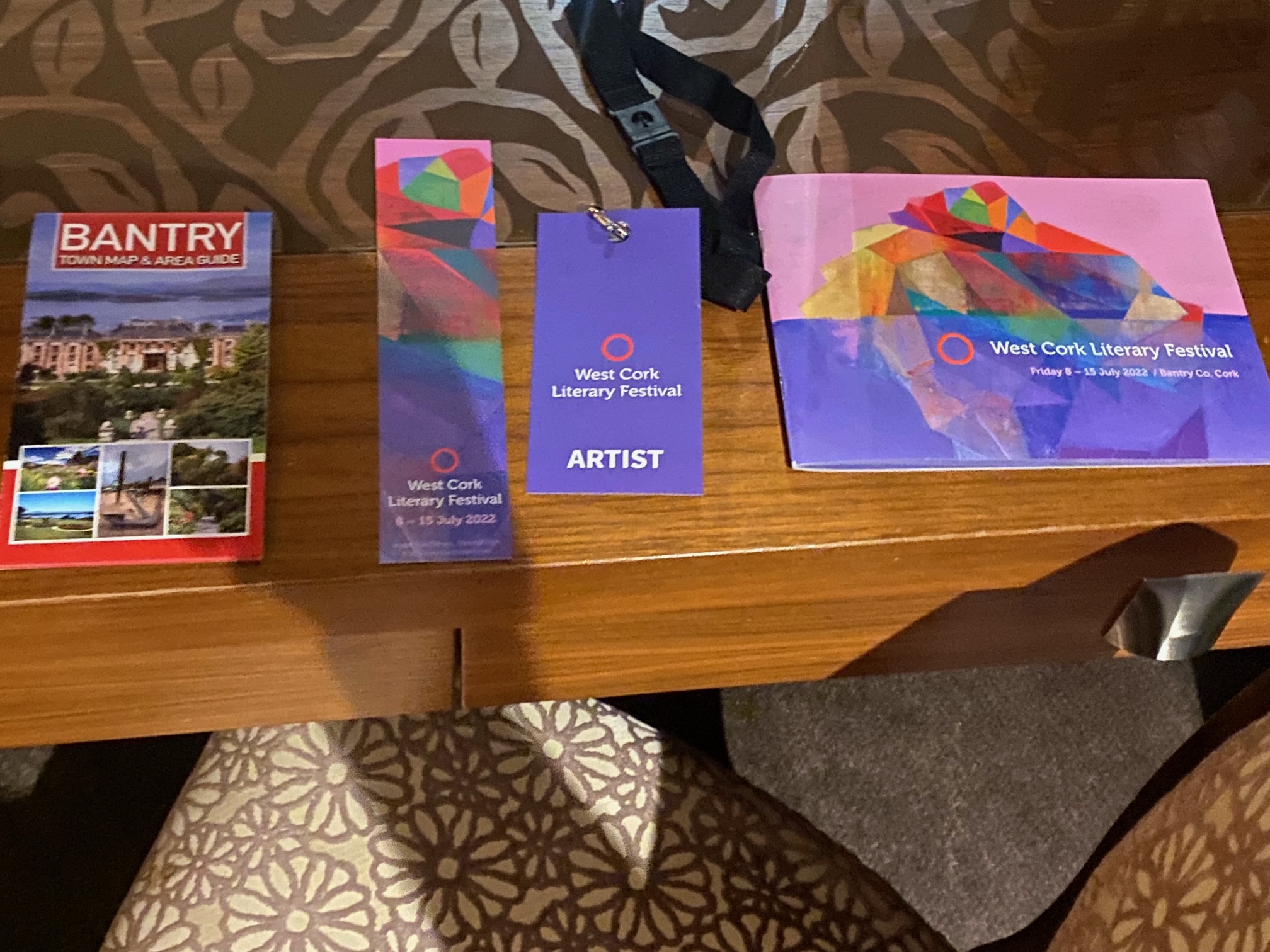
We’d been holidaying in Trabolgan in East Cork, but it was still a two-hour drive. When we arrived in the hotel on Wednesday evening, we were both fit to collapse into bed. I was unpacking my bag when a white envelope caught my eye. It was sitting on the table and it had my name on it. Inside was a bookmark, a lanyard with “artist” written on it, and a copy of the programme for the week. My photograph was in it, alongside my other Play It Forward fellows, Gonchigkhand Byambaa, Neo Gilson, Sara Chudzik and Majed Mujed. There were also details of other events featuring authors including Lucy Caldwell, Louise O’Neill, E.R. Murray and Marianne Lee. The name dropping could go on and on. I only wished I could’ve stayed for the week!

A photo of a map of Bantry, a West Cork Literary Festival bookmark, a lanyard saying “West Cork Literary Festival – Artist” and the West Cork Literary Festival Programme Brochure

Finally, on Thursday 14 July 2022, almost a year to the day that I was offered my place on the Play It Forward programme, I was preparing to introduce “Rachel” to the world. Gráinne from Skein Press told me not to be nervous, that I was reading to friends. Usually I would have someone read on my behalf because of my speech impairment, but that wasn’t going to be accepted as an excuse to weasel out of reading! The words were behind me on the screen. As I read, I became Rachel. People laughed, which was such a relief. It was such a pleasure to hear my fellow writers read about their experiences of marginalisation and belonging. Stories of cultures combining, memories of home and family members, themes of difference and trying to fit in. I was in awe of the talent of my fellow writers, and I hope to see more of their work in the future.

In five months, the Play It Forward Programme will come to an end, but I will always be grateful for this wonderful journey. I would like to thank all at Skein Press, particularly Nidhi, Mahito, Grainne and Fionnuala; the Stinging Fly, particularly Declan Meade; my outstanding mentor David Butler; the Irish Writer’s Centre; Independent Living Movement Ireland and the West Cork Literary Festival for affording me this unique opportunity. I will never forget it as long as I live.

The Big Imposter

Forgive me reader, for I have sinned: it has now been four months since my last blog. I was browsing through it today and decided that I need to make more of an effort to post more often. But I have been writing, I promise. In fact, I decided that I needed to give my novel another chance, after leaving it on the back-burner for the last three years while I got distracted by various projects and courses. I did the Certificate in Disability Studies in 2019 with the view of trying to get another job in the disability sector, and all I have got from that so far is further confirmation that I want to be a full-time writer. Lucrative? Not in the slightest, but I love it. I’ve been doing it for seven years now, with no-one prodding me to write. I’ve gone out of my way to prove that the statement “working on my own initiative” on my CV is true, that’s for sure. And when I look back on my writing career as a whole, I’m proud of what I’ve achieved, how many people I’ve reached and how many opportunities I’ve been given, from Independent Living Movement Ireland (ILMI) in particular (a big thank you once again).

Yet, when the opportunity came to push myself a bit further, I was reluctant. In June, ILMI joined forces with Skein Press and The Stinging Fly, offering a bursary to an emerging disabled writer. I eyed the advertisement with relish, but dismissed it initially. It wasn’t a good time: our house was being renovated and we were living twenty minutes away in Mountmellick, and we were coordinating the renovation as well as trying to keep Alison’s routine normal. The whole ordeal was so overwhelming that I had to step back from activism before I burned out. Suffice to say, it was a busy time, and when I threw the first ten pages of what I would usually term “my excuse for a novel” into the ring, the last thing I expected was to get an email two weeks later to say I’d won.

Reader, I felt euphoric. It was the middle of the July heatwave, and I brought Alison for an ice-cream so chocolatey and stodgy that we needed full showers afterwards; the pack of baby wipes didn’t cut it. I was so proud of myself. I had done it: everything I’d written since 2015 had been leading up to that moment.

But the next morning, after I had sent my “yes please and thank you for this opportunity” email to Nidhi Eipe from the Play It Forward Programme, I felt a sickness in the pit of my stomach. Why did I do that? I won’t be able for it. I’m not a real writer. No way am I good enough for something like this. Nidhi sent me a list of potential mentors from which I had to pick someone to work with. A list of established authors, with their work published, who knew what they were doing. I panicked, and drafted two emails. One was to Nidhi to say thank you but clearly there had been a mistake and I wasn’t the woman for the job. The other was to the two facilitators of a group that I’m part of called Writers Ink, and I wrote that even though I had been awarded this bursary, I wasn’t sure how I was going to maintain a pretence of being a half-decent writer and that I was terrified of making myself look like an idiot.

Thankfully, I didn’t send either email, as I would have succeeded in looking like an idiot. Instead, I stepped away from my laptop and took a breather for a few days. How was I going to shake this feeling of being a complete imposter? How was I going to overcome this feeling of sheer terror?

And then it came to me: I would have to fake it. I would have to pretend that I was a competent writer, capable of writing a novel. You see, the trouble is that I have never really taken this writing thing seriously. I’ve been told by people that there are some hidden gems in these pages, and yet I treat it like a diary, something I think no-one will read (perhaps taking the adage “write as if no-one will ever read it” a bit too far). In reality, despite how far I’ve come, I don’t feel like a “real” writer, deserving of any attention, positive or otherwise. The only thing keeping me going is coming to my laptop every day, telling myself “I can do this,” then typing as fast as I can before I change my mind, or overanalyse what my character is doing.

I’ve been allocated a terrific mentor, author and poet David Butler, who makes me smile: he loves Rachel, my character. Better still, he gets her, which I wasn’t expecting this early in our mentoring journey. He has been so encouraging on this novel-writing journey which can often feel so lonely, and now that I have more (though not full) control over my imposter syndrome, I can take his compliments as well as his suggestions for improvements and feel a sense of pride in my work.

I would like to thank ILMI, the Stinging Fly, the Play It Forward team, Skein Press and David Butler for this incredible opportunity. I won’t let you down! 

…Hopefully, if I keep telling myself that, it might turn out to be true.

Would I be Writer?

Having a lot of free time on our hands, all of a sudden, can be quite a dangerous thing. In recent days I find my mind wandering into dark, shady corners that I would normally protect it from, and thoughts that can become all the more sinister when overshadowed by a global pandemic. These thoughts vary from day to day. Lately I’ve been giving much thought to my career choices. At first, these choices were both sensible and socially acceptable. I did a good Leaving Certificate and decided to study English Literature in Trinity College. In fourth year, i was presented with another choice: to throw myself into my studies and get a good degree, or to compile a portfolio impressive enough to earn a place on the MA Journalism course in DCU. I didn’t have the energy to do both to the standard I might have liked, and I wept for two days when I got the rejection letter from DCU.

Maybe writing’s not for me, I thought. Maybe it’s just a hobby. It would be too difficult to try and pursue a writing career.

So I applied for jobs. Many jobs. The rejection emails and letters piled up on my desk as I continued to send application after application. It wasn’t impairment related as I never disclosed my impairment on initial application forms. Being unemployed can leave one feeling unhinged. I just wanted something, anything. My prayers were answered when Offaly Centre for Independent Living offered me a job. A good job. If I played my cards right, a permanent job. I was so relieved. I did everything I could to hold onto my job. It took the birth of my daughter for me to realise how unhappy I was. I was a PRO, in charge of the monthly newsletter. I was writing lots of words, just not the words I wanted to write.

I stayed for seven years. I stayed because it was safe.  I stayed because despite being seemingly incapable and inadequate, I strongly believed in the philosophy of independent living. I stayed because I thought that no one else would take me with so little experience. These thoughts wreak havoc on one’s self-confidence and belief.

But underneath it all, I still wanted to be a writer. There was a major flaw in my aspirations, however: in order to achieve this, I was going to have to write. i was going to have to be interesting. I was going to have to be honest about some things, both with myself and others. When I survived a nervous breakdown in July 2014, I knew things had to change. I knew that I would have to take a risk and show my words to real, breathing people.

The blog – this blog you’re reading now – was only ever intended to be a temporary thing. It wasn’t supposed to be a disability blog, or a blog about activism – it was supposed to be my ticket away from all of those things. As time passed,  however, it became ever more apparent that those two parts of me – writing and activism – could not be separated. The urge to communicate the real message of Independent Living and equal rights swelled within my veins until the dams could hold no longer, bursting all over the keyboard. I began to despair at my lack of control. I wanted to be a writer, not “just” a disability writer. I fought the urges, and lost. An article about someone “bound” to a wheelchair, the perpetuation of a victim narrative that no self-respecting disabled person would consent to be a part of, would bring me back to the keyboard, typing in a fit of rage. I felt I had a duty to add to conversations that were about me yet exclusive of my voice.

I fell into a rabbit hole.

“Be careful of being pigeonholed. It could destroy your career before it starts,” I was warned.

“This disability stuff can get pretty heavy for a blog,” another person told me. Still, I couldn’t take their advice. An invisible magnet always drew me back to independent living and activism. Even now, that can get annoying, but I’m tired of fighting against writing what comes so natural to me.

As I mentioned earlier, lately I’ve been pondering the word “writer” and whether it really applies to me. I’m not a weekly columnist. I don’t have a published collection of poetry or stories. I’ve tried to write the same novel three times, with each attempt ending in me leading the character into a cul-de-sac so deep that metaphorical suicide seems to be the only way out. So have I really earned the lofty accolade of writer? I would be inclined to say, no.

My vision of being a writer was having the ability to sit at my desk and stare at the screen in awe of my own words. My vision involved churning out poem after poem, story after story, without a moment’s hesitation. It involved generous pay cheques and prestigious awards, but above all,  I thought being a writer meant feeling secure and confident in sending your precious darlings into the world. That there would be a point where I could produce a piece of work that I was happy with and confident with. I haven’t reached that point, because as I’ve learned with the support of writer friends and various online communities, that’s not what being a writer is.

Being a writer is in fact tortuous. Many fellow writers that I’ve had the privilege of speaking with over the last few months still struggle within the clutches of inadequacy, imposter syndrome and crippling self-depreciation. It seems that a lack of confidence, a fear of being exposed is par for the course when you are a writer. It also seems that a lack of self–belief as opposed to a lack of writing ability is a writer’s biggest enemy.

I write because I can’t not write. I write because when I’m not at the keyboard playing with words, the clouds in my head become heavy and dark. I write because I enjoy putting different combinations of words together. I enjoy trying to capture scenes, emotions, outer injustice and inner struggles.

And, more often than not, writing keeps me from lingering in those dark corners.

Progress is progress is progress…

So, it’s the end of 2018, which in some ways has felt like the longest year ever, and yet I remember sitting here writing last year’s post as if it were yesterday. It’s been a busy year, and here are just some of the highlights:

I did a “Begin your Novel” course in January, and I now am 26,000 words into Draft 2. Maybe I’ll finish it before I die.

I had a couple of job interviews, none of which resulted in me getting a job. May I respectfully ask how in the name of chocolate are you supposed to get experience if you need said experience to get a job? Grrr. Grrr.

I threw myself into promoting Independent Living, which I still think is one of the most important philosophies in the whole world, as it recognises disabled people as equal citizens with rights and choices. I blogged about it and also made a video as part of the #IndependentVoices campaign. I also got to work with some amazing ‘young’ people (I don’t believe I fall into this category anymore) and found out that the future of the Movement is in their capable hands. In September we had the launch of Independent Living Movement Ireland, formerly known as Center for Independent Living Ireland.

I applied to be on the UNCRPD supervisory committee, but was not selected. I did get an interview though which was a huge honour.

I gave two lectures to university students – one about the use of technology to students in NUIG via Skype and the other was about parenthood and disability to UCD students (which was a bit impromptu as I stood in at the last minute for a friend who couldn’t make it). Nerve-wracking to say the least.

I wrote an open letter to An Taoiseach Leo Varadkar which was published in the Tullamore Tribune and also read out on Dublin South FM (Ger Scully and Sean O’Kelly, if you’re reading this, many thanks).

I started the Certificate of Disability Studies in NUI Maynooth in October, arrogantly thinking it’d be a piece of cake only to find it’s actually pretty intense with a lot of work and reading involved – oops! It’s so much more than getting the piece of paper for me, though. I want to understand the roots of the oppression of disabled people so that I know how to fight against it.  That said, I need  to stop speaking out in class. I’m coming across as a know-it-all and I will find myself getting beaten up for my lunch money. (If I don’t pass it, I may cry)

I’ve semi-committed to writing another monologue in the New Year with the talented Peter Kearns (Once this course is finished, though – my head is melted)!! Hopefully it materialises.

Oh, and I’m kind of doing some driving lessons! Think the instructor is a little dubious as to whether I can actually do it or not… only time will tell! Fasten your seatbelts!

And finally, I just about managed to keep this blog active (though don’t expect too much before my course finishes in April. Three essays and a group presentation will eat my time). Thanks to all my loyal followers for liking and sharing this pile of drivel. Your cheques are in the post!

Best wishes for 2019! xx


The Writing Process

Hi all, my apologies for not blogging here for a long, long time but believe it or not, I have actually been busy writing! I’m half-way through a ‘Begin Your Novel’ course (the time to do this, I suspect, was three years ago) and hope to dive into finishing Rachel’s story with more clarity. Deborah, if you’re reading this, we said the beginning of May for a first draft, but looking at the work I need to do that won’t be happening – sorry!

One of the other things I’ve been working on is an article about why I chose to write and my writing process. It was a great opportunity to promote myself as a writer and it will be published in the Spring edition of The Irish Wheelchair Association’s SpokeOut.  While everything I put into the article is completely true, I did make some omissions to the realities of the writing process. Here’s what a typical day might look like

9am – Arrive at my desk. My diary is open in a deliberate attempt to get me writing straightaway, complete with a pen to encourage me to jot down things straightaway. Ignore said diary and open emails instead. It’s important to know what skills my cousin endorsed me for on LinkedIn. Ooh, writing… oh yes, right…

9.30am Open Word and start freewriting. It’s great to get the old juices flowing. I love writing, it’s awesome.

10am – I did not know that your one Sarah from Corrie, Tina-whatever-her-face is, actually went out with Ryan Thomas who plays Jason. Oh, and that vicar Billy is going out with your man Daniel – wow he’s gay?! Oh all right, this has nothing to do with my novel, oops

10.20am – Back to work.

11.15am – That dryer has been beeping for the last ten minutes. I must turn it off because it’s wrecking my head.

11.30am: [ding] Who’s messaging me? Oh, it’s Ken from college. Writing back to him surely counts as work, him being a published writer and all. He’s sharing his knowledge. It’s imperative I don’t ignore him.

11.45am: 500 words written. Of pure and utter waffle! This is embarrassing, I’ve been working since half nine!

12.00pm: I’ve spend the last fifteen minutes rocking back and forth in my office chair, trying to calm myself down. But I feel I’m failing as a writer, and failing at life. Who did I think I was,  trying to be the next Margaret Atwood? I wonder did she ever feel like this. I’m going to quickly google and find out

12.15pm: Nope, probably not. I mean, look at all the books she’s written. Bet she didn’t spend all her time googling all her favourite authors. You know what? This internet’s nothing but a bloody distraction. I’m going to disconnect altogether.

12.55pm: 300 more words. Not bad if you omit the fact that I’m supposed to have my novel finished by the end of May. I feel sad. Cue more chocolate.

1.05pm: Nooooo, what is my laptop doing? Updates?! I don’t remember agreeing to this time. ‘Preparing to configure: 3%’. Why are you doing this to me?

1.45pm: Alison will be home in fifteen minutes but thank God the bloody laptop has finished updating itself, though what difference it makes I don’t know….. Oh no… no no no…my work, where is it? I’m opening Word but not seeing it… Recover unsaved files… no, that’s not it… agh! [enter string of expletives here]

2pm: Make note in my diary to write blog about my crappy day’s work, but maybe wait until I find it funny.

Of course, not every day is like this (if it were I wouldn’t bother writing at all) and if I had my wish, I’d be more organised and productive.

Then again, I’d also love to move to Australia, but that mightn’t happen anytime soon either.


e