Wednesday Wonderings: Five Years Ago Today, the World Shut Down

Today marks five years since the first Covid-19 lockdown in Ireland was announced by An Taoiseach, Mr Leo Varadkar, on 12 March 2020. Five years on, I’ve been reflecting on the surreal events that unfolded afterwards. Although everything is now back to normal, and many things are “as they were” before restrictions were announced, part of me cannot help but wonder whether as a society, we have collectively dealt with the psychological, emotional and economical impact of that uncertain period, which was followed swiftly by events that continue to unfold in Ukraine and Russia.

It was my good friend Shelly and late friend Leigh who first alerted me into thinking that this emerging virus in China was something to be worried about. I read back some of our group chats from late January/February 2020, and shake my head as I am reminded how the three of us tried to pre-empt what would happen next. I predicted that they might have to shut the schools for a few weeks, while efforts would be made to contain the virus. No-one could imagine the chaos that unfolded during the following weeks and months.

On the morning of 12 March 2020, while everyone around me was stocking up on tinned goods or toilet roll, I remember walking around Dunnes Stores looking for a nice Easter Egg for Alison.  I remember that I bought a few groceries as well, but I didn’t know what to buy. I just bought two bags of pasta and some noodles, along with four bars of soap (the pumped bottles were already sold out), while looking at people’s heaped trollies around me. The Easter egg was my priority. I could sense that Alison was going to lose so much in the coming weeks; she didn’t need to lose the Easter bunny as well.

Afterwards, I came home, feeling sick to my stomach. Despite being an avid reader of dystopian fiction, I didn’t know how I was going to deal with this uncertainty, nor how I was going to guide my eight-year-old daughter through it. That day, in an effort to distract myself more than being worried about my child’s education, I printed off a large number of worksheets from an educational website, thinking that if the world was about to be thrown into chaos and unpredictability, that it would be best to try and create some semblance of routine for the sprog.

That afternoon, when Alison came home from school, she’d just been informed that school was to be closed for two weeks, but even at the age of eight, she was clever enough to know that it would likely be longer. She asked so many questions, and for the first time in our lives, we had no answers. We sat watching the news as Leo Varadkar announced the lockdowns. John Paul had just started a career break, and I remember the relief that he would not be working and exposing himself to the virus. I became institutionalised very quickly, accepting isolation as the way things had to be. Like millions of us, I threw myself into work and homeschooling in to keep busy, trying to suppress my nervousness at the uncertainty around me. (What are the psychological effects of this now, I wonder?)

The world was thrown into autopilot, and slight lunacy. It became an offence to meet up with others, to take a drive into the mountains or to the beach, or to travel further than a 2km range from your home. Only one person could go shopping from a family at any given time. We had to mask up and keep our distance from those we loved, not only for two weeks, but for the guts of eighteen months. Hugging a friend was seen to be first degree murder. The message was, do you want your granny to die, all because you couldn’t resist giving your loved one a quick cuddle in the supermarket? What long-term effect is this messaging still having on people, especially children? 

In July 2020, Alison attended a socially-distanced drama summer camp in the local youth centre. I was apprehensive, but more concerned about my only child becoming too isolated from other children. After the second day, her drama facilitator messaged me to say that my eight-year-old daughter had told her that she had predicted the coronavirus pandemic, that she’d had a dream the week before restrictions announced that told her that something bad was going to happen in the world, and because she hadn’t told anyone she believed, essentially, that she was to blame for the entire pandemic. My heart turned to ribbons as I thought of the psychological burden that my little girl was carrying This is the unspoken impact of the OTT messaging behind the pandemic. We, her parents, were stunned as we explained, repeatedly, the scientific reasoning behind it. It took a long time to convince her, and even now, I see the damage that carrying that awful “secret” did to her.

Nobody in their right minds would ever want to return to those dark days of lockdown, although I will admit that it took me a long time to regain the confidence to put myself back out there and claim my life back. I became institutionalised in the safety of my home, going from somebody who went to Dublin at least twice a month, just because, to someone who didn’t go anywhere, until last year. 

We’ve had a rough few years that we simply have not been allowed to collectively recover from: COVID, the Ukraine-Russian conflict, economic instability, and now fecken Trump, so as we reflect on five years since the lockdowns were announced, we must remember that we have been through a great deal of collective trauma, and to give ourselves a break. And to congratulate ourselves, too, for doing our best in such unprecedented circumstances. 

A Tribute to Emmet Grogan

I honestly don’t know where to start when writing about this extraordinary gentleman. Part of me doesn’t want to write anything at all, preferring instead to stay in a bubble of soft denial, but experience tells me that this approach will not serve me.

The irreplaceable Emmet Grogan has left this world, and it hurts like hell contemplating a future without him.

I met Emmet when I was seven years old. We were both doing a “summer camp” in Clochan House. At that age. I had no concept of myself as being any way different, and I was suspicious of his wheelchair. What struck me about him when I met him first was his confidence. He knew that he deserved to participate in the world around him, a belief no doubt reinforced by his loving parents, Tommy and Mary. He loved showing off his piano skills, leading many a singsong when we stayed in Clochan House.

I remember the first proper conversation we had. I was ten years old and we were in the Harriers cycling around the track, me on my red tricycle, he on his handcycle. We started chatting about school and how we hated being told what we could and couldn’t do. From that evening, we always sidestepped the awkwardness, and a friendship developed that I too often took for granted.

Emmet became what I refer to as a “core friend”. He was among the first people I invited to my twenty-first, to our wedding, Ali’s christening and any other events we held. We didn’t speak every day, but he held such an important place in my and JP’s life.

We worked together for a year in Offaly CIL, and I was delighted to have a friend around to make the day go quicker. He designed the OCIL website and took great pride in his work. He was constantly asking for feedback, being eager to please and wanting to push himself professionally. He was a good laugh to work with, and I really missed him when he left.

As we grew older, I understood more about how pain affected him. Emmet had quite a severe form of Spina Bifida, and sometimes he was in so much pain, he couldn’t even speak. He’d had so many operations, and had been plagued by kidney infections for as long as I could remember. When I was sick, it was surmountable, but whenever Emm was sick, it really wiped him out. What struck me as we grew older together was how easily we could discuss these realities of our impairments. He never complained, but neither did he pretend his ailments didn’t exist; he wasn’t a supercrip, he was human. It was this humanity and authenticity that led me and so many others to gravitate towards him. But he wasn’t a misery guts either; he had a wicked sense of humour that was often unexpected. Understanding where he was coming from and trying to meet each other where we were at allowed us to share a friendship based on honesty, respect and love.

Emmet loved life. I slagged him many times over his love of going for coffees or a pint, either on his own or with friends. And why not? What he really loved (I hope) was catching up with friends. He also loved his annual family holiday to their mobile home in France every year, and usually came home either bronzed or as red as a tomato. 

Emmet loved his family, who meant everything to him, not only because of the assistance they offered, but because they truly encouraged him to be independent. They were his safe space, never stopping in their mission to ensure he had the highest possible quality of life. And I know how much he appreciated this. He was very much his own man, but his family always had his back. It’s very rare that such a balance is found when a family member has such a severe impairment. The line between empowerment and overprotection is a fine one, but his loving parents managed it perfectly. I know this because he only ever had good and positive things to say about them. And they had such a gorgeous relationship. Emmet was never a burden – he was a son, a brother, a cousin, an uncle. His family needed him just as much as he needed them.

I have cried so much in the last few days, yet I don’t think the reality has hit me. I’ve lost so many friends, but this is somebody who I never thought I’d have to contemplate living without. Rest easy Emmet. God knows you deserve it. X

Poem: For Leigh

We went travelling in Australia for the summer and, while we were there, a month to the date today, in fact, our friend Leigh passed away. Even though I was devastated, I don’t think it really hit me until I came home to Ireland.

I met Leigh by chance at a meeting in Dublin in 2014. We knew each other by reputation, and a friendship developed and blossomed over the years. Leigh reminded me of my mum so much, not because she was older(!!) but because she was from Newry and had a way about her that I ascribe to so many of my Northern Irish relatives: she had a wicked sense of humour; she said it as it was; and she was well accustomed to fighting for what she believed in. I tried scrolling back through our masses of Facebook conversations, to see when we first started messaging each other. After an hour, I was only as far back as 2018. Reams and reams of exchanged words of encouragement, anger, hope and fear.

Leigh was a religious reader of this blog and rarely neglected to leave an encouraging comment whenever I shared the latest instalment. During lockdown in 2020, she took up painting and sent me a canvas of two brown and white puppies, which I will treasure forever.

This hackneyed effort of a poem below won’t do Leigh any justice, but I can only hope she knew how much her friendship meant to me.

My condolences to Eugene, Karl and Aisling. You guys were her everything; that I know for sure xx

My grief-scarred heart 
Oozes gunge 
While I try to lend words
To articulate the loss
Of a headstrong woman,
Mother,
Wife,
Activist,
Friend.
Many times she wrapped me
Close to her heart
With her shortened arms
and endless patience,
Venturing across divides
Of land, time and attitudes,
Tough, but never hard,
Fearless, but not unfeeling.
The lullaby of her Newry accent
Luring those who tried to take advantage 
Into the searing, fiery ball
Of her passion for justice.
No longer will my phone ping
With requests to read presentations,
Or maybe just for a listening ear,
To ease her soul, though just for a moment.
And as long as I live, I will never forget
The woman who travelled to Texas and Pallaskenry,
Chasing dreams that were almost denied,
Crying tears she never should have cried,
To find the right man to stay by her side.
Nerves of steel, and a marshmallow heart
Ever present, yet too far apart. Xxx

Kids Today

Two months ago, how would we have described the kids of today?

The word ‘snowflake’ was bandied around an awful lot.

They probably had no empathy for others.

They spend too much time on their tablets and not enough time outside.

They were selfish and obsessed with material goods. Always wanting more. More toys, more technology, more games.

And now we find ourselves in the middle of a global pandemic, the biggest threat many of us have faced in the history of our existence.

School and extra-curricular activities cancelled. No visits to play centres, not even to our local playground. We cannot even visit aunts, uncles, grandparents or friends. No more playdates or day trips.

In the midst of it all, it is the kids, not the adults, who are coping so well.

They are using their tablets to keep in touch with each other, and have learned quickly how to use technology to host group calls  (I’m now only becoming used to Zoom calls). They watch YouTube for inspiration for art projects.

With no busy schedules, they have to spend more time at home, maybe picking up books that they otherwise would have had no time to read.

They use Google to learn about animals, other countries, famous people.

They want to help. They make cards for the frontline staff. They write letters to nurses thanking them.

Of course, sometimes they play games on their tablets. Maybe for longer than they should. And that’s ok too.

They are learning about the emotions that our generation of parents have been accused of shielding them from for too long. Sadness. Disappointment, Anger. Loss. We cannot give them everything they want, and they are learning to cope with that.

We are no longer raising the snowflake generation. We’re raising the generation of children who will change their world through kindness, empathy, understanding and compassion. We’re raising a generation who understand that physical and mental health must go hand in hand. We’re raising the generation that one day will make the world a better place.

And in fact, they already do. And I for one am very proud.

Shattered (Short Story)

(This short story was written in aid of World Suicide Prevention Day which takes place each year on 10th September. So I’m a little late. I apologise if this story upsets anyone but it doesn’t belong to me, it belongs to the *fictional* character)


Méabh smoothed out her silk olive green shirt. It looked baggier on her now, just as she had originally intended it to look when she first bought it. Her silver pendant, with two little pictures of the kids inside, hung loosely around her neck, giving her a look of carefree sophistication. She tousled her hair with her right hand, noting that the persistent greys were more prominent than usual. When was the last time she’d dyed it? She couldn’t remember. This inability to remember things, to retain basic pieces of information was starting to grate on Méabh. Once she had prided herself on being unnaturally organised, taking the jibes from Niamh and Diarmuid as good old-fashioned banter. Now, she felt that things were slipping away from her, but she couldn’t articulate what these things were. Time, her memory, her sanity? She tugged the skin on her face towards her cheekbones. This is what I look like now, she thought, an old turkey with excess skin like a sucked-out stomach after liposuction. That’s how she felt too: sucked out, hollowed, empty.

She threw the dishevelled duvet over the king-sized double bed, Conor’s suggestion of course. What an idiot I was, she thought, smoothing over the corners, just like she felt she was constantly smoothing over their marriage. They’d bought it a few years before she’d began sleeping in the spare room, when the children were still small. She had thought that such an extravagant purchase was a statement of where they were in the world, a sign that their marriage could be rescued. It was certainly a far cry from the old, springy mattress she’d slept on as a child, turning and readjusting so that the springs didn’t rub against her ribs. Conor had promised her that she would never be so neglected again, that she would always have food and a roof over her head. And she strove to be a better mother than her own mum ever was.

Nobody could dare accuse Méabh of being anything less than a wonderful, doting mum. It was well- known among the locals of Tullamore how incredibly organised and talented she was: she had always donated baked goodies to the kids’ school cake sales made from scratch; she had presided over the Parent’s council in Tullamore College for seven consecutive years; for sixteen years she ferried the kids to their after-school activities day after day, and was never without a kind word and a warm smile for those she met on the way. Whenever she spoke of Niamh and Diarmuid, her heart seemed to swell with pride. Diarmuid had just a few weeks before moved up to Dublin to be with his big sister in UCD. She was studying Arts while her brother wanted to be a doctor, just like his father. Indeed, he was becoming increasingly like his father, reflected Méabh: cold, arrogant and unfeeling.
Now that the children had flown the nest, the grim reality of how toxic their marriage had become was truly beginning to take hold. Conor had never been cruel to her in front of the children: distant, certainly, but until lately he had never descended to the depths of calling her names, putting her down, criticising her ironing, her cleaning efforts, her cooking. Perhaps, reflected Meabh, that was owing to the fact that there was always the children to act as a buffer between them. She hated herself for putting them in that position, and became disheartened often by how easily they had accepted it. Just like her Sunday roast dinners with the gravy made from scratch, watching her children referee between her and Conor had become a part of their lives.

At precisely five to eleven, the letterbox jangled. She heard the heavy thud onto the mat in the hall. Another pile of final notices, no doubt. Lately her post seemed to come in clumps, a collection of demanding letters and legal threats. For a moment, Méabh allowed herself to fill with self-pity. This is not how I imagined life at fifty, she thought, rubbing her temples. She’d hoped for a career of her own, something in fashion perhaps, something that would solidify her purpose. Now that the kids were gone and her marriage was on the rocks, she felt deprived of the opportunity to make her own identity. But she was just doing what women did at that time: she raised the children while Conor focused on his career. She hadn’t resented him for it, then.

She sat on the bed, staring into space, hoping to hypnotise herself into some kind of mental paralysis. Her heart was racing, as if she was about to get caught doing something wrong, as if someone would burst through her bedroom door and unmask her as the imposter that she knew deep down she was. Using the palms of her hands, she pushed herself upwards, feeling her cold blood rush to her feet. She didn’t have time to sit around moping. Those buns would not bring themselves to the school coffee morning.

Few things lifted Méabh’s spirits these days like seeing her pristine kitchen glow in the orange September light. The light shone from the marbled grey countertops and the black presses were immaculately clean. Méabh was proud that, at first glance, no-one would be able to tell from looking at her kitchen that she was a keen baker. Once she had all the ingredients organised, she loved to bake: to feel the flour clumping between her fingers, to watch the eggs, butter and sugar creaming in the mixer. The tubberware box in the corner of the counter was the reward for her efforts. Everyone always complimented her on her buns, her cooking. In fact, it seemed that everyone in Tullamore was envious of her full stop. Meabh acknowledged this without arrogance. She knew that her address of Clonminch Road was not merely her home but a status symbol, a statement about her place in life. Once she and Conor separated, where would she end up? What would her new address say about her?

Finally, she grabbed the keys to the Merc and trotted out of the house, wearing her shiny black high heels. She hopped into the car, carefully placing the box beside her on the seat. For a second, she stared into space, trying to remember why she was in the car. The kids probably wouldn’t have approved of her continuing to support school activities but, as she reflected, at least they were not here to suffer the embarrassment of her. Suddenly, her heart froze. Had Niamh really not been home for a whole weekend since the beginning of May, four months beforehand? Meabh was saddened by this realisation, but she knew why. In fact, she and her daughter had only spoke about it two weeks ago.

‘I don’t live there anymore, mam,’ Niamh had said on the phone, ‘so there’s no point in me coming home. Anyway, it doesn’t feel like home, you know what I mean?’ Niamh’s honesty had shaken her. Meabh had always thought that whatever was going on between her and Conor, she had always ensured that the kids felt secure and loved. She also hadn’t bargained for how much she’d miss her only daughter and their cups of hot chocolate in front of the Late Late Show every Friday night, going shopping in Athlone on Saturday afternoons, going for dinner in the Court every Sunday. Once, she had even seen Niamh not only as her daughter but her best friend. Alas, Méabh had let her down somehow. Niamh came from a different generation, Meabh reflected; she didn’t need the approval of a man or any kind of partner to justify her existence. That’s where I went wrong, she thought as she started the car.

As she pulled into the parking space, Meabh felt ashamed. I’ve no right to be here, she thought, watching the other mums walk in together, laughing and smiling. She envied how carefree they all seemed to be, some of them even wearing long shapeless t-shirts and plimsolls. Regina Hogan always came to these events in her tracksuit bottoms, the grey one with the red paint down the left leg. It annoyed Meabh that she never made an effort; some days, the woman barely looked presentable. And yet, Meabh noticed, Regina seemed happy. In fact, she was everywhere: at fundraisers, community events, sponsored walks. She waved as Meabh got out of the car, revealing a wet patch of sweat under her arm.

‘Well, pet,’ she drawled as Meabh walked towards her. ‘Aren’t you very good to take time out of your busy schedule and come up here with us commoners, eh? They look gorgeous,’ she said, opening the box in Meabh’s hands, then leant in closer to her, releasing a raspy laugh. ‘I bought mine in Flynn’s this morning. Was never one for this baking lark.’

‘No.’

‘Not for me. I’m an ‘ater, not a baker. We can’t all be as talented as you!’

Méabh was becoming irritated now. ‘I wonder how many will turn up,’ she said, quickening her pace, her high heels clacking behind her. The smell of old gym sweat, of cheap deodorant and cheese and onion crisps hit her as she opened the door, holding it open for Regina.

‘Thanks, pet,’ Regina smiled at her, flashing her yellow- brown teeth. ‘By the way, haven’t seen you working in the shop for a while. You still there?’

‘No.’ Méabh was tired. ‘Ah, it was just something to get me out of the house now that the kids are gone. Turns out I have plenty to keep me occupied!’ She held up the buns as Regina smiled and walked down the corridor towards the gym. It surprised her that Regina had noticed that she was not working in Centra anymore. Did anyone else notice, she wondered?

She wished she had the courage to tell people the real reason: that up until a few weeks ago, Méabh had spent the majority of every day in her pyjamas. That she had found every single task to be physically exhausting, from brushing her teeth to making a cup of tea. Conor had been gone for a month on one of his so-called business trips to Dubai, but Méabh wasn’t stupid. She knew that there was another woman involved, and that there had been for a long time. When she was in the house, alone, there didn’t seem any point in cleaning, cooking proper meals; mostly she’d lived on beans on toast or micro meals. It wasn’t her usual style: Meabh had once been a great believer in the benefits of healthy eating.

Frightened that she was starting to lose her mind, Meabh had gone to the doctor two days beforehand. She knew she wasn’t right: she’d even had two cigarettes the day before, despite not having smoked in nearly thirty years. It had killed her to confess that to the doctor.
I don’t feel like myself at all, she’d said.
Dr Murphy rubbed his head with his pen. You were fifty last week, yes?
Meabh had been insulted. I don’t think that’s relevant, Doctor.
Perhaps it’s all part of the menopause, he said, looking blankly at the screen in front of him. You ever been on Prozac, or Valium? It might help. Do you feel anxious? Meabh conceded that she did, that as long as she could remember, she had always been what her mother called ‘highly strung’.
Calm down, he’d said to her. Try some mindfulness or meditation. There’s apps for everything these days. He wrote her a script for Valium and held it out to her.
One more thing, he said, still distracted by the computer. Have you ever had unwanted thoughts? Méabh had frozen, feeling as if Dr Murphy had caught her unaware in complete nakedness. She felt invaded, exposed.
No, she’d replied, giving a small laugh at the absurdity of the idea, then, as an attempt to inject some humour into the tenseness, she added: Don’t worry, I love myself too much to do away with myself! She’d snatched the prescription off the table, not looking back as she’d walked out, holding her head high.

Now, Méabh sat in the car, watching the windscreen wipers move back and forth, squeaking slightly as they rubbed against the window. Squeak swish, squeak swish. This noise, she reflected, represented where she was right now: just going back and forth, going through the motions but not actually going anywhere. She was tired from her efforts of making polite conversation with other parents when really what she had wanted to do was crawl back into bed. The rain pelted loudly against her window, demanding to be let in. The six foot walk to her front door seemed impossible, then. If she got up, walked over and turned the key, she would then have to make dinner. Then she would have to clean up after and be in bed before he came in. And she would be doing this same thing, over and over, until they separated and she ended up in a grotty little bedsit on Church Street. That was assuming she could afford the rent and bills, of course, not to mention the bills that were waiting for her now, neatly stacked on the pristine counter.

Méabh’s entire body felt heavy.

This is it
, she said. I cannot do this anymore.

She turned on the radio in anticipation of having to drown out the floods of tears that she wished she could cry. Still she felt nothing. Not sadness, not anger: nothing. She opened the box of Valium and took one, and told herself she felt better. Then she took another, and another. The loud radio hummed around her, like a choral chorus, hemming her in:

…and it’s not a cry, that you hear at night;
It’s not someone who’s seen the light,
It’s a cold and it’s a broken halleluiah….

The music became increasingly muffled. Then, silence, the silence she’d been looking for. Diarmuid would find her slouched over the steering wheel, her silver pendant broken and the two kids grinning up at her from her lap. In these photos, they would never get older, and neither would she.

Absolutely shocking, they would say, later, after the news broke. She had so much going for her. Those beautiful children, God love them.
How’s Diarmuid going to cope now? Sure a couple more suited to each other I’d never seen!
…and she was so talented and all, ah wasn’t she just a lady?
Now Ann Kelly told me the other day she thought she might’ve got fired from that shop that she was working at…
Sure what is this town coming to, everyone killing themselves, what is the story?

Méabh would soon be yesterday’s news, and her neighbours would go on as before: smiling at each other, giving a friendly wave, or avoiding each other’s gaze, hoping nobody would ever discover their pain. All they had now was pointless speculation, and a ‘For Sale’ sign where she used to live.
New Year, Same Me?

So it’s the end of another year and I’m absolutely exhausted (though that is due in part to the fact that I’ve been fighting the dreaded lurgy for the entire Christmas. Evil, personified – seriously)

I know it sounds a little conceited but I’m sort of proud of my writing performance this year. Okay, so my novel isn’t finished yet but I know I will get there at some stage. I’ve written loads this year. Not just my blog, but short stories, articles and poems and monologues. You can see most of them on this website, and to be fair, I’m proud of them.

The problem is, there’s also lots of things I’ve written for publication that no-one’s seen because I don’t have the courage to show anyone. Sometimes I don’t show people because I don’t want to cause offence. Other times I don’t want to be told that my work is crap and I’ve no business calling myself a writer.

So this year, instead of making the same usual promises of going on a diet, promising to exercise more and all the other lies we tell ourselves to make ourselves feel better, I am going to endeavour to write more, and actually show people what I write. I’m going to send more proposals, set myself up for the world of rejection. Stop protecting myself. I’m also going to  be more true to how I feel and stop holding back in my writing.

I can’t wait to get started. In 2018, obviously. No point in overdoing it either.


(As an aside I’d like to thank my fellow By Us With Us team for allowing me to be part of such a unique event. It changed my life and gave me new hope for the future)


Be my Valentine …

Love it Karen – direct and from the heart x

beatingmyselfintoadress's avatarBeating Myself Into a Dress

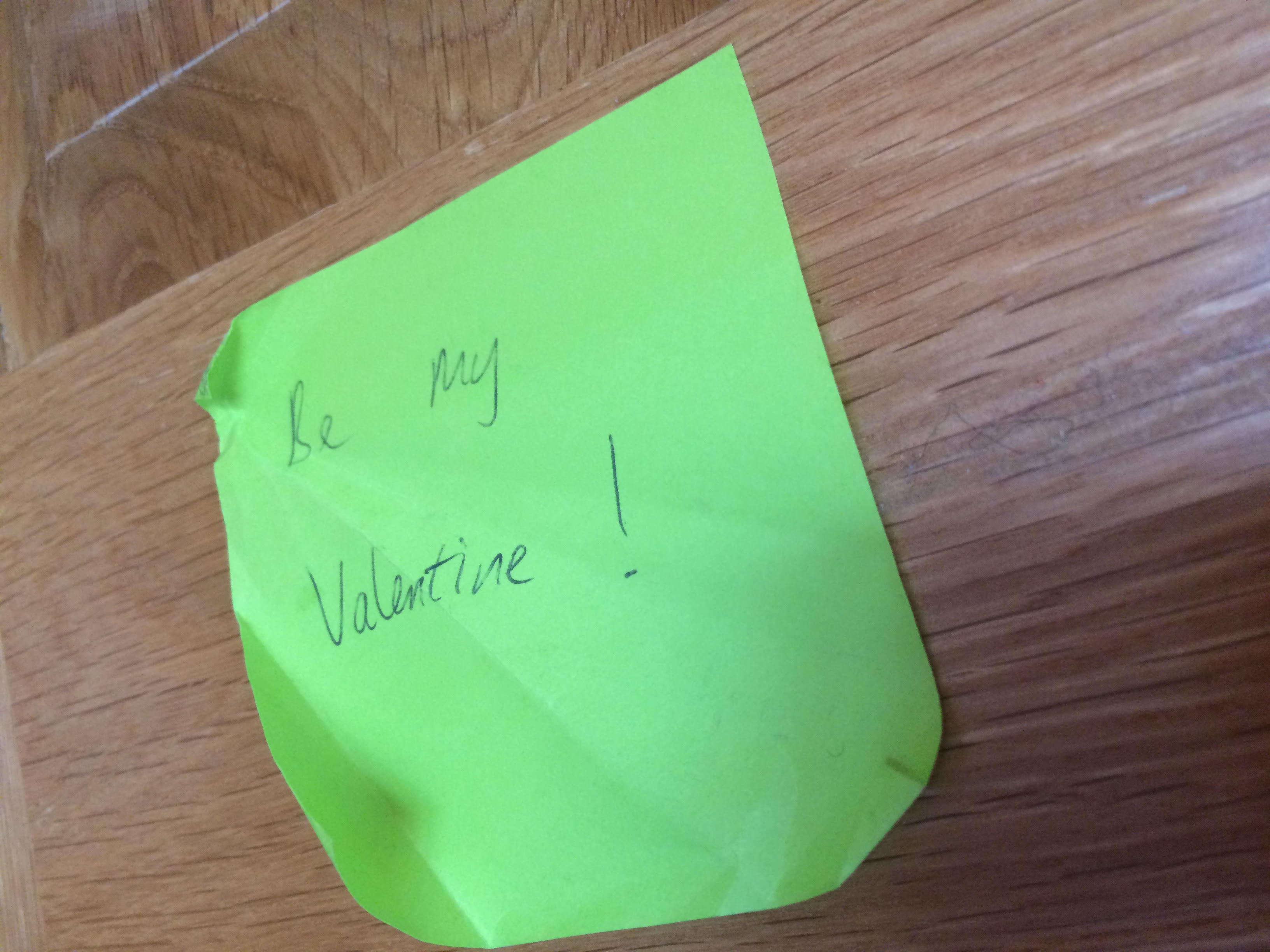
valentine-post-it A Valentine’s love post-it from about six years ago my husband left for me on the inside of a press so I’d see it when I opened the cupboard to make my breakfast. It’s still there!

I think I write a variation of this post every year on here, or if not here on my Facebook page, so you’re probably all sick of me waffling on, but hey, tradition is tradition so here it is.

I like Valentine’s Day.

It seems it’s a bit of a novelty these days to admit that you like Valentine’s Day, that you get some pleasure out of the day. In every newspaper and blog, in online forums and in real life people poo poo Valentine’s Day, giving out about commercialism and overpriced tat and forced love.

And you  know, I get it. I do. Because in a way they’re right. Nobody needs a six-foot…

View original post 488 more words