Sunday Ramblings: Jumping Back In

As I start writing this blog, it is 6pm on Sunday, 2 November, and it is dark outside. I hate this time of year. I honestly think I might have a touch of that SAD [Seasonal Affective Disorder], since I’ve been sluggish all weekend. Perhaps I’m just tired. It’s been two weeks since I got the pain injection into the shambles I call my hip. And while I’m not quite back walking full time yet, there have been some marked changes in my life. This afternoon, I took a painkiller for the first time in two weeks. Not because my hip was at me, but because I had a headache above my eyes, possibly from too much screentime. This afternoon, I cooked a delicious (if I say so myself!) steak dinner, complete with roasties and veg, and cleaned up afterwards. In fact, I’ve done a lot of cooking, with or without assistance, these last two weeks.

On Thursday, I went to a local disability meeting, with a group with whom I was heavily involved in prior to Covid. Everyone was shocked to see me. I think that they thought I was dead!

I’ve also managed at least half an hour on the exercise bike every day since last Sunday. I find that it’s taking me less time to cycle the same distance. And, if you’re reading this, this is the third blog I’ve written in the space of two weeks. I could get used to this level of productivity – it feels fantastic!

I need to hold onto this buzz I’m feeling, because I’m not able to go back in time. The truth is, whether I like it or not, I’ve lost so much time because of pain and exhaustion. When I finished the Disability Studies course in 2019, my plan was to do the “Train the Trainer” course, which (I think, but am open to correction on this) would enable me to give my own courses. Not only could I deliver Creative Writing Courses, but Disability Equality Training as well. Earn money, get a paycheck!

Or I’d like to do another oral history project, something like Conversations about Activism and Change. I typed out every word of those audio recordings, before editing them down. Damien Walshe and Des Kenny taught me useful lessons as I compiled and edited that collection, lessons that I’d love to apply elsewhere. Maybe I could do a collection of voices of up-and-coming activists? Without the heavy mantel of fatigue, my brain is swirling with ideas.

There are probably a number of reasons why I am reevaluating things at this moment. One is that I turned the big four-oh last year, and my original plan was to have my novel finished by then. Ironically, the first line of this, as yet, unfinished draft is “There are milestones one is meant to have reached by the time they turn forty.” This was me setting a deadline for myself, one that I’ve now missed. I would like to complete Rachel’s story, as I think many would relate to her internal (and external) struggles. She’s a hot mess, and often I want to strangle and hug her in equal measure!

Alison will turn fourteen in February. God willing, she will be going to college, an apprenticeship or a job when she’s finished the Leaving Cert, and as a stay-at-home mum, I suddenly find myself at a loose end. Where once I filled my days playing Lego, setting up Sylvanian houses or doing elaborate art projects, I now find all the time I once spent one-to-one with her spreading out in front of me like an overflowing lake. Don’t get me wrong – I’m still needed. For example, I was awake until one this morning applying tea-stains to her costume for the upcoming Addams Family Musical, as she is playing an ancestor. Apart from these moments, she’d much rather hang out with friends than her mum, which is a normal part of her push for independence. But I don’t really know what to do with myself.

I’m still available for proofreading work, but anecdotal evidence suggests that my opportunities in this area are fast diminishing in favour of AI. This is part of the reason why I didn’t feel motivated to complete that editing course that I started two years ago. If I think too deeply about it all, I start panicking. There’s nothing quite as sobering as scrolling through jobs.ie, and seeing that I am qualified for nothing relevant, nor have I the skills for local jobs. Waitressing, working on the shop floor, even factory work all seem beyond my realm of possibility. Of course, I apply anyway, because you never know. Dear reader, I don’t know if you’ve ever been to a job club. I have, and it was one of the most humiliating experiences of my life. I did this online career quiz and the top result was “Interpreter”. When the facilitator asked why I was laughing, I said “I can’t be an interpreter. I need one!” Awkwardness rippled around the room as my fellow jobseekers couldn’t decipher whether I was serious or messing.

So that’s where I am now, wondering what I should do next. All offers and suggestions welcome. In the meantime, I’ll be attacking my novel yet again while drinking the tears I’ve sobbed because of it.

Thursday Thoughts: A Tribute to Mrs “Bouquet”

When I turned ten or eleven, my friends started to ring me on occasion at the weekend, on the landline (one of those cream-coloured Eircom phones that had ten buttons on the right-hand side, where you could pre-program your most frequently dialled numbers, then ring them at a single touch of a button. Kids these days just wouldn’t understand that level of sophistication). As my friends rang the house, they would remark afterwards that my mother was “posh”, because she would answer the phone with a jovial “1-2-3-4-5, Una speaking.” They didn’t know any other parent who answered the phone in this way.

Nor did they know anyone who, in the early ‘nineties, made double-baked stuffed potato skins. Or fancy casseroles, beef ‘n’ beer stews, or used fondues or raclettes. I’m cringing as I recall how embarrassed I was that our parents seemed to be the “posh” ones. For God’s sake, we had a patio and a conservatory. This was pre-Celtic Tiger Ireland. We were probably considered the “Bouquets” of our area.

Even the fact that we were able to watch Keeping Up Appearances on BBC1, at a time when many of our friends only had two channels, RTE1 and Network 2, was a kind of snobbery in itself. When other Irish families were watching Glenroe, we sat laughing at Hyacinth Bucket’s (“it’s Bouquet”) misguided attempts at bettering herself, social climbing on a rickety ladder. Patricia Routledge was made for this role. I loved her clumsy displays of social awkwardness, her tireless efforts to invite those she perceived to be of a “higher social standing” to one of her candlelight suppers, and her embarrassment at being related to the plain Daisy and layabout Onslow. Of course, as I grew older, I learned that the Onslows and Daisys of the world, flawed as they were, were far more relatable than the pretentious Hyacinths.

Keeping Up Appearances became one of those things I will forever associate with my childhood and, more specifically, my mother. I remember the warmth I felt inside as I watched Mum watching it, dabbing the tears of laughter away with her hand. Of course, since the early to mid-nineties were simpler times, the whole Sheridan being gay thing went completely over my head (“oh but of course, you and Tarquin must have matching silk pyjamas”), but the bragging over Violet was something I picked up on straightaway (“my sister Violet, the one with the swimming pool, sauna, room for a pony”). 

I think part of the reason why Keeping Up Appearances is so popular is because everybody who watches it can relate to it. We all have a vision of what a perfect family should look like, and we tend to think that other people have their shit together when they do not. Patricia Routledge once said in an interview: “I think great comedy is based on pretension, pretending to be something that you’re not, and the exquisite danger of being found out.”

It is also a reminder that the more we try to maintain a fake outer façade, the more likely it is that façade will fall away. Sometimes, it’s easier to live in a fantasy than face reality; for example, Hyacinth’s father “Daddy”, who clearly has cognitive issues too large for any family to deal with alone, is reduced to an eccentric genius in Hyacinth’s mind, and perhaps this is a coping mechanism for her. Violet tells Hyacinth that she’s thinking of leaving her cross-dressing husband Bruce, and Hyacinth gasps in horror, exclaiming “What about the Mercedes?”

Patricia Routledge passed away on 3 October and with that, she took another small part of our childhood, and our mother with her. I know that this mightn’t make sense to you, dear reader, but it does to me; the end of an era, a bonding ritual with both of our parents that can’t ever be reclaimed. Every time I hear that jaunty theme music, I’m back lying on that mauve sitting room carpet (no dodgy hip back then), with my head in my hands, being brought into an adult world that I otherwise had no interest in, laughing at the futility of pretending to be someone you’re not. 

I recently watched an interview with Routledge on YouTube, dated early ‘nineties, where she remarked that she “gets a bit frightened of [Hyacinth] herself.” Routledge disclosed that while she herself was nothing like Hyacinth, she thoroughly enjoyed playing her, and after all these years, it’s difficult to imagine anyone else in that role.

Thank you, Patricia, for the belly laughs and for reminding us all, that despite appearances, we are all flawed, and delightfully human.

Review: Dara O’Briain’s “Recreation” and the StayCity Aparthotel

It’s been a week since John Paul’s birthday, and what better way to celebrate than enjoying his Christmas present? Yes, reader, you’ve read correctly: for Christmas, I got JP tickets to see his all-time favourite comedian, Dara O’Briain, in Vicar Street. It’s been JP’s ambition to see the man himself live since those poverty-filled weekends of 2008, when we couldn’t afford to go out and we sat in watching Dara O’Briain’s comedy DVD on repeat. Almost a fortnight ago, on Friday 28 February, we crossed that from our bucket lists, marking both our first time to see the comedian live, and my first time in Vicar Street.

Now, I’d never been to Vicar Street before, but was delighted to find a limited number of accessible tickets online (If you’re a wheelchair user, I suggest booking early to avoid disappointment). We travelled from Tullamore to Dublin via train, and I prebooked a wheelchair accessible taxi in advance on the FreeNow app, an act that felt like a game of Russian roulette. I will say that although I booked the taxi on the Tuesday, four days beforehand, my driver and vehicle was only confirmed a few minutes before arrival, and as the driver hadn’t specified where to meet, we had a fun impromptu game of Find the Taxi Driver. Nonetheless, he was very helpful and I marvelled at how easy the process was. Booking an accessible taxi in an urban (not city) area can be impossible, even with all the advance notice in the world. And if you use the FreeNow app, the fare can be deducted from your debit/credit card, meaning no fumbling with wallets as you are getting out of the taxi.

When I initially booked the StayCity Aparthotel, I was wary despite the high ratings left by previous guests. The StayCity is located around the corner from Vicar Street, which is crucial if, like me, you happen to be directionally challenged. I was expecting a basic hostel setup, and in many ways, it is basic; there are no frills. However, it was exactly what we needed. The accessible apartment was spacious yet cosy, with a wooden floor in the bedroom-cum-kitchenette and non-slip tiles in the roomy ensuite. The bed was at a comfortable height for a wheelchair user to transfer onto, unlike some other hotel beds that I’ve found to be too high. The bathroom was well equipped with plenty of handrails (blue for contrast of colour), two emergency cords (one beside the toilet, the other in the shower), and a good-sized sink with a long mirror and space for the wheelchair underneath. 

Having freshened up, it was time for the gig itself. Vicar Street is known as the perfect venue for comedy shows. We entered Vicar Street via the back entrance, where the staff were helpful and courteous. The bar area, which is right in front of the theatre entrance, is laid back and intimate also. While I loved this aspect of it, it fell on JP to order drinks as the bar is quite high.  The room itself was slightly bigger than I expected, but tables are quite close together, creating that feel of togetherness and comraderie among the crowd. I should at this point mention that, as far as I could make out, there are only four tables in the entire room suitable for wheelchair users, and each table is located in a corner of the room. This would have an impact on how many wheelchair users could attend any one gig. However, the atmosphere was cosy, with everyone giddy to see the show. 

Finally, when Dara took to the stage, suffice to say he didn’t disappoint. He is a fascinating mix of experienced seanchaí, dramatic actor and that neighbour you’ve said “good morning” to as long as you can remember. He’s quick-witted and razor-sharp, baiting and successfully reeling in front-row audience members into his quirky anecdotes. However, Dara’s set is far from a series of gimmicky stories. Like any great writer/entertainer, he bares his naked soul to the audience as he relates, in an honest and touching way, the whirlwind journey behind his search for his birth parents. We, the audience, experienced that journey with him, the dizzying highs and the crushing blows. Dara allowed us into his heart in the same way that everyone watching that night welcomed him into ours.  

In a turbulent world riddled with uncertainty, comedy is more important than ever before. I wanted to share this piece with you, as a wheelchair user who’d always assumed that attending a Vicar Street gig would be too awkward. I would highly recommend staying in the StayCity Aparthotel and reserving the accessible room (we paid €140 for bed and breakfast, where we would have been stung for €200+ elsewhere). The combination of decent, affordable accommodation, with its location near Vicar Street, made for an enjoyable, relaxing evening.

Tuesday Thoughts: Weathering the Storm

To my followers in Ireland and the UK, I hope that things have settled back to normality after the devastation of Storm Eowyn. Apparently, it was one of the worst storms that we’ve seen in our lifetime, and it’s predicted that these so-called “weather events” will become more prevalent in the future. As an island country, there’s only so much we can do. What are those who are living beside those idyllic sea views supposed to do, surround themselves in sandbags and hope for the best?

I must be honest: the only other storm I ever took seriously was Storm Ophelia in 2017. Others didn’t take it quite as seriously, alas; I remember looking outside to see a couple walking past the house, as if it were merely a brisk winter’s morning. Moments later, a leaning tree, firmly rooted in the patch of grass outside our front gate,  blew to the ground, the roots exposed, reminiscent of the uncovered spokes of a bicycle. All things considered, we fared well during that storm; no-one got hurt, our property (including the rabbit hutches outside) remained intact, and we never lost power. Surely if we could survive Ophelia, we could survive anything, right?

As the weather warnings intensified, I contacted my friend Orla who came the night before and helped us to heap everything into the shed. We charged up the portable chargers “just in case”, and I prepared food for the next day. Being honest, part of me thought the whole thing was a pointless exercise. When I went to bed that night, the wind was gathering pace, banging around the windows and walls. Still, I slept for an hour or two, but when I woke, the room was clothed in darkness. Even though I’m a forty-year-old woman, I feel no shame in admitting that I’m afraid of the dark. I reached for my phone and noticed that the battery icon was white, not green, which meant that it was no longer charging. Shit. We’ve lost power.

There was nothing I could do at five o’clock in the morning, so I waited until the sun rose to get out of bed. Everything I would normally do in the morning was now scuppered by this lack of electricity. I’ll just make a coffee…no, wait… I’ll hoover… oh, I can’t…. and so on. The dogs were whinging at me, clearly unimpressed that they weren’t getting their morning walk. However, I think the situation became clear whenever I opened the back door and the two of them nearly blew away on their quest for their morning constitutional! After that, they were happy to bunk down in their crate and wait for the chaos to pass. And it occurred to me that was all I could do, too.

Orla texted me, concerned at our lack of power. “Is there anything I can do?” she asked, and unfortunately at that stage, there wasn’t. But we were extremely lucky: at 2pm, without any fanfare, the power returned. We all hastily showered, stuck our phones onto chargers and prepped food in case we lost it again. Alas, I know that not everyone was as lucky, and we offered assistance to anyone we could think of who might have needed it. Four friends stayed with us until their power came back, and it was an honour to help. After all, it’s a horrible feeling to be stuck in the dark, feeling like there is no-one to turn to.

Very few of us, except the cold-hearted (and I don’t know anyone who falls into that category), would refuse help to anyone who needed it. The trouble is, we don’t always know, or can’t always tell, when someone needs help. And afterwards, we always feel terrible that someone has endured suffering alone, and we admonish them: “Why didn’t you tell me? You know I would’ve been there for you.” Of course, logically, we know this – but sometimes, when you are caught in the eye of your own personal storm, it’s difficult to explain the devastating impact of the damaging gusts raging around your mind. 

You can’t catch a breath. You can’t even think straight because your brain has automatically switched to survival mode. All you can do is grab onto something and hope you don’t fly away. You learn to become numb, because you can’t handle the guilt that goes hand-in-hand with feeling your emotions. For me, I don’t like letting people down. No feels like an impossible sentence to utter. So, rather than setting boundaries, I hide and pull away. 

And boy, did I hide. I left a beloved writer’s group (but rejoined today – hurrah!). I didn’t make contact with anyone, choosing instead to watch reruns on Netflix (up until last year, Only Fools and Horses was the only television programme I watched, or binged). Each day was a long struggle, from the time I woke to the time my head caressed the pillow again. And it didn’t have to be. I could have called someone, asked to be rescued from the storm. But I was ashamed. I was haggard and browbeaten, my confidence having flown away. Eventually, it dawned on me that sitting around waiting for the confidence to return was not going to make it happen.

I’m still in the baby steps phase, but I only made two New Year’s Resolution this year: one is to write as much as possible, even if I think it’s shit, and the other is to do everything in my control to ensure that, in low moods or dark days, I have some kind of emotional powerbank charged at all times, ready to use in emergency situations. Last year was tough. I lost four friends within a twelve-month period whom I think about every day, and the fact that human life is fragile has not escaped me. Of course, toxic positivity is just as dangerous as negativity, but I need to ringfence my emotional health, protect it from the storms of everyday life.

That said, in writing this I do not intend to trivialise the damage caused by Storm Eowyn two weeks ago. To those of you still waiting for power or water to return, facing repairs to your properties or cars, or have lost food due to lack of electricity, I’m thinking of you. The government needs to be prepared. We can – must — do better in the future. We must be more prepared for storms yet to come.

Tuesday Thoughts: The Baby Book

Even though I have my own swanky writing office, I’m currently sitting in my kitchen typing this, the back door open so that the breeze on my face keeps me awake, and so that the dogs can potter in and out without scratching at the door every five minutes. In front of me, on the wall over this dining table, are two black frames full of baby pictures of Alison with her aunties, her uncle, her grandad. It seems as though my love for her is splashed across the walls of our house. Her playschool graduation photos hang in the hall; her communion photos are in the sitting room. 

I’ve always loved photos. When I moved to college, the inside of my tiny wardrobe was covered in photos of family and friends. Until I got my first camera phone, I would bring these photos with me to remind myself that I was part of something bigger.

I didn’t own a camera phone in 2012, when our daughter was born. I didn’t have a whole lot, in fact. But life goes on, and incidentally, people who try to tell you that you should wait until you can financially support a child are talking nonsense. You will never be financially ready, or ready full stop. We were both working part-time, and juggling childcare between us, and a lovely lady called Sharon. And because we were both working, neither of us had medical cards. When Alison was diagnosed with cow’s milk allergy in June 2012, she was prescribed Nutramigen, which was €12.33 a tin at the time, so three tins was nearly €40. Camera phones were the last thing on my shopping list.

When I look back now, I wonder if I should have tried to savour it all a bit more. It wasn’t as though I wasn’t warned about this. People warned me that the days would drag but the years would fly. Advised me to treasure every moment, because she’d be gone before I knew it. To really make the most of it. And to be honest, now that Alison is entering her teen years and I’m trying to figure out what my new role is, I feel awful for having taken it for granted. 

As Alison and I enter a new and trickier phase in our mother-daughter relationship, once again I’ve found myself questioning my parenting ability. I know my parenting was scrutinised by professionals in the early days, but these days I find myself to be a harsher critic than any nurse, doctor or social worker. I need to be more delicate. No, more direct. No, more lenient. No, stricter. I give her too much independence. I need to let go more. Come nine o’clock, I will have a pain in my head, as I’m sure all parents of teenagers do. And this is without the traditional worries of sex, drugs and rock’n’roll, which I know are only around the corner.

And I see now that I should’ve captured her a bit better. I didn’t keep the first lock of hair that was cut. Nor did I keep any of her teeth. I have videos of school concerts, blurry ones that were taken by my shaky hand. I have incoherent handprints, futile efforts to capture her at a certain age. I didn’t mark the wall every year as she grew taller – this is the one that I regret most. I haven’t even made a baby book. A book recording her first words, the first time she crawled, her first steps. I don’t have the hair from her first haircut. These things weren’t priorities at the time. My main focus was on surviving and giving her as much of myself as possible.

Yet, I have such lovely memories that are mine alone and I don’t need to share with anybody.

Memories of teddy bear cinemas on Sunday mornings. Of tea parties and picnics on the kitchen floor. Of doing all the things I’d swore I’d never allow my child to do; Play-doh, sandboxes, art involving glitter and paint. I remember midterm breaks that involved me bringing her to Mr. Price to buy a few bits for a Pinterest-inspired art project, especially around Easter, Halloween or Christmas. Clay figurines, lollipop stick houses. It was a joy to watch, as she got older, the improvement in her colouring or the increasing time she’d give to painting decorations. She would design our Christmas cards and handmake birthday cards for family and friends, projects that were thinly disguised activities to get us both from one day to another on days where I struggled to hold everything together. 

Or we’d walk down the canal and pick flowers (weeds), again killing time while she looked for “rare” flowers. I used to love these walks. We’d find conkers and helicopters, all of which were pocketed of course, then caused problems in the washing machine when they were undiscovered. I remember the long days we spent in the town park, chasing birds or looking for butterflies or ladybirds.

I remember teaching her how to read, making cards with words like “table”, “chair”, and “fridge”, and watching in awe as she stuck them to the correct objects around the house. I remember the first book she “read” on her own: Angelica Sprocket’s Pockets by Quentin Blake. I remember her first day of school, how lost she looked in her uniform, yet how enthusiastic she was. In fact, until last year, Alison rarely missed a day of school, such was her love of learning.

On the sad day when she decides to fly the nest, I will have copious amounts of artwork, stories and photos to look back on. But the most precious will always be my memories, of a happy, intelligent and truly unique child, which will live in my psyche until I take my last breath. I know that I did my best. And I have a loveable girl to show for it.

Tuesday Thoughts: The Friends Experience

The. Boys’ Apartment with hockey stick through entertainment unit

It’s nearly been a month since Matthew Perry, best known for his role as Chandler Bing in Friends, was found unresponsive in his hot-tub. I admit that I felt a sense of loss, as if I’d really known him. Like most teens of my generation (the late nineties), I was obsessed with Friends. We aspired to be like them, with high-powered jobs, sitting around drinking coffee while we poked gentle fun at each other. We had posters of them on our bedroom walls, we slipped Friends quotes into everyday conversations (“How you doin’?”); as girls, we dreamed of looking like Pheobe, Rachel or Monica. And we rooted for them, as if we knew them personally. We always wanted Monica to find Mr Right (which she did of course in the sweet Chandler), we wanted Rachel to have her dream career (should she have got off the plane? I’m not convinced any more), and we wanted Joey to be offered THE lifechanging acting job that sadly never materialised (unlike Matt LeBlanc himself, who is said to have had thirteen dollars to his name before he landed the role). And of course, Phoebe found her stable influence and life partner in Mike. Friends was a massive part of our teen years; they really were there for us when we needed them.

Purple door inside girls’ apartment

With this in mind, as a surprise for our preteen daughter who is also a huge Friends fan, we booked tickets for the Friends experience in Dublin last Saturday 18 November. Location-wise, it’s ideal; a Luas ride to the Point and the Odeon is straight in front of you, next to the Gibson hotel. Both the venue and the exhibit were completely wheelchair accessible, with discreet ramps up to each set. 

Eighteen pages – front and back!

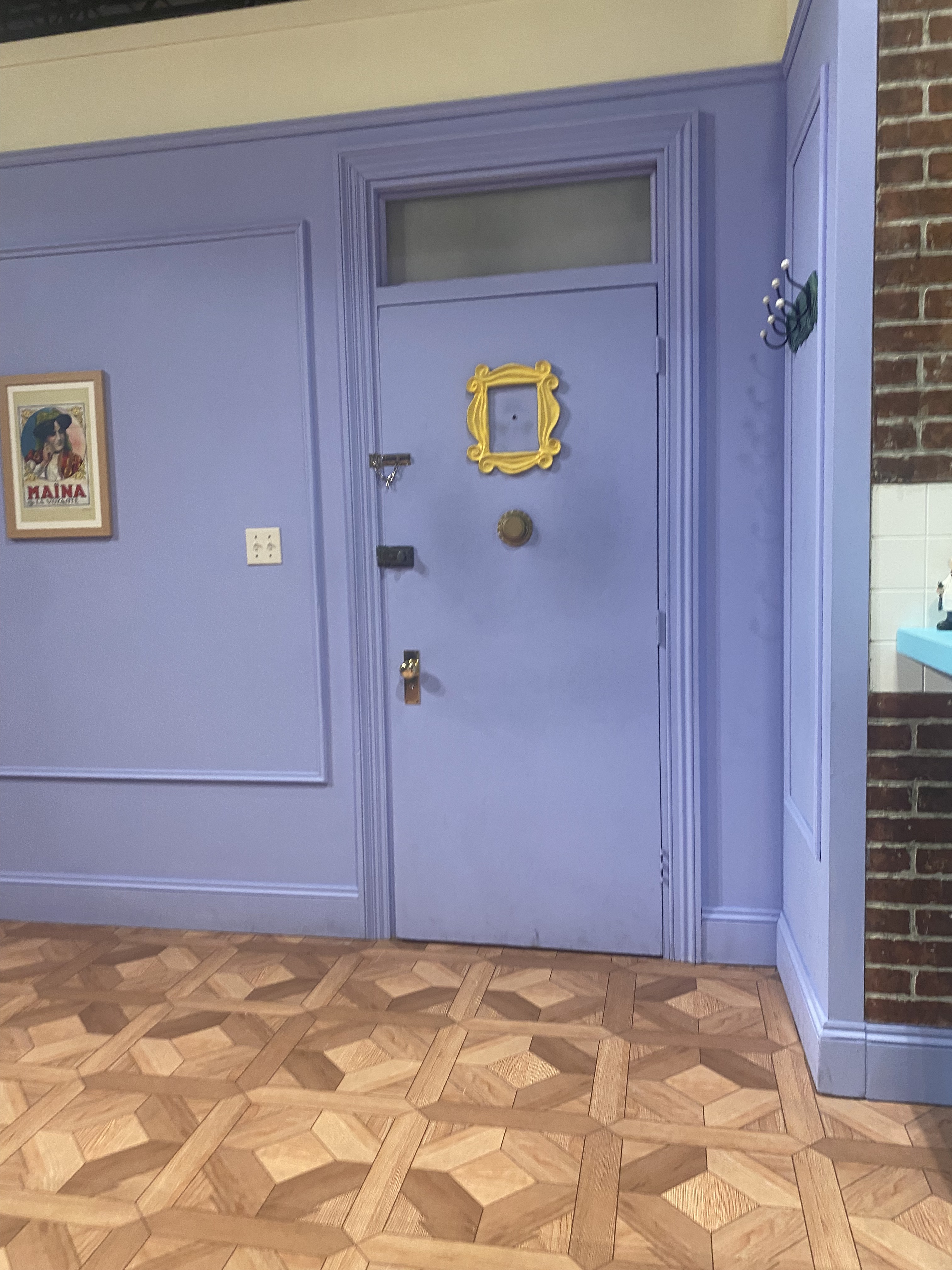
There are lots of photo ops to be had: at the iconic purple door in the girl’s apartment, playing guitar against the backdrop of Central Perk’s window, “pivoting” Ross’ couch up the stairs. It’s an exercise in nostalgia, with some Easter Eggs thrown in: a hurl through Joey’s entertainment centre (after the boys’ apartment was robbed, Joey was locked into the entertainment centre by someone he thought wanted to buy it); two little ornaments of a chicken and a duck in the entertainment centre as a nod to the boys’ illicit barnyard pets); Rachel’s famous “trifle” in the fridge of the girl’s apartment, and of course, The Famous Letter (eighteen pages, front and back!). And in case you haven’t caught the repeats lately, there are episodes playing in the background throughout the exhibit, which I’m sure many of us know off by heart thanks to the repeats on E4 and Comedy Central over the years.

Rachel’s famous trifle

Was it worth it? Yes, and no. A lot of detail went into the recreation of the sets. It was surreal to sit in Central Perk, on the infamous orange couch or standing at the counter that Rachel and Gunther worked at, or holding Phoebe’s guitar against the backdrop of the Central Perk window. I enjoyed the experience, but once you’ve seen it, I don’t think you’d go a second time. I also felt that it could have been more interactive (maybe a boys versus girls quiz, for example). We walked through it slowly, trying to savour everything, but we were still skulking around the gift shop at the end of the tour within forty-five minutes.

Pheobe’s first bike

I was also surprised that there was no mention of the recent tragic loss of Matthew Perry. Given how beloved Chandler was (he was always my favourite, as I found hís innate awkwardness so relatable), it might have been nice if there was a display or slideshow dedicated to Matthew’s (not necessarily Chandler’s) memory. It was sad to think of how Matthew tried to hide his inner demons from us in his mission to make us laugh (he admitted at the “Friends Reunion” that his need for audience validation was borderline unhealthy at times), and for me, knowing how human the actor behind the “funny man” was connected me to Chandler in a way that I didn’t connect with the others. I know I’m not the only one who feels that way. Matthew once said that he would rather be remembered for helping other addicts than for his role as Chandler. His passing on 28 October 2023 was a tragic event for many of us. Die-hard fans have said it’s like losing a real-life friend.

Menu in Central Perk

Overall, the exhibit was a lovely way to pass an hour, and kudos to the organisers for putting together such a detailed display. That said, Friends fans know what the show means to them, and it goes beyond the sets and memorabilia. It’s about following these characters on the journey of life, about keeping a sense of humour in the face of adversity, about finding a soulmate who is also your best friend and, above all, it’s about looking after each other. The Friends actors have a genuine love for each other, and I think that’s what made the show feel so authentic. Hashtag real friendship goals.

The Lost Years – Tuesday Thoughts 2

Two weeks ago, my husband and my daughter sat me down. They’d obviously been discussing something before approaching Big Bad Mummy (yes, I’m the bad guy in this house, which is always great fun). At first, I thought there was something wrong, but then Alison turned around and said the words I’d been expecting to hear for a while:

“Mum, I want to start walking to school. Not every day, but maybe two days a week…?”

“No way,” I snapped, with no hesitation whatsoever. “Are you mad? Too dangerous. You’re far too young.” And la-la-la, etc, etc, ad nauseum. My husband looked at me in surprise.

“Hon, it’s around the corner,” he reasoned. “Plus, she is eleven. She will be walking in secondary school, which is only a year away.” (That also stung hard. My baby is slipping away!) “We need to let her do it, learn how to take responsibility.”

I didn’t want to hear it. I flew into a silent rage and went to bed early, simmering because I hadn’t gotten my own way. But then I went on Google (of course) and was shocked to discover that it’s normal for kids as young as eight to walk as far, if not further, than our daughter was proposing to walk to school. And as I lay in bed, annoyed that Google had not taken my side, I realised that deep down, I don’t see Alison as an autonomous eleven-year-old preteen. (Well, sometimes I do. The mood swings don’t leave me much choice).

I admit that I’ve always been an overprotective parent, which is a direct product of the crippling anxiety that I’ve suffered from for as long as I can remember. Lately, however, while pondering how to allow my preteen some well-earned independence and keeping her safe at the same time, I wonder whether the pandemic affected the natural evolution of Alison’s independence. Is that why this sudden thirst for independence is such a shock to me – because of the lost time during lockdowns?

In the grand scheme of my own life, the three lockdowns we had in Ireland – from March 2020 to May 2020, from October to December 2020, and January to March of 2021 – don’t really matter. I was working from home anyway, I had a project to focus on (the compilation of Conversations about Activism and Change: Independent Living Movement Ireland and Thirty Years of Disability Rights), and I was involved in so many different organisations and advocacy groups that I often had two or three Zoom meetings a day. I soon got used to talking to friends over Zoom and Google Meets, even if I missed the intimacy of having dinner or a coffee together. All of this is now a distant memory, since we’ve supposedly returned to normal.

COVID has been around for approximately 1/13th of my life. But in Alison’s case, it has dogged nearly a quarter of hers. COVID struck the year of her Communion, meaning that the occasion was postponed and the party that we had planned, complete with in-house entertainment and seventy guests, was scaled back to a family dinner in the Tullamore Court Hotel (that said, Alison has about sixty people in her extended family alone, including aunts, uncles and cousins). Even when schools reopened in 2020, things were not the same: she still had to social distance, she could only socialise outside in the cold, and she had one friend who was allowed in our house, as part of her “bubble”. 

It seems like a lot to deal with, and I assumed she was pretty angry about it all. On Saturday night, when I was tucking her into bed, I asked her how she felt about the last three years.

“You must feel like you missed out on a lot.  Like your friends.”

“Yes,” she admitted. “For the first month or two, things were pretty hard, and I did find it lonely on my own. But it wasn’t all bad. You really pushed the schoolwork.” She laughed. “Honestly, I think I did more work in those six months than I have in the whole of primary school. And I enjoyed the challenge.”

“So, are you saying that you didn’t mind lockdown?”

She laughed. “I never want to do it again, let’s get that straight. But,” she paused, “we did lots of things that we just don’t get time to do now – the art, the baking, building forts, the movie nights.”

“And you don’t feel annoyed about any of that? About the things you missed?”

“Nah,” she shrugged. “We spent time as a family, even if we did kill each other sometimes. What’s the point in being annoyed, when life is much better now?”

I went to bed on Saturday night, pondering on how her unexpected answers were going to change the trajectory of this blog. And instead of dwelling on the psychological damage she’s supposedly suffered over the last three years, I thought about the things that Covid has given her. Alison is a prolific reader, having read everything she could set her hands on during the course of the pandemic. Once I manage to wangle her Switch from her, she loves writing her own stories, going for walks and playing football and camogie on the green. Occasionally, she’ll complain that she’s bored, but I think that has more to do with the age she’s at (eleven – not quite a child, not yet a teenager). Over the next few years, she’s going to face some of her toughest challenges – fitting in, discovering who she is, dating, and growing up in a world obsessed with social media.

But I wonder now if the whole Covid experience had lasting advantages as well. Alison has become an expert at dealing with disappointment, with making do with the circumstances facing her. She’s had Covid four times: one bout resulted in her missing a gymnastics competition, and she came down with it before Christmas 2022, causing her to miss her class Christmas party. Both times, there were tears for about ten minutes, then she dusted herself down and focused on getting herself better. She isolated on her own, not wanting us her parents to be sick too, and just sat it out. Reader, could you have endured that isolation, at the age of ten? Even with all the TV, books and Nintendo Switches in the world, I know for sure that I couldn’t have.

And maybe – probably – I’m making something out of nothing, as per usual. Perhaps, I’m just using Covid to deflect from my sadness that my little baby is growing up. And truth be known, even if time slowed to a snail’s pace, I was never going to be ready for it.

Clover’s Great Adventure

My first attempt at a children’s story, based on a true story! Hope you enjoy it.


The morning light illuminates the cage. This is my favourite time of day, when I can sit with my backside to the warm summer sun. My favourite spot is the far left corner, where I wiggle into and huddle down. Sometimes I lie there and sunbathe, teasing Tessa. Tessa comes to have a look at me most mornings. She’s a cantankerous old biddy, and she doesn’t say much which I find rather rude. She doesn’t talk about the weather, or the quality of cabbage these days. Instead she just lies on top of the cage, giving me her best death stares. To be fair, her stares are quite frightening: her eyes narrow and fill with a hellish darkness. She would love to come in here and fight me to the death, doing her victory mews as she rested her paws on my defenceless little bunny body. As if that would ever happen. After all – my name is Clover, probably the luckiest name any bunny could have. And I am far from defenceless.

As I settle into my favourite spot, I hear a familiar creaking. No, it can’t be possible, surely? Surely, after all this time, and three previous offences those ditzy humans always remember to lock the gate? And yet, it swings open, even though I’m hardly leaning on it. I stare at it for a second, remembering my last great adventure. Those humans weren’t best pleased last time I ventured outside the cage. I remember distinctly the sweetness of the dandelions, the crispness of those weeds, especially the ones growing around the poles of the swings. It would be foolish to pass up the opportunity of a lifetime, to deprive myself of a lovely fresh morning salad.

This is the part I hate most, I think as I look down. That ground below is hard, and landing on it feels like a sharp slap. Nonetheless, down I go, wheee! Quick and painful. Ow! My poor delicate little paws. I hop over to the dandelions. Nom nom nom. These are even better when they’re fresh! This must be how humans feel when they eat at one of those gourmet restaurants. 

Suddenly, I hear a clicking noise. It’s the noise of the human cage opening. There’s no escaping it: I’m busted now. Luckily, unlike humans, I can hop sideways and change direction quickly. I stand silently by the swings, eating the dandelions, marvelling at the loudness of humans. Honestly, they are so loud that I can never quite understand how they are on top of the food chain because they like to make so much noise. This is the alpha male of the pack, and he’s making a kind of whistling noise. Humans tend to make this noise when they are happy, but as I suspected, the whistling stops as he moves closer to the cage.

“Aw, are you serious?” he yells as he swings the cage door back and forth, as if he wouldn’t believe it was open unless he physically swung the door himself. Now, my Eng Lish isn’t great to be honest – the only word I really understand is “food” – but I think what he meant was “my word, the cage door is open and I believe my precious Clover has once again escaped. How awful.” It’s amazing how much humans can say in so little words.

He swings around and our eyes meet. Damn, I’ve been spotted. He stretches his arms out towards me, and for a split second, I actually feel sorry for him. I stay quietly in my spot, waiting for him to approach me. But as his cold shadow creeps towards me, a little voice whispers in my head. It’s a predator! Run, run, run! To make it fair, and because as a fellow bloke I understand the workings of alpha male pride, I allow him to come within an inch of me, only sprinting away as he bends down to pick me up. Now, as I said, my grasp of Eng Lish is terrible, but I wouldn’t even try to translate the words that I believe the male human is now shouting at me, because I’m sure there are children reading this story.

I wiggle my brown fluffy body under the expensive wrought iron gate, chuckling at the foolishness of humans. They think that they are so clever, but we animals are always one step ahead. I can’t resist stopping to look at the fear in my human’s eyes as he follows me into the front garden. Again, I feel sorry for him: he looks worried, which means he must really love me. But I can’t bring myself to let him win, and just as he’s less than a foot away, I hop out of the driveway into the Great Wilderness. The human follows me but I hop into a bush on the green, and when he comes nearer, I hop away again. I’m having such great fun. Who knew life could be so exciting?

The Great Wilderness is not how I imagined it at all. There’s not as many trees as I thought there would be; it’s more like a collection of human cages in a circle. Their gates are open, so I tentatively hop into the next human cage to see what it’s like. The menu is absolutely stunning, and so well presented. I would highly recommend this restaurant: the variety offered here is second to none. Yellow flowers, orange ones, purple ones – so many options. Where do I start? I nibble at the yellow one first. YUM! It’s so light and refreshing. I love the delicate aroma of these purple ones – just out of this world. Suddenly, I hear a human shriek. Honestly, they are so noisy – why the need to vocalise every little thing?

This human is a woman, and she’s not happy at all. Maybe I was supposed to make a reservation or something? Surely not – there’s no other customers? I only hope she appreciates the perfectly bowl-shaped hole I made in the middle of her lawn. It could be handy for storing her own food, or if she wants to feed me – hey, it’d be rude to stop her. She’s shouting and waving me away, even though I’m not finished. I’m not exactly impressed with her style of customer service – she’s a bit rude and abrupt, if you ask me. Though I must admit that the food is just too good for me to snub her place altogether. I make a note to come back later.

I’m tired now and contemplating going back to my cage to chill and sunbathe when I hear a slight rustling on my own front lawn. The sight of Tessa’s yellow eyes frighten me. She’s lying there like she owns the place, and I’ve a good mind to set her straight once and for all. I tiptoe towards her, conscious that her eyes are on me all the time. Suddenly, there’s a hiss, and she pounces, her face mere inches from mine. Perhaps this wasn’t the best idea after all. Nonetheless, I am always up for a challenge. I hop into the shrubs, waiting for her to follow me before hopping back out. I clamour towards the back garden, frantically looking around for somewhere to hide. Bunnies aren’t good at climbing trees. My only option is to hide behind the smaller human cage – I think I’ve heard them call it a “shed”. It must be like a holiday home or something. What is humans’ fascination with cages? 

I curl up for a nap, confident that I am safe at last. One thing I will say for cage living is that you don’t get any of this drama – this adrenaline is too much for me, I’ll admit. But I should know by now that Tessa is not stupid. Annoying, certainly, but not stupid. Her feline shadow blocks the little sliver of light that was coming through. The yellow in her eyes has adopted a sort of ominous, luminous glow. Is this how my life is going to end? Surely not. Yet, she is edging towards me, her slinky body preparing for a chase. I turn to run, but it’s too narrow in here to build a proper momentum. That’s it, I think, as my short bunny life flashes before my eyes. I leap out towards the sunlight to land into the arms of another predator…

…my smiling human! Normally, I would struggle until he let me go, but to be honest, I’d much rather not be ravaged to death by a deranged cat. He puts me back in my cage with some fresh food, chuckling as he locks the hutch. Right now, I don’t care.  I’m safe and back in my warm cage. Tessa looks up at me, and I press my bum against the cage in defiance. I believe in this instance, you humans would say “na-na-na-na-na.” Tessa understands, and slinks away in disgust as if to say “you’ve won this round, but I’d watch your back if I were you.”

I ignore her, stretching out with my full belly, exhausted after my busy day. I’m pretty confident that tomorrow will be quiet and boring – I can’t imagine the human leaving the cage door open again for a while. Still, I can lie here and sunbathe in peace, while dreaming of my next great adventure.

Short Story: On the Edge

The pale pink light gave the room a heavenly glow. Siobhan lay in silence, watching the cavity of her chest rise, then fall, then rise again. The dripping noise from outside her window had stopped; the rain must have finally subsided. It had kept her awake most of the night, which meant that she was not jolted from the security of darkness to give Aoife her night feed. Michael was supposed to be on duty tonight, but Siobhan had supposed that there was no point in waking him up. He’d have only been cranky, and God knows there’d been enough bloody rows between them in the last few weeks to last a lifetime.

‘You’re crazy, woman,’ he’d said to her at the peak of yet another row where she had threatened to leave for good. She’d even had her cabin-sized wheelie packed beside her, although she wasn’t sure what she had put into it. The decision to leave had been, as in times previous, a spur of the moment one, made because she couldn’t bear those nasty voices in her head. This time had been different, however. She had really hurt him.

‘If you hadn’t wanted your precious baby so much, I’d still be normal and not a bloody psycho,’ she’d screamed at him as she walked away, the sound of her own sobs failing to drown out Aoife’s.

She’d come back of course, hours later, and she knew Michael was relieved, even if he didn’t want to show it. They should’ve tried to talk it out there and then, but they were both tired from the fight. The constant fighting. Fighting to make it through the days, the hours. This had been exactly three weeks before, and now the pair of them were walking on eggshells. It infuriated her how he always tried to say the right thing, always tried to give her space. If he could find it in himself to be as much of a cunt as she had been, then she wouldn’t need to carry so much guilt.

A crappy mother, a crappy wife, thought Siobhan as she peeled off the bedclothes and slid into the tracksuit bottoms that she’d strewn on her bedside locker just a few hours before. She picked up one of Michael’s hoodies from the shelf, not because of sentimentality but because the excess material hid her grotesque frame, the extra pouch that now hung around her waist, like an internal bum-bag. She inhaled as she peered into the cot at her sleeping daughter, longing to feel that special connection. Aoife’s thick lips smiled, something which Kathleen, Siobhan’s mother-in-law had insisted was just wind. Well of course it was just wind, Siobhan had thought. It seemed that Aoife was willing to settle in anyone’s arms but in the arms of her mother. Siobhan didn’t know how she felt towards Aoife, but it wasn’t love. It wasn’t hate, either. It was nothing.

What sort of mother feels nothing towards their own baby? A baby that she had yearned for since she was given her first baby doll by Santa at the age of just five years old? Three years of expensive and gruelling IVF had given Siobhan a daughter more beautiful than she could have ever imagined, and yet at that moment, Siobhan didn’t feel that she was cut out for years of self-sacrifice, of putting somebody else first.

Trying to stop herself sniffling in the dark, Siobhan padded towards the door, watching the sleepy scene. It was almost romantic, like a Cow & Gate ad. A gentle inner voice tried to persuade her to take back off her clothes, to lie down and try to sleep, but Siobhan thought it was too late now. She crept into the kitchen and rummaged through the medicine box, pocketing every painkiller she could find.

Soon this pain would be over.

Soon she would be over.

Despite the high winds earlier in the night, Siobhan hadn’t expected to be peppered with cold, misty rain when she opened the front door. She smiled to herself as she momentarily considered bringing an umbrella. Ha! She thought. People who are dead inside have little call for umbrellas.

She walked over the Whitehall bridge. The road was gleaming black from all the rain, and the usually busy Daingean Road was quiet. She had it planned: she would walk a few miles down the canal, then she would take all the pills until she felt a little delirious. At that moment she would succumb eternally to the murkiness, allowing herself to sink to the bottom. She supposed that people might be sad for a few days – her sister Aine would take it particularly hard – but in that moment she was grateful that her parents were no longer alive to feel the pain. She wished that she was more religious, that she believed that she would be reunited with her mam, whose voice she yearned to hear with every fibre of her being. But she wasn’t.

The wind was gathering pace again, a perfect time to venture nearer the edge. This way, she wouldn’t have to jump. She might have been just out for a midnight stroll when she was blown in. Nobody would have to know. She was just about to step closer to the edge when a gravelly voice behind her startled her:

‘Wild night to be out for a stroll.’

At first, Siobhan thought she was hearing things, because surely nobody in their right minds (she didn’t fall under that definition, she supposed) would be out at this hour? When she turned around, the sight of a shadow startled her. Despite the wind, she could detect the metallic smell of vodka from his breath. Yet this person was not staggering: he was trudging along slowly, as if carrying a great weight on his shoulders. She felt the hairs rise on the back of her neck, ready to go on the defensive.

‘Mind your own business,’ she said at last. Couldn’t he see that she wanted to be left alone? It occurred to her that he could be dangerous, maybe capable of rape or murder. But then again, wasn’t everyone? ‘I don’t have any money. Leave me alone.’

She half-jogged further up the canal path. It never occurred to her to walk back towards home, where there would be somebody waiting to protect her. What she did realise, however, is that she didn’t feel that she was worth protecting. She also noted that while she wanted to disappear, dissolve into the earth as though she never existed, she needed to have control over how it happened. God knows, she thought, it’s the only thing I seem to have any control over at the moment.

Her footsteps slowed, and when she was outside her own head she heard the hesitant footsteps behind her. The aroma of cigarette smoke was infused in the sharp October breeze. She sat down on the hill outside the old Daly farmhouse, inwardly cursing herself for doing so as the wetness crept in, leaving her derriere saturated. The violent wind had subsided; all she was left with was silence and self-disgust.

After a few moments, her companion crouched down beside her. He smelt of sweat, of old urine, of hopelessness. Bloody typical, she thought. Trust me to meet a drunk. Her partner inhaled, which started a violent coughing fit.

‘You ok?’ she asked, forgetting herself.

The man nodded. ‘Be grand in a minute,’ he said, wiping the tears from his eyes. ‘I’m well used to it by now.’ He reached into his jacket pocket and pulled out a long can.

‘You should quit the fags,’ Siobhan said, immediately hating herself for her own self-righteousness. Who was she to talk when she had the entire contents of her medicine box in her pocket, ready to take in one go?

‘I probably should do a lot of things,’ he answered her, his voice quiet. Siobhan heard the snapping of the can, and her stomach turned at the smell of fresh beer, presumably cheap. ‘You shouldn’t be out here so late. These parts can be dangerous for the likes of you.’ The beer trickled down his throat. He wiped his mouth with the back of his hand.

‘What do you mean, ‘the likes of me’?’

He waved his hand, fanning her words away. ‘You know exactly what I mean.’ He rummaged in his pocket. ‘Smoke?’

‘No.’ Her voice was firm. ‘I don’t smoke.’

‘Ha. It must be hard to be so bloody perfect.’

Siobhan was relieved to smell the smoke; sitting so close to him, her bloodhound-like sense of smell detected urine and old underarm sweat, with the slightest hint of shit. She yearned to escape, to be at one with the swirling brown water in front of her. She took a deep breath, then another. Already she felt like she was suffocating. It wasn’t the feeling of comfort that she had been looking for.

‘Perfect. Ha! If only.’ For the first time since they met, Siobhan considered how she must appear in her companion’s eyes: a silly little damsel in distress, a privileged housewife who couldn’t possibly know what real hardship felt like. ‘You don’t know anything about me.’ She stood up, putting her hand in her pocket, feeling safer as she held the pills in her hand. As long as she had a plan, however warped that plan might be, she felt grounded. More grounded than she had felt in a long time.

Her stomach turned to bile as she thought about events earlier that day. It had started as an average day, or at least what she now considered to be average. She found it difficult to believe that just a matter of months before she was the manager of the Tullamore branch of the Bank of Ireland, bringing in quite a generous pay cheque. They’d squirrelled most of it away, of course, being sensible and thrifty. Aoife had been a surprise, a most welcome surprise. Her mere existence was testament to the fact that even the most highly paid and expensive doctors can get things wrong sometimes.

Aoife had awoken at six that morning, demanding her morning feed. Siobhan should have been well-rested; Aoife had slept since half nine the night before. Instead Siobhan had laid awake all night, unable to turn off her brain which was thinking at breakneck speed. What if she had dropped Aoife when she nearly tripped over that loose tile in the bathroom earlier? Aoife’d had a tiny bit of red in her spit-up earlier which Siobhan had assumed was from the strawberry she’d eaten earlier that day, but now she was worried that it was blood. She should’ve checked, and she didn’t. What sort of mother would allow her own child to bleed to death?

Siobhan couldn’t live with the constant inner panic anymore. It didn’t take a genius to work out that Aoife would be better off being looked after by someone more experienced, someone who would appreciate her for who she was. She warmed inside as she thought of Aoife’s blonde eyelashes, the tiny half-moons of her fingernails, the dimples that appeared when she smiled. Aoife was perfect. She deserved better than the fighting, than a mother who didn’t know what she was doing.

Another hacking cough disturbed Siobhan from her daydreaming. She stood up, and adjusted her jacket.

‘Anyway, it was nice to meet you. I really must…’

‘It was this very spot,’ the man said to her, gesturing towards the canal. ‘Where they found her. You know, I come here every night, try to work out why… She didn’t even leave a note.’ He wiped his chin on the sleeve of his jacket. ‘They say she killed herself, but I reckon that’s bullshit. She had three kids… she was happy.’ He lit a cigarette, the blue threaded smoke lingering in the calmness; the wind had passed, as Siobhan had known it would. ‘I’d only seen her the night before. She was smiling, laughing, dolled up to the nines…’

‘Who was?’ She only asked because she assumed it rude not to.

‘Karen. Oh, Karen. Now I’ve made a lot of mistakes – I’m sure that’s obvious – but she definitely wasn’t one of them.’ He pulled hard on the cigarette, as if he was seeking comfort. ‘She had it all, believe it or not – looks, brains – her mother’s doing of course.’ He crushed the empty can into the palm of his hand. ‘You hear stories, don’t you? Tell-tale signs, people losing interest in their lives -goodbye notes – we got none of that. No explanation.’

‘I’m so sorry.’ She didn’t know what else to say.

He shrugged. ‘They say men don’t talk. I don’t talk about Karen. I don’t know… maybe I’m hurt, ashamed… She could’ve fucking said something.’ The trees rustled gently in the breeze. ‘In the beginning, it was so simple. She’d been selfish, a coward – I thought maybe it’d been some silly woman hormonal thing, but they have pills for that now, don’t they?’

Siobhan scoffed. ‘You men are all the same. You think that solutions are so simple. And that we’re hysterical little women who know nothing about hardship. You have no idea what it’s like to have no control over your emotions, having to act all normal when your head is completely frazzled.’ Her voice started to break as she thought of her daughter at home. ‘How it feels to be completely useless and to have someone depend on you…’ Her chest shook with hacking sobs; she could barely catch her breath. The man looked up at her, nodding his head.

‘There,’ he said. ‘It’s out there. You’ve said it. So you’re a crap mum.’ His candidacy surprised her. ‘I suppose you beat her black and blue when she cries…’

‘Well, of course not…’ She was taken aback.

‘Or spend your money on high heels instead of baby formula.’

Siobhan’s fists clenched. ‘How dare you…’

‘Or head off for evenings out and leave bubs home alone. Leave a bottle in the cot, be grand.’

She laughed at the absurdity of the last one. She knew he was joking now.

‘You’d be surprised,’ he shrugged. ‘I’ve seen it. But Karen wasn’t like that, and neither are you.’ He stood up, wiping his hands on his thighs. ‘Go home. Get a nice hot bath.’ Siobhan screeched as he slid his hand into her oversized jacket pocket, taking out the pills and throwing them into the canal. ‘Things will be better in the morning. You’ll see.’

‘How did you know?’

‘Woman, you’ve been rooting in your pocket all fecking night.  This isn’t my first time to do this, you know. After Karen, I swore never again. Not on my watch, anyway. If you wanted to kill yourself, you would’ve done it by now. We’ve been here all night.’ He nodded at the orange rising sun and grinned. ‘For all you knew, I could’ve helped you. Murdered you. Look at the state of me. Wouldn’t blame you for making that assumption.’

‘I guess we can never know what’s going on in other people’s lives.’

‘Nope.’ He started to walk away. ‘Unless we choose to tell people. How can people save us if they don’t know that we’re drowning?’

She watched him walk away, and how he walked with a sense of purpose. She supposed he had nowhere to go. But, she realised, he had done an important thing that night – he had saved her life. She was still shaking when she got to the front door. A white-faced Michael greeted her, his face filling with relief as he beheld hers.

‘Thank God,’ he said as she broke down, wrapping his protective arms around her. ‘I was so worried, I thought you might’ve done something stupid…’ Both their faces were awash with tears. ‘I’m so sorry… I’m so glad you’re okay.’ He squeezed her closer to him.

And then Siobhan whispered the words she had always found so hard to say:

‘Michael, I’m not okay. I think I need help.’

He nodded, and finally Siobhan felt the weightlessness she had been craving.
Unsocial Media?

I’m in writing mode now. But ten minutes ago I was flitting mindlessly around Twitter and Facebook, seeing what was happening in the world. You don’t need to tell me this is a waste of my time, of course I know that. By ‘waste of my time’ I naturally mean ‘waste of my writing time.’

A few months ago, I felt so guilty about the length of time I was spending on social media that I deleted both my Twitter and Facebook accounts. I think this lasted all of one day before I panicked and reinstated them. It’s sort of disturbing to know that ‘do you want to permanently delete your account?’ doesn’t actually mean what you’d think it would, as even after choosing this option your account can be restored.

It’s depressing how social media owns us. We all know how sharing pictures of our kids and our houses and our beautiful pets can make us look needy, narcissistic and fake. Who hasn’t been scrolling through their Facebook or Twitter feed at one stage or another and thought, ‘oh my God, this is a pile of rubbish, why am I still on social media?’

We’re told that social media is ruining the ability of people to make real-life friendships and conversations. Well, I’m sorry, but social media is not the sole scapegoat for people being lonely. I’m sure I’m not the only one who doesn’t live in the same town as any of my family members. For many of us, it’s not a case of going up the road for a quiet natter with family or friends (I have one close friend living in town at the moment). People are out living their own lives in every corner of the world, and it’s social media that is keeping them all connected.

Social media has helped me in three areas of my life: as a mother, a writer and a person with a disability. When Ali was born, my friend added me to some wonderful parenting groups where clueless first time parents like me were asking questions about parenthood. Often I don’t comment: instead I ‘lurk’, nodding silently in agreement with other mums. In fact it was another mother’s open admission on Facebook that she was struggling with PND that ultimately motivated me to get the help I needed, take care of myself and write a blog about it. Knowing that I was not alone really helped. I also joined a reflux survivors’ page when Ali had reflux and seeing other parents come out the other side really gave me hope during this difficult time.

As a writer, being present on social media can be both rewarding and tiring. I’m still trying to find the balance between suave self-promotion and being interesting without just being plain annoying. In terms of rounding up an audience for my blog, I’ve found Twitter to be especially useful. Like most Twitter users, I haven’t a  clue who half of my followers are, but some have proven to be really useful contacts. For example I met a lady on Twitter who helped me find some secondary reading for writing my novel. I met another lady who’s teaching me about chocolate and making material accessible for the visually impaired.

Finally, social media is opening up the world for so many people with disabilities right now. Whereas before peer support mainly involved occasional meetings or coffee mornings, people with disabilities can now communicate with each other on a daily basis. This is so important given that there are nearly three thousand people with disabilities living in inappropriate nursing homes or hospitals and thousands more, be it through lack of transport or Personal Assistance, trapped in their own homes. Social media is becoming an increasingly popular tool for PWD challenging injustice in their everyday lives, and as a result, our stories are being highlighted by mainstream sources including local and national newspapers. People who were once voiceless are now becoming very vocal, all from the comfort of their own homes. The inability to get out does not necessarily mean the inability to participate, to count, and to matter.

So although I should probably curtail my time skulking around on Facebook and Twitter, I’m not ashamed to acknowledge that social media has helped me become a better mother, a more conscientious writer and a fiercer activist. I’m so grateful to be part of a virtual community that accepts and helps me. It certainly doesn’t beat face-to-face contact but it does make the world that little bit more accessible. Not just for people with disabilities, but for everyone.


Ps. If you enjoyed this blog, ‘like’ and ‘share’. Joking!

Pps. Well, half-joking anyway