Mastering the Art of Loss

Losing someone you love isn’t a one-time lesson, it’s a process that one must endure for the rest of their lives.

‘The art of losing isn’t hard to master’ Elizabeth Bishop, ‘One Art’.


No-one will argue with the statement that in 2016, we’ve lost a lot of people from the celebrity world. People who had such an impact on our lives, even though we never knew them. People who we looked up to, maybe idolised. Some people that we felt we knew personally. There’s no sugar-coating it: bereavement is cruel. Nothing can prepare you for that sudden void that it creates, and nothing ever fills that void, even if you try to.

Grief doesn’t believe in having a timespan, either. This will be our eighth Christmas without our beloved mother (and today is her fifty-ninth birthday) and I’ve already spent four weeks steeling myself mentally against crying like a sap every time I hear ‘Fairytale of New York’ because it was her favourite Christmas song. And this year particularly I’ve felt her slip further and further from me, because I’ve had to grieve for her repeatedly over the last twelve months. My brain frantically clutches onto fragments of memories I have of her like a man overboard clutching onto an inflatable raft.

First, there was David Bowie, on the tenth of January. I’m not a diehard Bowie fan, but Mum was. She used to tell stories of how she styled her hair like his, and there’s photos of her wearing a cross around her neck as he did. According to Mum, Bowie dictated what Mum wore in her late teens/early twenties, one outfit (if I remember correctly) was an orange top with yellow trousers  (which she got caught wearing by one of the Sisters in the hospital in which she was working at the time). Bowie’s death brought those memories back instantly and that day I mourned for time that couldn’t be recalled.

Four days later, Alan Rickman died and it brought back memories of a family tradition long forgotten: the four of us ‘kids’ meeting on St. Stephen’s Day in Mum’s house, eating crap and watching Harry Potter. Some years that would be the only day that we were all together. Alan Rickman was also in Love Actually, where he plays a love rat. I watched that film with Mum and there’s a scene where Rickman’s wife (played by Emma Thompson) has discovered her husband is having an affair (she discovered some jewellery in his pocket but she was given a Joni Mitchell CD for Christmas instead). In this scene, she listens to Both Sides Now, one of mum’s old favourites and even now, even though I’m expecting it, this scene breaks my heart.

In between the deaths of two absolute comedy legends (Frank Kelly’s on the 28 February, my husband’s birthday, and Victoria Woods’ on 20 April), another absolute comic genius, Ronnie Corbett, died. Every Christmas my mother snuggled on the couch and tittered at the antics of The Two Ronnies reruns. She’d probably seen every episode before, but she still laughed until she cried at them.  And after she died, whenever I saw Ronnie Corbett, I saw her and the big smile plastered across her face.

More recently, the passing of Leonard Cohen (11 November) suddenly reignited that sense of loss that each day, I try to keep buried inside me, along with a sense of panic. I explained in last year’s instalment of Mum’s Birthday Blogs that my way of dealing with particularly stressful things is to push them into a black hole and pretend they’re not happening. Thanks to the nervous breakdown I had two years ago, I now deal with what I’m feeling as it comes, though I must admit old habits die hard. And this year, what I’ve been wondering is how much I actually remember. How much of it is real, and how much I’ve fabricated.

For example, her voicemail message which I rang incessantly for a year after she died. What was it exactly? Was it ‘Sorry I can’t take your call?’ Was it ‘Sorry I missed your call?’ Not important, I know, but you’d think I’d remember that much. Her favourite singer as far as I’m concerned was Joni Mitchell but it might have been Alison Krauss, Elaine Paige, Mary Chapin Carpenter. I’ve no idea what her favourite dinner was because she cooked so many. Every year, as the sense of loss heightens, my memory of who she was becomes entangled with who I would need her to be today.

Of course, there are things I remember. Silly, insignificant things. Like the way we used to stop at KFC in Newry every time we went to Belfast (there was no KFC in Tullamore at the time). The time she bought a collection of Harrods Beanie Babies in the pound shop in Athlone. How she used to paint her pictures slowly, using bold primary colours, giving them thought, time and care. How you weren’t allowed to talk during Casualty or Holby City (we didn’t have Sky+). How glamorous she looked after putting on makeup and how she was the envy of so many women in town. How she had a brooch to go with every outfit, even in the noughties.

And today, on her fifty-ninth birthday, I remember thinking how she was invincible, how she’d be around forever, how I couldn’t see my life without her in it nagging me. And yet, here I am, fielding questions from her almost five-year-old grandchild who would’ve loved her Nana Una.

‘Mummy, was Nana Una pretty?’

‘Yes she was honey, very pretty.’

‘Was she a good cooker like you?’

‘A brilliant cook, she did lovely stews, lasagnes and roast dinners.’

‘Did Nana Una like art?’

‘Yes, she did, and she did lots of paintings and drawings like you do.’

‘I bet you miss her very much.’

My dear Alison, you have no idea how much.

Happy birthday Mum. I was never going to be able to stop you slipping away from this world, but you will never slip away from our hearts. And I know that even if all the other memories fade, we will always be left with love.

Halloween Tricks and Treats

I am absolutely exhausted. I keep forgetting that I’m not Martha Stewart and I’ve spent a good part of today baking and making little treats with Ali. JP says that we were making memories, but that’s not what I would’ve called our kitchen circa 3pm this afternoon. Think confined space, sticky gloop and hand grenade. Funny how none of that is captured in those expensive baking magazines, eh? (In hindsight, marshmallow top-hats would’ve sufficed. Making muffins was pure madness, especially for someone who is almost allergic to baking).

Ali was harping on at me for ages to have a Halloween party, but to be honest, I don’t think Halloween is that big a deal. It certainly wasn’t in our day, when the majority of costumes were plastic masks and bin liners (I haven’t seen a kid in a bin liner in yonks). I certainly don’t believe in holding unnecessary gatherings which require cleaning up of any description unless it’s not in my house. We didn’t have Halloween parties, although some of the other children did. They were weirdly extravagant affairs, with material costumes and Halloween decorations.

I remember how I used to almost resent mum for this lack of effort, for this apathy towards what was such an important holiday. She didn’t even let us go trick-or-treating on our own: instead, we were bundled into the back of the car and escorted to her friends’ houses, where we would stay for half an hour at a time. I wasn’t impressed that she would let my older brother Steve go by himself. I remember the really early days, when Steve was still trick-or-treating, emptying our bags, trawling for cash. We’d usually be able to stump up about four pounds and Steve would walk to Egans the next day and buy four hundred penny sweets which would be long eaten before we’d touched all the monkey nuts we accumulated.

I  don’t think anyone in our house liked Bairin Breac, so every year mum would bake two apple tarts (which we sometimes ate after Trick-or-Treating) and hide punt coins wrapped in greaseproof paper. No ring shite for her; she made mauling her apple tart worthwhile. She also bought sweets for the trick-or-treaters, which was rare at the time, and I know for a fact that certain trick-or-treaters changed costumes and visited our house more than once! (Won’t mention names though – the past is the past and all that). And that was Halloween.  No frills, no party games or bobbing for apples. Pretty boring really.

And then one Halloween night, in 2001 to be exact, Dad got a phone call to say that his mother had passed. He looked so forlorn, so lost, and so tired, having only come in from work fifteen minutes before.  Fifteen years have passed, but in many ways it doesn’t feel like it. It’s something that all we cousins remember even now. After all, gatherings at granny’s was often the only place we were all together, and now that was gone. Her wake and her funeral happened during midterm, and us girls went back to school, a little bit emptier.

As an adult, the feeling of loss is what I now associate with Halloween, but as a parent, I want Alison to remember Halloween for the right reasons. I want her to remember fun and happiness, and not sadness. I want her to remember the lengths we went to to decorate, to make treats, to enjoy each other. But sometimes I have to remember to calm the f**k down.

As scary as it is, there’s certain things I just can’t control. It’s taken me a while to learn it, and one day, she will learn it too. It doesn’t mean that I’ll stop trying to make her happy. Although next year, I might just decorate shop-bought madeiras instead. And in doing so, I’ll be teaching her something important: there’s no point in trying to be something you’re not.

To Alison on your first day at school

IMG_0061


Alison at eighteen months


To my beautiful daughter, Alison,


It’s ten past nine on Monday, 29 August 2016 and you have been in bed just over an hour. Since then, I’ve spent the time running around like the proverbial blue-arsed fly trying to make sure I’ve everything ready for tomorrow morning. Another big milestone in your life.

Your very first day of primary school.

I marvel at myself for how I can sit here and type that sentence so dry-eyed and straight faced, my thoughts still coherent enough to write this blog proclaiming my undying and never-ending love for you. I should be in a heap in a corner somewhere, sifting through your baby photos, pining for the years I will never have again with you.

But I’m not (Don’t worry though, mummy isn’t some sort of insensitive bitch, promise honey). Not yet, anyway. As nervous as I am, I’m also really excited about it

I don’t know if you know it, but there was a time when I didn’t think I was good enough for you. There was a time when I believed you would be happier without me, that I wasn’t a good parent. And then you started to walk, to talk, to count, to recognise your colours and shapes, to sing little songs over and over again. Things that I taught you. You kept mummy going in the darkest days; you were the light, your butterfly kisses the fuel of my strength.

You are so beautiful, inside and out; don’t let anyone tell you outside. You are so kind, gentle and loving that any one of your classmates would be lucky to have you as a friend. You’re also a bit of a messer, so I’m anticipating a lot of notes home over the next few years. I think auntie Alex is in there somewhere!


Alison, as you may know, mummy spends every night in her office, trying to  write the best novel ever written (okay, a little pretentious, but who’s judging? Let me enjoy my delusions in peace). Mummy often gets frustrated, thinking she is going about things the wrong way, and sometimes wonders if she should’ve stayed at her job. But then, Alison, I look at you – the stunning, clever girl that you are – and I know that I will never regret the extra time I had with you. Sure, some days were crap (especially when it was raining or mummy was PMSing), and others were fabulous (when the sun shone), but they were memories made together that I will eternally treasure. Thank you so much.

Honey, when the time comes I want you to follow your dreams, no matter how far-fetched they seem. I want you to be always happy in who you are and not to be afraid to be yourself, no matter what. Fitting in is overrated – take it from someone who never did (and never really wanted to, either). Don’t ever be afraid to stand up for what you believe in.

My daughter, my little girl, my only one – have a fab time at primary school. You’re going to Scoil Mhuire, which used to be my favourite place in the world. It was there I became who I am and developed a sense of myself  as a person. School taught me that I would always have to fight to be recognised as equal, but that the fight would invariably be worth it. School taught me that in order to be trusted and respected that I would have to respect others. Most of all, the fabulous teachers there encouraged me to write which has been my sole ambition since I was a small girl like you.

And as I say to you every night, thank you for being my daughter. I am so lucky to have you. I love you princess. Just please-stop growing up, okay? If for no other reason, just so that you will always fit in the hollow below my ribcage xxxxxxWIN_20151128_192444

Four Years Old (poem)

for Alison


A doctor’s visit can be healing,
But not as instantaneously as mummy’s magic fairy dust.
The beating of a butterfly’s wings entertains you for hours.

You don’t need any help, and yet you need me,
Your head slots so perfectly into the hollow beneath my ribcage.
Your soft hands always so busy, so dirty
Creative delicious mud pies or digging for buried treasure.

Your lips purse together into invisibility when you’re looking for something,
Hands behind your back, swaying to and fro, grabbing at my heartstrings.

Every night, you sit, pen in hand, practicing your letters,
You tell me that you want to learn. Well, you are also my teacher,
As I am yours.

You teach me that time is sand slipping through my fingers,
You teach me that what I am is all you want, that perfection in your eyes, is me.
You teach me that sometimes you need to make time to pick dandelions out of the grass.

We both know that you will never be four years old again,
And that one day you will tower over me with a mischievous smile,
But still I will hold you and rock you like a baby,
My daughter, my Alison, my world and my life.

The Secret Agony of Postnatal Depression

WIN_20151128_192444

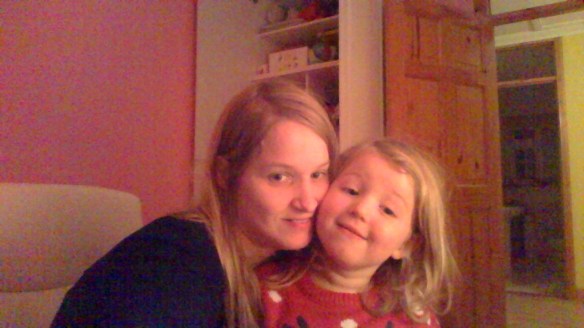
(Me and my little princess)

Sometimes the hardest thing about being a writer is writing about real feelings, about your reality. Once the words are out there, you’re opening yourself up to merciless scrutiny and possible criticism. But I’ve decided that in order to be free of the most horrible experience of my life, I have to write about it and share it with you. And I’m so happy that I’m finally in a good enough place to do it.

(written Wednesday 22 June 2016)

It is one o’clock on a Wednesday afternoon. All is quiet, now. We’ve spent the whole morning talking to a lovely woman who is interested in our story of how we, two parents with various degrees of Cerebral Palsy, found the whole experience of having Alison and whether we would have any advice for the so-called medical professionals if they ever come across a case like ours again.

We are not a ‘case’, of course. We are people. Real people with real feelings. Talking about how we were doubted when we had Alison and when we brought her home first is always draining. As a person who loves to bottle things up and have that bottle explode at the most inopportune times, talking openly and honestly about what is going on in my head is something I hate to do.

So why now? Well, maybe it’s because no matter how hard I try to deny it, the fact that I had postnatal depression will always be part of my identity. I will never forget how I was made to be so afraid that I had to go through it alone, even though I know that some friends tried to help me. They couldn’t of course. I had to help myself.

I was nine weeks pregnant when I self-referred to a physiotherapist and an occupational therapist. I wanted to be the best for my baby, I wanted to improve. I wanted to show people that I was capable. Deep down, I wasn’t sure if I would be. The last time I’d cared for a baby was when my little sister Alex, six years younger than me, was born. Dressing and feeding a doll wasn’t going to be the same thing, I knew that.

Anxiety lingered where excitement should’ve resided. Our Public Health Nurse started visiting when I was twelve weeks pregnant, asking questions that I didn’t know the answer to. How are you going to feed the baby? Change it? Carry it? (Apparently my plan to wheel the child around the house in a buggy was inappropriate; a sling was more suitable. How was I going to get the baby in and out of a sling?) It didn’t really matter – they had come up with a solution, they knew best. Sure what did I know? I wasn’t a medical expert, like they were.

But if they were medical experts, then I was treated like a medical marvel. We’ve never come across this sort of situation, I was told countless times. What did they mean, this ‘sort of situation?’ Surely I was just a normal woman, having a baby? I was told that I’d have to be under general anaesthetic to be sectioned, and it was only the week before the section when we discussed our concerns with the anaesthetist that a spinal was considered. Then there was the apparent issue of me being  left alone with the baby. I spent months trying to illustrate how, if I got help with basic tasks such as bottle making, washing and cooking, being alone would not be a big deal. I later heard about how everybody was apprehensive, watching me with bated breath, expecting me to fail.

Alison Mary Fitzgerald was born on the 9th February 2012 at 11.52am, weighing a sizeable 8lbs 4oz. She was, and remains, the most beautiful person I’d ever met. As I held her in my arms I was blown away by her huge blue eyes, her physical strength and her flawless, unblemished skin. Immediately after the birth the lactation consultant showed me how to breastfeed. I hadn’t really considered breastfeeding, nor had I any interest in it, but Alison took to it easily and I watched her ‘help herself’ it occurred to me that if I could do it, then I would always be useful. Even with my horrible, mangled body I would still be useful.  Even if I couldn’t do anything else for her, I could do this. And if I  was her main source of food, then no-one could take her away from me.

Warped thinking, yes, I know. But I wasn’t thinking straight at this stage anyway.

I was a fog of hormones, crying from hormones and  tiredness. But finally, everything was in place. We became claustrophobic in that small hospital room, the three of us, and by Monday, all I wanted to do was go home. There was no medical reason why this couldn’t happen. John Paul was staying with a friend and that morning, it was just me and Alison in the hospital room. I looked into the little cot and sang ‘Baby, now that I’ve found you’ to her, studying her little hands, her thick head of hair. I promised her there and then that I’d always do my best by her, that I’d always love her. just as I was doing this the anaesthesist came in, grinning.

‘Do you remember calling me a legend last Thursday?’ he asked. ‘I recorded it in case you don’t!’ He checked my stitches, which were healing  nicely. ‘So are you off today? There’s no reason why you can’t. You’re recovering well.’ My heart soared. The ward manager agreed.

‘You’re doing really well,’ she said, ‘and we need your bed. What time is your husband coming in?’

‘Ah, soon,’ I said, packing my belongings. ‘Can’t wait to go home!’ But I was nervous too. I’d never handled a newborn baby before, and here I was, her primary caregiver, and like so many first-time mums I didn’t have a clue what I was doing.

The trouble was that I wasn’t like other first time mums.

I was just after feeding Ali when the head midwife came in. ‘I’m going home today, aren’t I?’ I said excitedly, gesturing at the half –packed suitcases on my bed. The midwife smiled, her lips pursed and shook her head.

‘Not today,’ she said. ‘You see, we have… concerns that you might be a danger to your baby, that you might drop or hurt her. What we’ll have to do is ring your social worker, your public health nurse and the Centre for Independent Living again and just verify what supports you’ll be getting, see if they think you’re ready to go home.’

‘But I’ve already done all that,’ I cried, my words an indecipherable screech. ‘Everything’s organised. I spent my whole pregnancy getting everything ready. How can you say we’re not ready? I can’t believe this is happening…’

The midwife shook her head. ‘I can’t understand what you are saying,’ she said. ‘Can you take out your phone and text out what you’re saying, like we agreed last week?’

Tears fell out of my eyes as I looked at the perfect sleeping baby beside me. I could hurt you, I thought to myself. I shook my head dismissively and instead rang John Paul, not letting Alison out of my sight for a second.

‘You have to take her,’ I sobbed down the phone. ‘There’s no point. They won’t let me take her home. You take her, you look after her. I’m obviously the problem, so you take her.’

A startled and breathless John Paul burst into the hospital room fifteen minutes later. ‘All right?’ he said casually, looking at the nurse. ‘Sarah said that you won’t let us home with Alison…’

‘Oh no, that’s not what we said at all,’ the midwife gushed. ‘We merely wanted to make sure that you two would be fully supported when you got home. So the Public Health Nurse will be out to ye every morning…’ I waited for John  Paul to protest angrily, but he remained calm. ‘And she’ll be a great help, no doubt. We’ve also ordered Sarah a cloth sling which she can use to carry Alison in her wheelchair. It’s sixty euro, so…’

‘I’ll get that,’ John Paul said confidently, although I knew by his reaction  he’d no idea where it’d come from. ‘And all going well, we’re going home tomorrow?’

‘Of course,’ the midwife said, although I felt like a royal idiot at this stage.

Getting home, away from the maternity hospital, felt surreal. We arrived at our house where my P.A. had decorated the house with ‘It’s a girl’ signs. Our family was waiting inside, armed with presents for me and Alison. There was even lasagne, and cake from friends. It was lovely. But I still felt like crap, as if I’d escaped from prison and that at any minute the midwife would come and try to take me back.

And so I began the journey of motherhood constantly feeling like an imposter. As those early days wore on, I began to feel tired. The physical effort of breastfeeding took its toll, but I persevered nonetheless, determined to do it. It took me forty-five minutes to do a nappy change and outfit change, and the fact that Alison had reflux and spewed during each nappy change didn’t make the process any faster.

********************************************************************

My aunt informed me that now that Ali was born, I would always chart life events through the life of my child.

Alison was eight weeks old when I started to feel odd. I wouldn’t say miserable, and I didn’t think I was depressed. But I definitely didn’t feel like myself. I put it down to exhaustion, physical and emotional, as well as recovering from, as my aunt put it, major surgery.

One night, when John Paul was at work, I sat looking at  Alison in her buggy. She was crying frantically and I was bent over her, ready to pick her up. Suddenly I felt light-headed and the room started spinning. All I could see was Alison’s head smashing against the floor, blood splattering everywhere. They were right, I thought with trepidation, I can’t do this. I’m going to hurt her. I phoned my friend, and when she arrived I was holding Alison in my arms, shaking with the relief that she was okay, and that I hadn’t hurt her.

But one day I will, I thought, and they will take her off me for sure. It’s only a matter of time.

I say ‘one night,’ but in truth, there were many, many nights like this. And if it weren’t for this friend, I don’t know if I’d be writing this blog right now. She saved me from myself more times than I can count.

***********************************************************************

As part of my bail conditions, the Public Health Nurse came nearly every day, for nearly six months. We would try to look together, calm, pretend to know what we were doing. However, Alison had severe reflux which gave the Public Health Nurse the perfect excuse to drop by, sometimes twice a day, often unexpectedly, to weigh her. The house could be a tip. I could be wrapped in my purple and white bathrobe, curdled milk encrusted in my hair. To this day I firmly believe that Ali picked up on my nervousness, which in turn exacerbated her reflux to the point where she was throwing up whole feeds. She also had colic, but that was nothing compared to the pressure I felt to show people that I was able, capable.

‘Do you think it’s a cow’s milk allergy?’ I asked one day, as my heart ripped in two watching Ali spew another feed over yet another newly changed outfit. The Public Health Nurse smiled and waved her hand dismissively.

‘I doubt it,’ she said. ‘Do you know how rare that is?’

By Friday of that week, I’d had enough of this shit and brought Ali to the doctor, demanding a letter for the A&E in Mullingar, that I wasn’t going to be fobbed off any longer. It was the June Bank Holiday of 2012 and the hottest weekend of the year. We spent it in Mullingar hospital where the doctor finally prescribed Ali Nutramigen, a soya-based formula. I felt like kissing his feet in gratitude. Between the Saturday and the Monday Ali gained four hundred grammes and the heart-wrenching colic dissipated instantly. The colour came back to her face  and she became a happy baby, full of chat and smiles.

‘You see?’ my husband said as we came home from the hospital. ‘You are a good mother. You know exactly what you’re doing.’

I closed my eyes tightly and desperately wished it were true.

***********************************************************************

I went back to work in August 2012, for fifteen hours a week. Fifteen hours a week filled with anxiety, wondering how she was. Fifteen hours a week that I had to hand her over to someone else. Some days I would look forward to the break, until Alison left the office with the childminder. I knew I couldn’t have it both ways, but it was still so hard. It’s something I still struggle with, but I suppose every mother does, to some degree.

It was around this time that a horrible, mean voice moved into my headspace, and I was feeling too low and vulnerable to tell it to fuck off. Whoever this voice was, he/she/it was intent on destroying me. It was the voice that told me that I was going to drop Alison whenever I picked her up. The same voice told me that Alison was not safe in my care, that she would resent me as she got older because I wasn’t a normal mum. If I spilled something or knocked something over, the voice would never fail to criticise.

Alison turned one on 9th February 2013, and I’ve never felt relief like it before or since. Relief that I hadn’t caused her any serious harm or injury. Relief that she was home with us, celebrating her birthday in the company of friends and family. Relief that the first year was over. But I also felt anger. Angry that I had lost so much enjoyment with her because I was constantly worried about what others thought of me and my parenting skills. Angry that I would never be good enough for this little girl, no matter how hard I tried.

As Ali bent over her birthday cake and grabbed the flame, burning her little hand, I burst into floods of tears in front of my friends and family.

‘Don’t worry,’ my dad said, hugging me tightly. ‘Her hand is fine. She didn’t burn it too badly.’ I looked up at him and smiled, relieved that he didn’t know the real reason for my tears. Ali hadn’t been afraid to grasp that candle; she’d been strong and fearless. I’d felt that way too when I was pregnant. Now, all I felt was constantly afraid and so, so useless.

And my biggest fear was that somebody would guess how I was feeling, and threaten to take my little girl away from me. So I stayed silent, plastered on a smile and threw myself into the monotony of work and my daily routine.

***********************************************************************

I started to have thoughts of suicide, as they say, when Ali was eighteen months.

I’d no intentions of going through with anything, but I had it all carefully plotted out in my head, just as a back-up plan. Knowing it was there made me feel safe, happy even. (Don’t worry, there is no backup plan now. If there was there would be no way that I would even mention it on a blog).

John Paul and I would have a row, and I would storm out of the house, vowing never to come back. Sometimes I would take pills with me. Sometimes I would storm out and walk around for hours. I would come back. John Paul would say that I needed help, but we would both agree that we could not live under the scrutiny of nurses and social workers again.

He was tired, as was I. tired, and alone. So, so alone.

***********************************************************************

We moved house in 2014, to a bigger house with a lovely garden and lots of storage. And, it seemed, mirrors everywhere. We had no mirrors in the last house we’d rented and I found it difficult to deal with seeing my inadequate self everywhere I looked.

It was a tough year. My nephew died at thirty-four weeks gestation, which really affected me, having had my own baby just two years beforehand. I was grateful that Ali’s birth had been so straightforward, but also felt guilty because Kaleb’s should have been too.

Ali started crèche, which meant she was sick every week with one thing or another. It was an exhausting, sleep-deprived time. John Paul and I would stay up with Ali at night, then head into work the next day, frustrated when we weren’t able to function properly. And the voices spoke louder than ever, telling me I was useless, inadequate, nothing but a waste of space. I was constantly tired to the point where I myself was sick all the time.

One day I went to the doctor’s with swollen glands. I had had a tummy bug the week before, which had wiped me out completely. I sat in her surgery, answering the routine questions.

‘I can’t go on like this,’ I said. ‘I’m sick nearly every week, and I’m constantly tired.  I’m taking my iron. What the hell is wrong with me?’

‘That’s what having a baby does to you, I’m afraid,’ the doctor smiled. ‘Unless – well, how are you feeling in yourself?’

I stiffened. ‘I feel grand, great. Why?’

‘Sometimes physical symptoms can point to an underlying emotional problem,’ she said. ‘Has anything particularly stressful happened over the last while?’

‘Well, we moved house, and my nephew died this year,’ I explained. The doctor nodded.

‘That’s probably what’s causing it,’ she said. ‘Just try and take it easy.’

As I left the surgery, I thought of how one of my college friends had recently sought help for postnatal depression and how she had bravely posted about the whole experience on Facebook. And I remember reading it and thinking oh, if only I could be so brave. So strong. So honest with others, and with myself.

***********************************************************************

By July 2014, I was exhausted. I was ringing in sick at least once a week, and producing no work whatsoever in the office. All I could do was stare mindlessly at the screen, scrolling through random Independent Living sites, taking nothing in.

And I hated myself for this lack of productivity. (You’re nothing but a waste of space)

I would come home in the evenings, and spend time with my lovely daughter, playing on the floor with her, silent tears running down my face from the pains that radiated from every fibre of my body. (You will never be good enough for her)

I wanted my house to be perfect, my daughter to be perfect. But how could that be when I wasn’t perfect? When I looked in the mirror, all that I saw was a deformed nobody, an imposter waiting to be exposed. I was a terrible wife and mother, and I was convinced that the two people I loved more than anything in the world deserved better.

‘Where do you think you’re going?’ my husband asked, his face shocked. It was half one in the morning, at the end of July and I had been in bed. Now I was awake, looking at him from the doorframe of the sitting room, fully dressed under my bathrobe. And all I saw was mess. In reality, it was a couple of dirty dishes, but it might as well have been thousands of dirty dishes; I hadn’t the energy to deal with them. If only someone had given me the memo that a couple of dishes wouldn’t signal the end of the world, but there and then, I couldn’t deal with it.

I couldn’t deal with anything.

‘I’m off,’ I screamed, jumping into my wheelchair. ‘And you can go and fuck yourself for all I care. I won’t be back. I mean it this time.’ John Paul tried to stop me but I tore out past him and headed out into the darkness. I didn’t know where to go so I wandered around aimlessly for hours, watching the cloudy sky gradually become brighter. The grey haze enveloped me as I sat beside the canal, and cried, and cried and cried.

Later that morning, I went into work, sitting mindlessly in front of my laptop. After about an hour two of my colleagues collared me.

‘You look dreadful,’ said one, surveying my dark circles. ‘Something has to give. You can’t go on like this.’

‘You need a break,’ agreed the other. ‘Before you crack up.’

My initial reaction was oh shit, I’m going to lose my job, but they were right. I couldn’t go on like that. We agreed that two months off work should help me to feel like my normal self.

Within two weeks of being off work, I felt more like myself again. which was odd, because I thought that I would hate it. I absolutely loved being home with Alison, and getting to know her better.

And then, I started writing again.

It began as a few words here and there in an empty Word document. As the weeks wore on, I began to write out the thoughts in my head, and they didn’t look as stupid as they sounded in my mind. I wrote exactly how I felt, staring at the words until I smiled. This was how I felt. And as I explained in a previous blog, I began to understand why I’d felt so shit; so many things had happened that I’d repressed, including the death of my mother and the way I’d been treated after Ali was born. I started to blog about them and it made me feel happy and peaceful in a way I hadn’t felt in years.

***********************************************************************

I didn’t write this very long preamble because I want sympathy. I wrote it so that I can say that that horrible part of my life is over. I’ve never been happier, although loving myself is going to take a bit longer. I still have bad days, but everyone has; none of us are perfect. The main reason I’ve written this, however, is because it breaks my heart to think that there might be other women out there, suffering as I did, afraid as I was to speak out and ask for help. I know it’s easy to say this now, but there is no shame in having PND. It’s an illness, a horrible, horrible illness, and nobody should have to wrestle with it alone. And if you’re reading this and can relate to any of the above,  please ask for help. I’ve heard that there are so many great counselling services out there and I’ve read and heard so many success stories. Don’t hold off – just do it. You are worth so much to so many people.

Most of all, you owe it to yourself. Because despite what those head demons are constantly trying to tell you, you’re actually pretty damn fantastic. You really are.
Enough is enough

I’ve decided to take a career break from work. Six months, to be exact. It’s something that I’d been toying with for a while but couldn’t quite bring myself to do. I work in the area of Independent Living and I’m passionate about the rights of people with disabilities. I love working with my fellow leaders. But I also love writing, and I want to have more time with my daughter, so I’m off. And it is blooming scary, I tell you. Not only because I’m not bringing in a wage, but because I’ve always worked, it’s a crucial part of my identity.

That said, I will never regret all of the time I’m enjoying with my daughter, who is now three-and-a-half and great fun to be around. She’s energetic, imaginative, cheeky, and growing up all too fast. I admit that there was a time when depression clouded my time with Ali; everything seemed hard, an effort; I didn’t think that I was enough for her. But now that I feel more like my old bubbly self again I intend to enjoy every second with her.

Since Alison was born, I’d always been afraid that I’d never be good enough for her. I was overly conscious of how I was perceived as a parent with a disability. I worried that Ali would resent me for having her, that I would become a burden on her. I’m not at all afraid of this now. Today, Ali and I walked to the shop alone together for the first time, me in the wheelchair holding her hand, her on the inside of the path. It was the best feeling in the world, because heretofore I wouldn’t have trusted myself to do this. I am finally starting to see myself through my own eyes again, not through the eyes of others.

It’s amazing how we expect so much of ourselves, but we never step back to admire what we have done. We don’t have time, we are too busy, it’s not enough. For example, I told myself that I would be an established journalist with my first novel written by the time I was thirty. I wanted to be fit and able to walk everywhere unaided so that I could keep up with Ali. Since turning thirty, I’ve been bitterly disappointed in myself that I’ve done neither of these things. It was more than disappointment, it was pure disgust, self-abhorrence. It sounds dramatic, but for months I could barely look at myself in the mirror without this disappointment washing over me.

Recently, however, something changed. And for all the things I teach my daughter on a daily basis, a month ago, she taught me the most important lesson of all.

It was evening-time. Ali and I were watching telly and I said to her, ‘I love you,’ to which she replied, ‘ I love you too mummy’. I thought for a moment. Lately, I’d been feeling grossly inadequate: I’d been in too much pain to play football, too tired to play chasing and I’d say she would have baulked at the sight of another defrosted spag-bol, cooked in bulk about a week before. ‘Ali,’ I said, ‘how would you like a new mummy?’

Ali was intrigued. ‘A new mummy? Is she nice? Who is it?’

I replied, ‘I don’t know yet. But this mummy would be super cool and play football and basketball and chasing and tie up your hair and do your buttons and go for walks. Well, what do you think?’

Ali shook her head and looked at me, placing her small hand gently on my shoulder. ‘I don’t want a new mummy. I just want you.’

Pathetic that I should need such reassurance from a three year old, but little does she know that those four words, ‘I just want you’, have changed my life so dramatically. Physically, the aches and pains seem to have faded significantly. I have more energy and a new positive outlook on life. I feel I can do anything because this little person looks up to me. I just want you.

And being so happy has made me realise that my fantastic husband is still my best friend. He has been incredibly supportive and just wants to see me happy. He is more than happy to see me tapping away on the laptop, trying to come up with literary masterpieces. He never tells me that I am crazy or deluded, though I am probably both!

From an early age, we are encouraged to compete against each other. In school, we are encouraged to study hard in order to be the best. Even under-tens partake in handwriting competitions, poetry competitions and art competitions, we have sports competitions. When we are eighteen, we sit the most competitive exam invented, the Leaving Cert, in order to get high points, to be accepted into a course so that we can pursue a challenging career. We push ourselves to be the best employees, the best friends, the best partners, the best parents, often to the detriment of our physical and emotional health.

And now, I’m saying enough, or more specifically, that I believe that I am enough. I will still give my all to everything I do, but I won’t be beating myself up if I don’t succeed. Today, at least, I feel happy and free, and if my daughter and husband still love me in spite of the self-berating and toing and froing I’ve been doing over the last few years, then I must be doing something right.

Schooldays

A couple of weeks ago, John Paul and I finally got around to dropping in the enrolment forms for Alison for primary school, which she is due to start next year. We’ve spoken to lots of parents about their opinions of what school might be best, and based on this we have nearly decided which school would be suitable. I’m not telling, but needless to say, standards and class sizes are factors in this important decision. As long as Alison is happy, I don’t really mind. Her happiness is everything to me.

Enrolling Alison in primary school has brought back memories that I thought I’d long forgotten. I started school in September 1989 at the age of five. I obviously don’t remember this myself, but I know that my mother had to beg the principal to let me into the school. There was a ‘special class’ on site in prefabs, which would’ve been suitable for accessibility reasons but stood separate from the main school building. My mother wanted me to be integrated as much as possible and finally, after much coercion, the principal agreed that I could join Junior Infants, specifically Mrs. Dowling’s class.

Mrs Dowling was so kindhearted and soft that I couldn’t believe my luck. On my first day of school I sat beside a girl called Emma, who remained a close friend all through primary and secondary school. I was a novelty, but school was the first time that I felt any different from my peers. I had to be wheeled about in a buggy for my first year in primary school. Children would be told, both by teachers and parents that ‘Sarah is very delicate and walks differently from other people.’ Delicate, my hole. I was clumsy, but sturdy. Yes, I was easily knocked over, but I could pick myself up just as easily. After a while, it was more like ‘Get up off the floor Sarah, you look like a tool.’

Indeed, I don’t remember primary school as being one of the most dignified times of my life. I remember in Junior Infants there was a box of old trousers and underpants under the teacher’s desk, in case somebody had an accident. If ever there was an incentive not to soil yourself that was it. God only knew who had been wearing those pants beforehand.

As if being wobbly and misshapen wasn’t quite enough to separate me from the pack, I was awarded an electric typewriter, possibly a state-of-the-art machine at the time, that sounded like it was coughing every time a letter was pressed, and a machine gun every time the eraser was activated. Because my speech was seemingly unintelligible, the typewriter doubled up as a communication device. I think I ended up costing a fortune in ink! There were no laptops at the time, but there were Acorn Computers which needed lots of complicated codes to access. These were only available in the Resource room at first, but soon there was a computer per classroom.

It was in primary school that I started to develop a lazy work ethic, and I think being sternly corrected for my antics have left me with a phobia of being lazy or not reaching my potential. In third class, I told the substitute teacher that my parents had decided that I shouldn’t have to do homework because they were afraid that it would tire me out. I got away with playing computer games for a whole month because I acted as if I was so stupid in class that the sub evidently thought that there was no point in teaching me. Needless to say, that when my parents were confronted about my antics, they were so mortified that they couldn’t summon up a punishment severe enough. Actually, this is untrue; until the day she died, my mother would casually bring up this particular incident in order to frighten me into achieving my potential.

I also went through a delightful phase (that only ended towards the end of first year of secondary school) of wanting to write down everything by hand. I wanted to be like everyone else, and if my disability wasn’t enough to stop me getting homework, then at least I should be able to write with a lovely fountain pen just like my classmates. Problem was, of course, that teachers are not trained to read Ancient Greek. By the end of first year, I succumbed to using a laptop and computer for classwork, but only because it was a modern Windows 95 and not the ‘abomination’ with the illuminous green screen that had been donated by Dad’s work colleagues. I would have nightmares about pressing the wrong button and breaking it. Even now, my parents don’t believe me.

I wasn’t really allowed partake in mainstream PE, but I was given a gym mat in the corner where I could do my physio while the others played games. Hmmm, fun. Not. However, I did enjoy a few sessions of Irish dancing in my older years, and I was allowed on the trampoline a couple of times. Needless to say, however, I was not chosen for the basketball teams. As I got older, I was allowed to bring my tricycle into sports day at school and I would spend all day cycling around the town park, cheering on my friends.

Indeed, primary school wasn’t all ‘doom and gloom’ and I remember crying for days when I left sixth class. It was in primary school that I decided, with some conviction, that I wanted to be a writer. Primary school taught me that with equality comes responsibility, and that if I wanted to be respected and treated with dignity and credibility, I would have to prove that I was worthy of this. I also learned that being outside the ‘popular’ circle was not a bad thing, and I never felt pressured to be anyone but the needy social misfit that I was (am!)

And now, as my precious daughter grows older and nears her own primary school adventure, I hope that she makes her own memories that she can look back on with fondness. I hope that she won’t get teased in the yard for having ‘wobbly’ parents. Most of all, I hope she has fun. Though if she could find fun in activities that didn’t involve manipulating her teachers like her mother did, I’d be grateful.

The Sarah Fitzgerald Guide to Raising Toddlers

I would like to reiterate that prior to having my beautiful daughter, I knew nothing about children. I didn’t know anything about pregnancy, childbirth (I now think this worked to my advantage) or caring for a newborn. In fact some evenings, when I tell my husband that I’m working or ‘studying’, my mind wanders and I somehow end up on Google looking up ridiculous things such as ‘normal three year old development’ and ‘how to encourage your toddler to read’. Yep, I’m a little crazy, but Ali didn’t come with a manual and I don’t always know what I’m doing. Do ye?

The best teacher, of course, has been Ali herself. Of course, it’s my job to teach her right from wrong and how to be a sensible, well-rounded person, but she has also taught me so much about the world around me and how to best respond to her needs. I’m not sure if any of the following skills can be applied beyond the privacy of our house, but for those of you with kids that are three or younger, you may/may not find the following advice useful:

*The following is copyright of yours truly and cannot be found on any internet site*

  • You will suddenly find yourself unashamedly fascinated by your child’s toileting behaviour. Pervy? A little, but unfortunately necessary. If you are lax it may result in a disgusting accident that I imagine my childless friends would have nightmares about. For parents of toddlers, it’s just another day at the office. My daughter won’t let me into the bathroom until she has done her business, but the conversation between her, and I standing patiently outside the door, usually goes like this:
    Me: What are you doing, wee or poo?
    Her: Wee
    Me: Did you wipe your bum?
    Her: I’m already dry.
    Me: WIPE YOUR BUM. I’m coming in to help.
    Her: Don’t look at my bum.

On a related note, the luxury of privacy is not afforded to me when I need to go for a piss.

Me: Can you wait outside please?
Her: Mummy, I love you.
Me: I know. I’ll be out in a sec.
Her: Wee or poo? Oh I hear a wee, good girl mummy!

On another related note, sniffing a stain to ascertain if it’s chocolate or poo. Without reservation.

  • Toddlers are particular. Sometimes Ali gets a notion that she can only drink out of a pink cup. She has to have a special pink teddy going to bed. And if you tell them to eat three more bites, they will only eat three more bites.
  • Toddlers don’t understand ‘Mummy’s tired/sore/too lazy to play with you’. Not only do they want you to play with them, they want you to become fully involved in their imaginative play. Now don’t get me wrong, kids are kids, but there is something degrading and plain wrong with crawling on your hands and knees around the garden and mewing like a cat/barking like a dog. What, don’t tell me I’m the only one that does that? Ye haven’t lived!
  • Young children tend to imitate what they see and hear. I was getting a little frustrated the other day and said to Ali, ‘Right, let’s swap places. I’m Ali, you’re mummy.’ Excited by this new game, Ali readily agreed. When ‘mummy’ asked ‘Ali’ to eat her dinner, I said ‘no, don’t like it,’ and pushed away the plate, and  ‘mummy’ responded by saying ‘right. No Jumping Jacks and no playschool any more’ and I just thought to myself,  ‘wow, I am so annoying.’
  • It’s against every rule in the book, but occasionally you will have to resort to bribery. Recently, I promised Ali a few Buttons when she ate all her dinner, and by God, the second the last morsel crossed her lips, she instantly asked for the Buttons. Sometimes, Ali can be disappointed. For example, just tonight I was encouraging her to put on her own PJs and hearing my hubby come into the house, I said, ‘I have a surprise for you’. she put her pyjamas on faster than lightening and her daddy came in, delighted to have made it home for bedtime. Ali looked at him and said ‘where’s the surprise?’ to which John Paul replied ‘I am the surprise’. Thinking we were joking, Ali smiled and said, ‘No, really.’ I felt the love. I know JP did too.
  • Toddlers/young children can be a little economical with the truth. A few months ago, I caught Ali drawing on the floor behind the couch in the sitting room. I of course hit the roof, but Ali said, ‘no mummy, it wasn’t me, it was my friend’. (Ali was holding the marker in question in her hand at the time, and her friend wasn’t in the house, at all). She also told an elaborate lie one evening about a cat who broke into the house and stole her good flowery jacket and carried it off to his family. Damn you, neighbour’s cat and your jacket-stealing tendencies.
  • Toddlers can also be very sensitive. Around the time of my mother’s anniversary, I was a bit teary and Ali discovered me crying in the kitchen. ‘Mummy, what’s wrong?’ she asked. ‘I miss my mummy’ I explained. ‘Oh, here’s a big hug and a magic kiss, and now you feel all better.’ Little hug. Silence. ‘Mummy, are you okay now?’ ‘Yes hon’. ‘Great, you’re Elsa, I’m Anna’. (on a bad day, I’m Olaf the snowman).

Ultimately, raising a toddler has been one of my most interesting and insightful experiences to date, and while I may not always get it right, we all have fun learning through our mistakes. And Alison has tremendous fun testing the boundaries. Well, they say kids learn when they’re enjoying themselves, right?

Alison has not only taught me how to be her mummy, but also how to be a better person. I’ve become more patient, more understanding, gentler (to Alison, anyway. JP may beg to differ). Most importantly of all, she gives me great hugs and superb writing material, so thanks hon. Love you! xxx

Just a date

It’s funny how the human mind can make associations, how a chill in the air or a familiar smell can wash over you and bring you back to a time and place that you thought you’d never have the good fortune/grave misfortune of experiencing again. For example, when I see my own breath fog up against the black sky for the first time every October, I know that Halloween is just around the corner, with Christmas nipping furiously at its heels. I know as I chomp on a contraband Easter egg after Alison has gone to bed at night that the slight red tinge in the sky is signalling the arrival of summer. I smell the barbecues, the freshly mown grass, the faint titter of laughter wafting gently through our windows.

And despite the improvement in the weather (well, normally. At the moment it is freeeeezing), I begin to feel cold, heavy, wary. Sometimes I feel sick with restlessness and anxiety as memories, good and bad, swoop in and strangle me until I can’t breathe. May used to be my favourite month of the year, and in many ways, it still is. For me, May signifies the beginning of the end of school and college. It reminds me of a photo that was taken of my brother and I when I was five, celebrating my brother’s ninth birthday on 18 May, just me and him, with an icecream log. Mum wasn’t there because she was recovering from her c-section; my sister had been born almost a fortnight beforehand, on 7 May 1989.

Exactly twenty years later mum closed her eyes for the last time.

I’m sure that it’s an absolute bitch for my sister to have to share her special day so selflessly. I’m sure that no-one wants to sit around moping on their birthday, getting all maudlin about the past. Birthdays should be happy days. Personally, though, I’ve always found birthdays to be a bit of an anti-climax (apart from my 21st when John Paul proposed in front of my family and friends. That was an awesome birthday), to the point where I would actually rather if the day came and went without being marked or acknowledged at all.

And for years I felt the same about my mum’s anniversary, which I try in vain to separate from my beloved sister’s birthday. Can the two be separated? It’s a struggle every year to experience such happiness and sadness at once. How have I managed it? Trying to pretend that the anniversary didn’t bother me, that’s how! Oh so it’s mum’s anniversary today? Well, she was dead yesterday and she’ll still be dead tomorrow, so what difference does a date make? It’s Laura’s birthday, let’s not forget that!

Trying to deny the sadness didn’t work for me in the long run, and last year five years of suppressed emotions hit me suddenly like a freight train. I had to take a considerable length of time off work to feel normal again. Note to the readers: don’t bottle up your emotions. They will come back when you least expect and bite you on the ass. Hard.

For the first couple of years after mum died, I went through the motions. For the first anniversary, I insisted on holding lunch in our house after the anniversary mass for all my relatives so that I didn’t have to face my emotions. It worked; I was so busy in the lead up to the event that I barely had time to think. The second anniversary, I stood beside the grave with my aunt, husband, sisters and brother, then proceeded to go out that night and get wasted (in the name of celebrating Laura’s birthday of course). By the third anniversary, I had an almost three month old baby with terrible reflux and I spent the whole day crying because I felt like an inadequate mother. I had been so hard on my mother and yet, she managed to raise four of us. At that stage, I was seriously debating whether I had it in me to raise one.

Yet somehow mum was there, guiding me. Some days, it just wasn’t enough. I needed to hear her voice. I longed for the opportunity to ridicule her childraising advice. I wanted her to tell me I was doing something wrong, nagging me to the point where I’d lose it and ban her from seeing her only grandchild. I needed her to remind me that I was not alone. And she did, in her own way. I managed to push past the fear and the preconceptions I had of myself, and do the very best for my child, the way my mum did for me.

This year, I will try to embrace the date and try not to suppress my emotions. I promise to allow myself to feel the dread, the sadness, the emptiness. I will grieve for what we lost, as well as what we could’ve had. Most importantly, I will remember that the 7 May is a day of happiness and celebration, and acknowledge that people enter and leave our lives in the strangest of ways. And even though this day is tough, simply because of a date on a calendar, I will be thankful for the fact that I had such a wonderful mother who gave us a sibling who is intelligent, beautiful and loving. (Laura, I can hear your head exploding from here).

For me personally, 7 May will always be a strong reminder that good things happen, and bad things happen, and after they do, all that is left are memories, both beautiful and terrifying.

Rest in peace Mum, and thank you for bringing Laura into all of our lives. I think of you and miss you every single day. And happy birthday sis, make sure you fill your special day with lots of wonderful memories. xxxx

The scourge of the ‘Mummy Wars’

It is the greatest privilege in the world to be a mummy, though there are days when I ponder why God (the higher power I believe in) would allow such a fickle, clueless woman such as myself to have children. I’ve said before that prior to having my daughter Alison, I did not have the slightest clue what raising children involved. My hesitancy to have children was directly related to my complete lack of knowledge of what was involved. I was certain that it was hard work; I had many a friend bemoan to me about how they had become social pariahs since having children.

I knew also that there would be sacrifices when having children. I was told that I would always be broke because the cost of nappies and formula is ridiculous. Children also tend to outgrow their clothes and shoes quickly. Then there’s the cost of childcare, school and, eventually, college. I mean, why bother? All the little brats seem to do is sap all of your financial resources!

If I was totally unprepared for the role of care-giver, then nothing could have prepared me for the phenomenon of the judgemental mother and the power that other mothers had to make me feel shit. Some say that there is no right way to parent, there are no rules. This is a lie: there are too many rules and the goalposts are constantly shifting. You can’t do right for doing wrong when you are a mummy.

The question mummies seem to get wound up about the most is whether or not they should be out working. Because women are choosing to delay having children until their careers are established, many are reluctant to leave the workplace when junior arrives. It wasn’t too long ago in Ireland that women had to leave their jobs once they get married. Now, despite having the option of staying at work, many mothers struggle with the guilt of missing out on precious moments with their children. This tug-of-war is compounded by the ridiculous cost of childcare, which leads many to question whether they are doing the right thing.

Alas, are mothers ever doing the right thing? Why do we, as mothers, judge each other so harshly? Is it mainly to validate our own choices? And unless these choices are adversely harming our children, why do we feel the need to justify them?

It seems that you can’t win in the mum world. If you are a working mum, you are judged as being selfish, farming your children out to be minded by other people while you pursue your career. If you’re a stay-at-home mum, you should have time to keep your house spick-and-span, your children spotless and a nutritious meal cooked from scratch every evening. If you wear comfortable clothes, such as trackies, you obviously don’t give a shit about your appearance. But if you decide to dress up, or ‘do’ your hair and makeup, you have too much time on your hands, time that could be otherwise invested in raising your children.

A campaign was launched in the US in late 2013 called ‘End the Mommy Wars’, which encourages mothers to be proud of their own parenting choices and not to judge the choices of other mothers. As part of the campaign, mothers were photographed holding placards such as ‘I breastfeed’, ‘I formula-feed’, ‘I work outside the home’, ‘I’m a stay-at-home mom’. These women are trying to remind us that each mother has their own value system, and try to do what is best for their children based on this belief system. None of these choices are ‘wrong’ but they are intensely personal. The campaign aims to deconstruct the ridiculously high standards mothers set for themselves and others and instead to support each other and to understand that our way of parenting isn’t the only way.

Pressure on mothers is both external and internal. Every day, we are bombarded by images of the glamorous mother in the media; the mother who has time to get her hair and nails done; the mother who juggles five bags of shopping and two smallies with her mobile phone; the mother who runs her own business in between baking organic cookies with her kids. Let me tell you that the stay-at-home mum in her trackies who is constantly wiping puke out her hair and spends the day cleaning after a mini hurricane and hoping to God that the brown smudge on her jeans is chocolate and not poo (again) is equally as deserving of our respect.  Other mothers are increasingly yardsticks for us to measure ourselves against, and invariably we either don’t meet the invisible, ambiguous standards, or we feel superior to others, as if others’ shoddy parenting somehow justifies the choices we make for our own children.

I often wonder how strong this tug-of-war was between mothers in the ‘eighties. My mother isn’t around to regale me with such tales, but I’ve read accounts on the Internet and from this I’ve devised an unrealistic utopian lifestyle: mummies from the same neighbourhood befriending each other and inviting each other for coffee; in the absence of work, mothers needed to meet each other to stay sane. I remember my mum exercising her intellect with our neighbour Patricia, over Scrabble and cups of coffee. I remember Alice and Maureen popping in for coffee or wine, depending on what time of the day it was (although sometimes the time of day didn’t really matter !). Mum’s not here to answer my questions but I wonder did she feel the pressure I and other of my generation feel now. (Anyone who would care to admit that they’re of mum’s generation are welcome to discuss this in the comments section).

As a child, I remember us three girls wandering the streets of our estate on our bikes, sometimes till 10pm on a summer’s night, with no mobile phones to let the folks know that we were okay. And yet, despite our mum not being a helicopter parent, we kids turned out okay. I’m not sure I’d have the confidence to let Alison have the same kind of freedom. Every day it seems a child is abducted or goes missing. God forbid, if a child were to be abducted, who is at fault? Do we sympathise with parents, or judge them for their carelessness? I know I would probably judge, so what does that say about me?

I have spent three years of my life trying to be perceived as a capable and worthy mother for my little girl. I went on television to talk about how acutely aware I was of how people judged me for being a disabled mother, because I was worried that people would think that my daughter would be deprived in some way. But deep down, I don’t think I was trying to prove anything to anybody other than Alison. She’s the only person who will ever be able to say whether or not I am a good enough mummy for her. At the end of the day, every mother wants to do the best by their child and hell, it’s difficult enough pandering to the every need of your children without constantly wondering what the woman across the street thinks.

Enough.

I may not be the perfect mummy, but I will always strive to be the best I can be. I know this applies to every single mummy I know.

(Psst, you, yes you, well done. You’re doing a great job. Let’s hold each other up instead of tearing each other down).

[S1]