National Carer’s Week 12-18 June

This week  (12-18 June) marks National Carer’s Week, which is an initiative designed to give recognition to the estimated 180,000 unpaid carers across the country. These people are hailed – and rightly so – as heroic. Many carers have given up dreams of marriage, having a career, maybe juggling caring with raising a family. It’s noble and admirable, yet I find something deeply troubling about the narrative surrounding carers in Ireland.

I probably don’t have any right to be writing this blog.  I’m lucky insofar as my care plan doesn’t currently involve intimate personal care, just help with things like tying up hair, doing buttons etc. I mentioned before that one of the things I value most is my independence. That, and not being labelled a burden.

As a mother of one little girl, I’m ready to plop myself on the couch by eight o’clock in the evening. I love being a mother more than I ever thought I could, but sometimes it can be exhausting – answering incessant questions, doing role plays, going to the park. And this is without having to take care of toileting needs, inserting feeding tubes or anything like that. BUT I would hate to be in that dangerous position where I would view my own daughter more as an object of care than her own little person.

Traditionally, when a disabled person has a child, it is often assumed that the child will take on the role of a carer. Well, let me tell you – Alison has her little chores for which she gets rewarded, but she is not a carer. I have an excellent personal assistant service (not carers) that enables me to be the best mother I can be. I myself direct the Personal Assistant in what I need, and doing so allows me the energy during the day to write pointless blogs like these and spend some quality time with my daughter in the evening. And it allows my husband to enjoy an existence separate from me. I don’t have to worry about him harbouring resentment for me, because I’m not completely dependent on him. We are very much an average husband and wife.

It is harmful to reduce the identity of a person who has ‘high-dependency needs’ to an object of care. Everyone has the right to personal autonomy, to choose how and where they spend their day and with who. I know if I had ‘high dependency needs’ I wouldn’t want my parents, my husband or my child caring for me. I’d want someone fresh, not so emotionally involved, someone who could appreciate my individuality as well as know how to meet my needs. These sort of people are hard to come by. A FETAC Level 5 in Healthcare Support is useful from a practical point of view, but there is a danger that service provision is becoming overmedicalised, with less emphasis on finding out what the person actually wants and more about ticking boxes and providing a basic care plan and often wholly inadequate service.

If this government really cared about the needs of disabled people and their carers, then they wouldn’t dare contemplate cutting the Personal Assistant Hours or the hard-to-come-by Respite Grant. Instead of having a tokenistic approach to unpaid carers by dedicating a measly week to them, the government could alleviate the workload of carers by looking after the needs of the disabled person themselves and, as the late Martin Naughton suggested, allocating them funds so that they (and their families if appropriate) can choose the services they need. Martin called this putting disabled people ‘in the driving seat of their own lives’.

I’ve spoken to people over the last number of years who regard the possibility of acquiring a disability or impairment as ‘a fate worse than death’ and who, like me, would hate to become a burden on their families. But this attitude is a dangerous one. Centuries of conditioning has led us to believe that it’s our impairment that is the problem, and it’s not. It’s the manner in which Irish society and our healthcare system are constructed to make disabled people feel like they’re somehow ‘wrong’, problematic, inconvenient. We are now the only EU member state that hasn’t ratified the UNCRPD. In the UK, disabled people who cannot work are labelled ‘scroungers’ and I can see that attitude creeping in here now. I now believe that positive change is not progressive, and can be undone more quickly than it happened in the first place.

To all of you unpaid carers across the country: I salute you, and keep up the good work. You deserve recognition, not only this week, but every single day. But can I ask a favour? Please join us in challenging the system. Please don’t resent your loved ones for the care they need. They are not at fault. All of our lives would be so much easier if the dignity of disabled people and their carers were upheld through the provision of basic human rights.
 

Enda the Line


Finally, after what seems like an inappropriately long wait, Enda Kenny stepped down as party Leader of Fine Gael at midnight on Thursday 18 May, and a new party Leader will be announced by the 2 June.  And predictably, many people in this country, including myself, are reflecting on the work (or damage, depending on who you’re talking to) he’s done over the course of his time as Taoiseach. Many of us will not be sad to see him go, especially the many people with disabilities that he’s let down so badly over his term.

Now, I am not saying that by any means that Enda had an easy job. Nor am I denying the fact that his predecessors, Bertie Ahern in particular, left a massive mess behind that Enda would have to clean up. However, during Enda’s time as Taoiseach, I have witnessed a frightening change in the narrative of disability in this country. Perhaps it’s merely age-acquired wisdom, because I don’t remember feeling this trapped as a disabled person during the early noughties. I went to college, I found it easy enough to find summer work and for a very brief period, I was even naïve enough to view myself as equal: willing to contribute to society and worthy of respect for it as a result.

I was just watching an interview activist Joanne O’Riordan had with Gay Byrne’s RTE series The Meaning of Life, in which Joanne discussed her experience with Enda Kenny. Kenny had promised her that the funding for P.A. (Personal Assistant) Services would remain untouched, and then turned around and delivered the blow that a whopping €130million would have to be taken from the HSE Budget, including a €10m cut to the P.A. budget. This soul-shattering announcement demonstrated how little our Taoiseach thought of our lives. This announcement drove activists with disabilities to sleep out in the cold for three days outside Leinster House until these cuts were reversed. It was both a victory and a slap in the face for people with disabilities, because although we were listened to, we realised that we would always have to take drastic measures to have our voices heard.

I worked in the area of Independent Living for seven years, and Enda Kenny was Taoiseach for four of those (since 9 March, 2011). Part of the reason I made the tough decision to leave my job in 2015 was because I found it too difficult to watch, as I saw it, the degeneration of the Independent Living Philosophy. When I joined Offaly CIL first, I was told to have passion. I was encouraged to get excited about equality for people with disabilities, to see the Personal Assistant Service as the key to achieving this equality. I was told that Independent Living was about freedom, control, choice. It was a liberating service with its own unique history and philosophy.

For me, Enda Kenny’s government destroyed all of that. Suddenly, service provision was about a hierarchy of needs, and the service became more about covering the basics rather than encouraging ability and individuality. When I spoke to people about this great ‘philosophy,’ I felt I was lying to them. I would ring my fellow Leaders and ask them to come into the office for a coffee and a chat, and they would tentatively ask me ‘are my hours going to be cut?’ I have to hand it to Offaly CIL, they did and still do resist cutbacks and they go above and beyond to protect Leader’s hours. But it infuriates me that because of Enda Kenny’s nonchalant attitude towards disability that my fellow Leaders continue to live in fear.

I’ll never forget reading the coverage of the three-day protest Martin Naughton led outside the Dáil in 2015 (unfortunately, I was out of the country at the time – yes, I really am just an armchair activist). Martin was asking for the opportunity for people with disabilities to have more control over their own lives by allowing money normally paid directly to service providers to be redirected to the experts, the person with the disability. The protest bore little results apart from a lot of negative press about Enda Kenny, with people by now being so annoyed with him that the focus from the public was more about what a complete tool he is as opposed to what Martin Naughton was asking for (the right for people with disabilities to truly experience Independent Living, in case you’re in doubt). And yet, even after talking to Martin and other disability activists, the future of our lifeline – the Personal Assistant Service – is constantly in jeopardy.

Oh, one more thing – some of you out there think that Leo Varadkar should take over as Taoiseach. And perhaps he should, but I’m personally a bit wary. Aside from the fact that our health system is currently a shambles, a report entitled ‘Make Work Pay for People with Disabilities’ recommends that people with disabilities keep their medical card, as well as raising the current cut-off point of €120 before they start to lose their Disability Allowance. Now, don’t misinterpret me – this is great progress – but given that a report from Inclusion Ireland in 2014 estimates the weekly cost of disability to be €207, it seems that there is a long way to go before people with disabilities can expect a decent quality of life. Also, there is a fear that this system could force people into work that they are genuinely incapable of, a bit like what’s happening in the UK at the moment.

So goodbye, Enda Kenny. Undoubtedly you did many great things for many people across Ireland during your time. You’ll have to forgive the disabled population of Ireland for struggling to remember exactly what they were.

And a quick message for your replacement, whoever you may be: We as people with disabilities have put up with enough shit over the last nine years to last a lifetime. We definitely are not in the mood to tolerate any more. Just thought you should know that.

I’m only human, after all…

TMI alert, people: I’m currently in the middle of my, shall we say, ’emotional’ time of the month. And as every woman out there knows, during this period (pun intended) we can become irrationally angry or overwhelmingly emotional for no apparent reason (but hey, isn’t that what chocolate is made for?) Anyway, there is a point to this, I promise. Stay with me.

My husband, my daughter and I were travelling in the car on Monday when ‘Human’ by Rag’n’Bone Man came on the radio. Of course, being an emotionally unstable female, I was instantly in floods of tears, much to the surprise of my husband who nearly crashed his car in shock.

‘What’s wrong with you?’ he blurted out, while I wiped my tears. I shook my head.

‘It’s crazy time again,’ I joked as I tried to compose myself. But there was more to it than that, and he knew it too. And I didn’t have the words to explain. I do now, though.

The energy of the song and the repetitive line ‘I’m only human after all’ brings to mind what’s been going on in the media over the last few months with the remains found in the septic tank at the Mother and Baby Home in Tuam. Like many of us I feel sick as I think about all those women, both young and old, who gave birth to their babies and never knew what became of them. It’s likely that some, if not most of these pregnancies were unplanned, and instead of being supported these women were disgraced, disowned by their families, and left in the hands of the nuns. You’ve read some of the stories, I’m sure. It’s truly harrowing stuff, and it’s been playing on my mind for the last two months.

How can we claim to be compassionate when we don’t even allow people to be human?

I live in a country where my rights as a person with a disability are not protected. This is because something called the United Nations Convention on the Rights of People with Disabilities (or the UNCRPD) hasn’t been ratified by the Irish government. In theory, this Convention guarantees that no person with a disability should be forced to live in an institutional setting against their will. It guarantees access to Personal Assistance as a right, not a privilege. Those who have ratified the Convention (and Ireland is the only EU country that hasn’t) are answerable to the UN if human rights are breached. With constant threats of cuts to PA hours and people with disabilities having to give twenty four hours to use public transport, Ireland would certainly have a lot to answer for.

What upsets me the most is when you have a disability, you’re not allowed to make mistakes. Everyone makes mistakes, takes wrong turns and yet, when you have a disability you’re either expected to be some kind of Superwoman, or an utter failure. If you make a mistake, well, obviously you’re not cut out for education or parenthood or whatever it was you were trying to do. People judge each other; I’m no different. But this pressure to live up to an arbitrary standard, set by people who may have no experience of disability, is overwhelming. As my loyal followers are aware by now, I came up against intense pressure to prove myself when I had my baby girl. And as you may be aware, I never sought help for my postnatal depression which lasted two and a half years because I was afraid that, combined with my disability, it would give the HSE the authority to take my daughter.

And my overwhelmed, hormonal, PMSing self thinks this is truly unfair. I feel frustrated and tired with it all, and I only wish there was more I could do to challenge this injustice, to stop history from repeating itself. Sometimes I wonder if life would be easier if I wasn’t so sensitive, so stubborn, if I just didn’t care. But the truth is, I do care. A lot. Too much.

But there isn’t much I can do at  eleven at night, and I’m pretty stuffed from that Easter Egg I’ve just polished off…

Hey, don’t judge me, I’m PMSing.

…and I’m only human, after all…

Wheel Independence


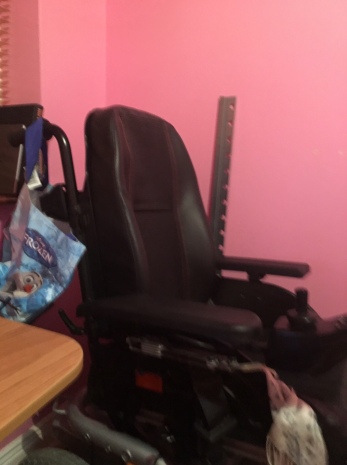
wheelchair.JPG

My poor, sad, neglected wheelchair (sad face)


I have really missed blogging here for the last two weeks (I’m back, yay), but to be honest, I just needed a break. I felt wiped, depleted and I know from hard  experience that when I feel like this it’s better to take a breather rather than having a meltdown and sobbing in my jammies at the side of the canal at 4.30am (ahem, apparently). I have been busy though with activism, and I got my submission in to Date With An Agent (I hope – I never enclosed an SAE to acknowledge my entry but I know my  future award winning novel will totally be selected), so that could account for why I’m that little bit more tired.

Or maybe it’s because for the last month and a half, I’ve been without my electric wheelchair, and the extra physical effort of walking everywhere is taking its toll. And thank God it is finally getting fixed tomorrow, because I am wiped.

My dear mother, who spent the first five years of my life doing physio with me every morning, was dead set against me using a wheelchair. We lived in a two-storey house when most of my disabled friends lived in bungalows. She wasn’t too keen on me having a wheelchair in college, although she understood the reasoning behind it. Growing up in a mainstream world led me to believe that one’s value was largely based on their physical ability to do things and to get around.

When I had Alison, my friend advised me that I wouldn’t want to miss out on doing things with my daughter, and so I got myself an electric wheelchair. Being ambulant I don’t think I’d have any chance getting one off the HSE. And for the first time since becoming a mother, I wasn’t housebound. I could take Alison for walks whenever I wanted, long walks and still have the energy to come home and do some housewifey things, and write my masterpiece. This is why the phrase ‘confined to a wheelchair’ annoys me so much. A wheelchair doesn’t confine, it liberates! Without it, I feel confined, trapped within the limitations of my body.

I firmly believe that when we are given access to tools like wheelchairs, technological aids and Personal Assistance, we are enabled to become the best us we can be. There is great strength in acknowledging that your physical impairments are not the problem, that society needs to address the needs of people with disabilities and be more inclusive. Above all, I believe that people with disabilities need to drive this change themselves.

It came to my attention over the weekend that student Kathleen McNamee, senior editor of the University Times, ‘cripped up’ or explored Trinity College campus in a wheelchair. What’s wrong with this, you might ask. Isn’t it great that people without impairments are trying to see the world through the eyes of a wheelchair user? Well firstly, Kathleen is not a wheelchair user; at the end of her article she wrote: ‘While I will be happy to hand my chair back tomorrow morning, I am also aware that not everyone is afforded this opportunity’. To me this implies that she sees the ‘problem’ as the wheelchair,  not the inaccessible environment. Also, why did she have to ‘crip up’? Why didn’t she look for the experiences of full-time wheelchair users who navigate the campus on a daily basis?

Secondly, I felt that the article was a little unfair on Trinity. When I carried out an access audit in 2004, we identified all of the problem areas and efforts have been made to fix things: the pathway through Front Square, there’s now a lift up to the Pav (the on-campus watering hole) and ramps to the buildings in Front Square. Things are far from perfect, but they’re improving.

Irish Rail, however, seems to be getting worse. A friend of mine told me recently that on principle she refuses to give any train station 24 hours’ notice of her intention to travel because she sees herself as equal. Today I had to travel by train (I had no wheelchair, just my rollator) and didn’t give notice, so I had no reason to be disgusted when assistance didn’t appear in Tullamore (even though I rang an hour beforehand), leaving me no choice but to fling my rollator and myself off the train. Had I been in my wheelchair I’d probably be writing this from Galway!

So to summarise, I’m looking forward to my wheelchair being repaired in the morning and to getting my independence and energy levels back. My normal life back. I know I should make more of an effort to get fit, and some might think I shouldn’t be so lazy. Feck that. My daughter needs a mummy who has the energy to do things and go places with her, and I need the energy to write, and that’s exactly what my wheelchair offers. It doesn’t matter how you get there, as long as you do!

How Many More Graces?

I go through phases, extremes of mood and thoughts. Sometimes I’m elated. I love writing. I know I’ve made the right choices in life. Other times I worry that I’m making myself increasingly unemployable as the days go past.

I haven’t really left the Centre for Independent Living behind, of course. I still volunteer a lot of my time to promoting the philosophy of independent living and campaigning for equal rights for people with disabilities. In fact, I’m now part of an activist group called By Us With Us. we’re still relatively new, but we recently set up a blog which is well worth a look.

Independent Living is not my job any more, my husband insists. You’re a writer now. You should be dedicating every free minute you have to writing and trying to get published.

And oh, how I would love to! How I wish life could be this simple, that I could have the luxury of locking the office door every day, focusing on nothing but putting words down on paper. My  mother used to tell me that I can’t fix all of the wrongs in the world. She was right, of course, but there are so, so many wrongs that I feel that I must try and do something;

As most of you know, I’m writing a novel at the moment, a story that initially came to me in 2007 while I was unemployed for six months. The story explores the life of a disabled woman who was tortured by a nun in a residential institution and how she copes with the aftermath of that abuse. Lately, I’ve been finding it hard to stay motivated. This is off the wall, I thought to myself as I rewrote the first chapter the other night (for the sixth time). No-one reading  this is going to believe that someone could be treated with such cruelty.

I’m not a trusting person anyway, and I’m sure I’m not alone in this distrust, particularly in the government at the moment (or, as it is starting to transpire, any government before or after this). Yesterday, the story of the abuse suffered by ‘Grace’ dominated headlines, a girl with an intellectual disability (now forty years old) who was abused while in foster care. It’s still a little unclear the extent or the nature of the abuse; some of it is of a sexual nature.

Grace has an intellectual disability and in the eyes of the Irish state at least, cannot be trusted to have her own narrative voice. And in Ireland, this is not limited to those with intellectual disabilities. The opinions and lived experiences of disabled people in Ireland don’t seem to matter to our policy makers.

I doubt that Grace is an isolated case. So why is there such little uproar about the status quo? There is mounting evidence to illustrate that disabled people should not be living in institutions, that the state cannot be trusted to provide a decent standard of care. Who can?

In December 2014, the nation was shocked by the Aras Attracta scandal, which saw people with intellectual disabilities being physically and psychologically tortured by those who were meant to care for them. People were disgusted by the RTE documentary; at one point my husband, whose stomach was turning, asked me to turn it off. I refused.

‘How can you sit there and watch that?’ he asked, bewildered by my seeming nonchalance.

‘Because,’ I replied, ‘Ireland has buried its head in the sand for too long. We have a government, and this and successive governments not only allow this abuse to happen, but by implementing cutbacks create situations such as these. We need to see this and someone needs to take responsibility.’

The Aras Attracta staff were later held accountable and given paltry sentences of community service. But what happens to those who continue to abuse people with disabilities behind closed doors, and are never questioned? I’m not talking solely about people in congregated living settings – I’m talking about people who suffer abuse at the hands of their families too.

When I started doing some research for my novel, what struck me was the lack of information available about how disabled people were treated in Ireland over the last fifty years. Apart from a few research papers, the Irish Wheelchair Association’s collection of stories, Extraordinary Lives, and this documentary on the programme ‘Horizon’ called ‘The Weakest Link’ on RTE in 1966, there isn’t a lot of documented stories about what life was like for a disabled person, particularly in a residential setting. So essentially I’m writing a story about something I have little information.

But if I can achieve this, then I will be happy. Because it’s time for disabled people to tell their stories, and to discover and reclaim their histories.

If we don’t, then our stories will be like Grace’s – spoken through the mouths of people on the outside.  Our stories should – and deserve to be – woven into the mainstream fabric of Irish society.

Locked away

For as long as I can remember, I have had an irrational fear of being institutionalised, or more specifically, living in a residential institution or a hospital.

I remember being eight years old, an age where my sense of self-awareness was growing rapidly. I was beginning to sense that I was different from my classmates. They had to tell me that I walked and talked differently, because I’d always assumed that I was no different to them. They didn’t use a typewriter. They played in the yard at lunchtime while I sat watching them. I remember complaining to my parents about it. ‘Count yourself lucky,’ my dad would say, ‘you can do so much more than other people with Cerebral Palsy.’ What the hell is Cerebral Palsy? My mum told me it was a kind of brain damage; that all of the body’s messages come from the brain, and that’s why I did things a little differently to others. That was that.

Then one night, my parents and I watched a documentary on the institutionalisation of people with disabilities during the Second World War and in the 1950s. Horrified does not describe how I felt as I watched how people were locked away by the Nazis, never to be seen again. I heard stories about people who were hidden in their parents’ attics for decades, and I thought: I am lucky. I am lucky.

That year, I would stay in Clochan House, a local respite centre, for the first time. My parents told me it was a sleepover summer camp, and indeed it was lots of fun. We did art, went on trips shopping and to the cinema, and had singsongs in the evenings. Don’t get me wrong, I have very fond memories of my time there, but the first time I stayed there I was convinced I was going to be left there, even though my mother went to great pains to tell me this wasn’t the case. That week, I learned to use a tricycle, which would be my main mode of transport for many years. It gave me independence, liberated me. I would later cycle to school and into town on a trike. I loved freedom. I lived a pretty bog-standard life. I did my Junior and Leaving Cert, went to Uni, got a degree and started working. Nothing remarkable there.

Unfortunately, not everyone agreed. In my school, I became a role model for people with disabilities and got told that I was great. I decided to compete for a place in Trinity, but knew I’d have to work hard, to the point where I made myself sick. ‘Remember that you can only do your best,’ teachers would say, their voiced tinged with concern. ‘Like it or not, you do have a disability so you will face challenges no other student would face.’ I refused to take my eye off the ball, afraid that my future would be full of endless computer courses and day centres. I have nothing against either, but that’s what you’re automatically supposed to do, as a person with a disability. You’re supposed to partake in a pre-formulated narrative. And if you do manage to fight the system and get a degree and a full-time job, then you’re great! Absolutely fantastic altogether! A real example of triumph over adversity! A pre-formulated narrative in itself.

I often think about what it must be like to live in an institution. According to the latest figures, 1,000 young people are living in residential institutions and hospitals. This is outrageous in 2015. Cuts to the adaptation grants, household benefits and Personal Assistant Services have all contributed to this problem. But institutionalisation is not just about your living arrangements. In my view, institutionalisation is spreading into the wider community. It manifests itself when business premises are not accessible for wheelchair using clients. Hate crime is also on the rise, that is, people with disabilities (including myself) being attacked because they are perceived as being vulnerable and ‘easy targets’. In my case, being attacked forced me to leave an affordable council house in Portlaoise and move back into the private rented sector. I felt I had to move back to my home town in order to have emergency contacts in case something happened to me.

I wonder how many more people out there feel held to ransom by circumstances beyond their control.

I wonder how many people are trapped within the four walls of their own homes, day in, day out, because they have to use their Personal Assistant hours for Personal Care or household duties. I wonder how many don’t see anyone else from one day to the next.

I wonder how many people, despite being in their homes, still don’t control what time they get up and go to bed at, or who is going to help them with these tasks.

When I had Alison, I had to start fighting before she was born. Fighting for the help I’d need to care for her. Fighting against the misconceptions of my parenting abilities as a mother with a disability. But most difficult of all was fighting against the negativity that I myself had internalised over the years, mirrored from a society that want to define me, keep me in my place. What if you drop her? the voice would say. What if you can’t look after her properly? What if she resents you for having her? What good can someone like you be to her?

Alison has recently started to ask ‘Why?’ about everything. ‘Why does it rain?’ ‘Why can’t we eat chocolate for dinner?’ I never want her to stop asking why things are the way they are, and as people with disabilities, we should never stop questioning things either. Yes, having to be continually vocal about your rights is exhausting. Yes, sometimes it feels as though the Disability Rights Movement is going around in circles. But if we stop challenging injustice, then not only will we be institutionalised in our own homes, but also in our minds and in our way of thinking.

And this kind of institutionalisation is the scariest and most debilitating of all.

Owning my limitations

I have a confession, and anyone who knows me will appreciate how difficult it is for me to say these words. I think I may have some limitations. When they read this blog, my husband and my dad will probably read the italicised sentence a few times, just to make sure they read it correctly. I hate admitting I can’t do things. Quite frankly, failure makes me feel weak and pathetic, and instead of learning from these experiences and moving on, I persevere until I’m certain it can’t be done.

Alison has recently started nagging me to teach her how to use a skipping rope and hula hoop. As I have serious coordination issues, I can’t do either, and it makes me feel stupid. I fob her off with ‘someone else will teach you’, but sooner or later she will want a straight answer to these questions and just like that, I will be forced to once again accept my shortcomings while hating myself just a little inside.

There was, of course, a time when I was completely oblivious to what my limitations were. Here are some of these times. Rest assured that I am sitting here blushing behind the glow of my laptop screen.

  • I love writing, as in writing things down by hand. To feel the pen glide (or dart when you have involuntary movements) across the page is one of my guilty pleasures. Alas, my handwriting makes the doctor’s worst scribbles easily legible. As a child, I loved writing in notebooks and diaries (as all little girls do) and fought tirelessly with my parents because I couldn’t see why I couldn’t write like the other kids. I wrote all of my Leaving Cert notes by hand because that’s how I remember things best. My parents cruelly forced me to use a computer and laptop instead. Sure, doing so enabled me to go to university after doing my Leaving Cert, but that’s not the point. I will never admit they were right (pig-headed, moi)?
  • I spent about a month when I was eight trying to cycle a normal two-wheeled bike with stabilisers that Santa had brought me. It was only after about seven falls, countless bruises and a deep scrape that went from my thigh to my ankle that it dawned on me that this wasn’t going to work.
  • I tried both skipping and French skipping in the playground. These trials didn’t last long as I didn’t know how to jump. After a while, I gave up, but I wasn’t very happy about it.
  • I was never good at knitting or sewing, but I kick ass at weaving, as I discovered in second class. The teacher gave me a weaving loom, and with that I wove a scarf, a headband and a purse. However, when I took Home Economics in first year in school, I was given the task of making a collage while the other girls did their cross stitching and used the sewing machines. The experience scarred me to the extent that I can’t bring myself to make a collage with Ali.
  • I remember getting brochures in school about really cool summer camps that included activities such as skating, bungee jumping, Qazar, water fights, football, basketball and hurling. My parents would look at each other and my mother would say, in a suspiciously bright voice, ‘How would you like to go to a better summer camp, where you can even sleep over?’ This place was Clochan House, a respite centre for people with disabilities just like me. They couldn’t go skateboarding either, but once I overlooked the fact that I hadn’t gotten my own way, I enjoyed myself and even nabbed meself a husband! Best camp ever! (bet you’re sorry now, eh dad?)
  • I took guitar lessons in TY much to the amusement of my classmates. At the end of a three month course, I could play E minor. I’m ashamed to say that in my family, at least four of us can play the guitar. I am not one of them.
  • Much to my disappointment and relief, I will never be a slave to fashion. High heels and me = disaster. In an effort to look elegant I wore high –heeled shoes to my school grad. They came off within ten minutes as I fell over for the fiftieth time. I looked pissed, and I desperately wished I had been, but no.
  • I think my mum wet herself the day that I announced that I was going to try and get a weekend job in the Bridge House or something, as a waitress, to supplement my college income. ‘Er, your studies are far more important’, she insisted through her tittering. Hmmph.

There are times when having so many limitations can be a real pain in the ass, and it does get me down sometimes, especially when Alison asks me to skip, climb and run after her. But then I think, no, I’m not exactly like every other mum in the playground, why should I be? Time to focus on the positive:

        • I have a handsome husband and beautiful daughter
        • I can work, write and spend time with my family (although I’m still working on the balance)
        • I have a degree from Trinity College, where I learned to live independently
        • I love, and am grateful for, my life at the moment.

Don’t get me wrong, the way I am wired means that I’ll probably always be pushing the boundaries, trying to achieve the most unrealistic goals. If I achieve them, I will be delighted, and if I don’t, I’ll come to terms with that too.

But I won’t know until I try.

Facing my demons

It’s amazing what we as human beings are prepared to do to ourselves in order to avoid facing our feelings. It may be throwing ourselves into our work, in order to make every minute so busy with activity that we haven’t a moment to contemplate anything else, or it could be self-medication with whatever drink, drugs or substance we can lay our hands on. However, there comes a point where we can no longer do this and the only way to eradicate the demons that mercilessly control our lives is to face them and disempower them. And this is exactly what I am about to do.

Almost a year ago, my husband and I took part in a documentary ‘Somebody to Love’, which explored the challenges facing people with disabilities in finding love and forming romantic and sexual relationships. Partaking in that documentary was one of the most difficult things I have done in my life. The intimate nature of the recording and production meant that there was nowhere to hide from our feelings. We were in our own home,  our own environment, laying our private lives bare for Irish viewers to dissect.

Watching the documentary back, I can see myself trying to stifle my husband’s words, trying to stop him from saying something ‘stupid’ or ‘dangerous’. By ‘stupid’ and ‘dangerous’, I mean the truth or, more specifically, our truth. Our truth is that we felt frightened and alone. We felt that we constantly had to prove ourselves, that we  knew what we were doing, when in fact we did not have a clue. We’d never cared for a newborn before, and we were terrified, but we couldn’t let it show. In short, we were denied the right to be first time  parents: to cremate the bottle, to hold the baby upside down, to make mistakes.(By the way, I am neither condoning nor encouraging this behaviour. Please read the instruction manual that comes with your child).

One of the worst moments of my life was the day my husband and I were supposed to take Alison from the hospital, It was a Monday, and I was recovering marvellously from my section. I was feeding Alison well, and she was thriving. I was even walking a little using a walker, having had to use a wheelchair for the last three weeks of the pregnancy. However, I felt emotional and like shit; my section scar was sore, I was missing my own mother like crazy, and it felt like fluid was leaking from every bodily orifice. And this was the moment that the  head midwife, ward manager or whoever she was told me that they had ‘concerns’ about my ability to take care of my daughter. My heart broke. In that moment, it felt like Alison had died. I rang my husband and told him to take  Ali with him and leave me behind, because it was me, not him, that they had the problem with. Reading it now, it seems like the rants of a crazy person, but in that moment, it made sense. After numerous phone calls to social workers, public health nurses and Offaly CIL, we were allowed home, on the condition that a Public Health Nurse could come to our home every day and monitor our ‘progress’.

Nearly three years have passed , and now one of my best friends, who also has Cerebral Palsy, is excited about welcoming her new arrival in January. But after witnessing what  we contended with, she is starting to worry about how she will be perceived after the birth of her c child.. She will be a mother, not just an object of care, and it’s vital that she is enabled, without fear of judgement, to care for her child, It makes me furious to think that she, that we, have to think this way about the most precious event in any mother’s life, when children are being neglected by their parents every day.

and so I would urge her: If you by gross misfortune have to contend with these obstacles and attitudes, please have the courage to speak out.  This is only the second time I have done so, but I feel so much better. Only through our honesty can we truly help others and deconstruct the negative attitudes that have the power to destroy us.

A Scary Story

It is three weeks to Halloween. You can tell this by the smell of turf lingering in the air at four o’clock in the evenings, by the sudden chill that envelopes you in the mornings, and by the faint sound of bangers being let off by the local ruffians.
Halloween seems to be the only time of year when it’s okay to be a freak; in fact, the gorier your costume and makeup, the better. You can even add fake blood, squelchy eyeballs and severed fingers to the mix for a truly horrifying effect.

What most people are trying to achieve is to look as unhuman and frightening as possible. I’ve been opening the door to excited trick-or-treaters for six years now, who stand there waiting for me to express my terror (and to hand over the goodies).

More often than not, it is they who end up full of terror.

What they see is a misshapen young lady, with sudden and uncontrolled movements, saliva flowing freely as she reaches her hand into the oversized tub of sweets, her speech slurred as she compliments their shop-bought costumes (I haven’t seen homemade ones for years). I can’t imagine what it’s like to be that young child on my doorstep, but it’s clear to me that my disfigured body and unusual movements are scarier than any costume they will ever see.

For somebody who doesn’t have one, having a disability can be a frightening prospect. I’m sure I’m not the only one that’s been told ‘I don’t know how you do it. If I had what you had, I’d die.’ My disability has often been referred to as a ‘handicap’, ‘illness’, ‘that’ disease (which is my favourite so far) and of course, like many others, I’ve been called retard, rehab, spastic (actually correct in a way, but not when there’s an ‘a’ in front of it), and other uncomplimentary things.

The truth is that people are afraid of disability, because being born without one does not grant you immunity from the possibility that you may acquire one by being in an accident, or even develop one, such as Parkinson’s or MS. Recently there has been speculation over whether being diagnosed with Parkinson’s led to Robin Williams’ suicide. We can never know for certain, but this sort of hearsay only reinforces preconceptions that disability is something to be dreaded, often a fate worse than death.

And in spite of the outrage that followed Hitler’s T4 Project during World War II (i.e. the mass murder of millions of people with disabilities across Europe, inspired by the concepts of racial cleansing and ‘survival of the fittest’), people are still afraid of disability. Some of the implications of this for people with disabilities are obvious, such as being stared at, and imitated by, strangers; being ridiculed for the way one walks and talks; being asked ‘is there somebody with you?’ as you mind your own business and wish that others would too.

However, lack of awareness and empathy surrounding disability issues have more devastating consequences than having to endure idiotic questions from Mr. Joe Soap. There was a conference held on the 25th September last in Kilmainham which addressed the financial and social costs of disability. Unfortunately I could not attend, but it seems like the biggest cost of disability is the loss of dign¬ity. A high proportion of people with disabilities live in poverty, unable to gain profitable employment. Many have lost their Household Benefit packages and their medical cards, and people with disabilities tend to face higher food and heating bills owing to their impairments.

Every so often, experienced disability activists stage well-publicised protests against cutbacks outside the Dail. These are the people who campaigned for equal rights and deinstitutionalisation for people with disabilities, nearly twenty-five years ago. How depressing that, nearly twenty-five years later, we are still campaigning for the same things.

And believe me, these things are fundamental to people with disabilities. All we want is equality. A lot of us need assistance to contribute to our economy, be this Personal Assistance or technological assistance. We need to be given access to goods and services through the provision of accessible transport and accessible business premises. Most significantly of all, we need to promote inclusion and integration in our communities by deconstructing the preconceptions surrounding disability and promoting the ability and strengths of each individual. If we don’t, things will never change and people with disabilities will be stuck in an endless time warp.

Which would be much more frightening than all the ghost stories on the planet.

Making my own identity

There are many things in life that shape our identity. These can be ordinary things, such as where we grow up, the education we receive and the careers we choose, or extraordinary events beyond our control, such as having a disability or illness. All of these things may define who we are, but they should not determine what we are capable of.

I have a disability which in Ireland, seems to mean that I am perceived to be an object of care. Living with Cerebral Palsy has meant that over the years, I have had to allow many medical experts into my personal space, patiently enduring their prodding and poking, their testing my muscle tones in their relentless quest to determine my abilities and disabilities.

Never in a million years did these so-called ‘experts’ expect to be lost for words when I announced that I was pregnant in June 2011. Firstly, they were intrigued and made it clear that they intended to use my pregnancy and Caesarean section as some sort of case study. Secondly, they were baffled (there are seemingly few parents with disabilities in Ireland) at how somebody, who would be traditionally perceived to be an object of care, could in turn fulfil the physical and emotional demands of a small baby.

I am a stubborn and single-minded woman, and throughout my pregnancy I arranged meetings with Primary Care Support Workers, physio- and Occupational Therapists, and even the Public Health Nurse, whose initial expectations of our parenting abilities were depressingly low. However, by the time the big day arrived on the 9th February 2012, I was confident that at least these professionals were on our side.

After my daughter Alison was born, however, it did not feel as if we were all working together. Instead, it felt like the time my husband and I had spent appeasing the ‘professionals’ had been wasted. There was concerns that I would pose a safety risk to my daughter, without substantial grounds for this. On the day that my beautiful daughter and I were meant to be discharged from hospital, I was told that the hospital would need to be satisfied that there was enough practical support at home to help me with Alison, and insinuated that I would not be allowed home until they were satisfied. They recommended the use of a wheelchair and a cloth sling for transporting Alison around the house, and I had to buy this sling before they would discharge me from hospital. Incidentally, I have never used the sling, choosing instead to push Alison around the house in a sturdy buggy. I have never let her fall.

If someone were to ask me how I define myself, I would answer an aspiring journalist, a devoted wife and a dedicated mother. However, having Alison in m y life has transformed how I perceive myself as a person. Watching her grow into a beautiful, intelligent and opinionated young lady has made me realise that a person’s identity cannot truly be defined by her appearance or by her disabilities, but instead by a willingness to continuously challenge the stereotypes forced upon them by society and to live one’s life in spite of the perceptions of others.