Dear Martin Naughton…

A letter to Martin, eight years after your passing

(written after going to see No Magic Pill in the Black Box Theatre, Galway on 9 November 2024)

Dearest Martin,

There are around six hundred thousand people with disabilities, the term you used, in Ireland. Yet, for some reason, you seem to have had the biggest impact on many of our lives, regardless of disability. You were an extraordinary man, even though, just like your peers, you were probably made to feel β€œless than” for not β€œmaking an effort” to walk or try to conform to mainstream society. You taught us that the discrimination we faced was not our fault, through discovering this fact yourself.

I consider myself an intelligent woman, yet until we met, I genuinely thought that it was my duty to push myself to become almost normal. I did not believe it appropriate to highlight my own weaknesses and shortcomings, for fear they would be used against me. Until I met you, I thought I was great for hiding my struggles, for beating myself into a world that I didn’t seem to fit into, for doing everything myself rather than asking for help. When we met for the first time in 2005, the first thing I saw was an older man with greying hair. What could this auld one possibly know about life, I thought. Little did I know that it was down to the actions of you and your friends that had enabled me to have the relatively sheltered mainstream life I enjoyed, and by β€œsheltered”, I mean I was sheltered from feeling the full effects of institutionalisation, exclusion and rejection. 

That June day, in Chief O’Neill’s in Smithfield, you shattered my world into pieces, and I found myself questioning myself and everything I’d ever been taught. Was it heroic or folly to try to hide the elements of myself that made people uncomfortable? You led me to realise that there was nothing wrong with me, and that there never had been.

I remember our first conversation. You asked me if I knew what a Leader Forum was, and I said yes. We both knew I was lying, because at the time, there was no such thing. Yet something about you told me that I had to β€œfake it β€˜til I make it.” From that moment on, I watched as an entire movement came to you looking for answers. It seemed that you always knew what to say and do. What was that like, were you honoured or did it piss you off from time to time?

From that fateful June day, you have been in the background of everything I have done and achieved; living independently, working with Offaly Centre for Independent Living, and when I was presented with the opportunity to get married and have a child. I thought of you and how you and others had led the fight that enabled me to have these luxuries (yes, they should be rights, but I think we’d agree that we’re not quite at that point yet). You lived as you pleased; you didn’t answer to anyone, something that so many of us continue to aspire to.

Like many of us, I put you on a pedestal. I always expected you to have the answers. Did you like this, as so many people intimated, or did you feel lonely? Please know that watching you spurred myself and so many others to find our own answers. If you could do it, anyone could. I recall when I worked for you that summer of 2005, how frustrated I became with you for asking me to set up a Leader Forum, but neglecting to give me any hints as to how to do this on a practical level. Now, twenty years later, I understand why: you wanted me to find the answers myself, to take risks, to fail and learn from my mistakes. I guess I should thank you for trusting me, because since then I’ve taken plenty of risks which have led to a life that was beyond reach for many of your generation.

I remember watching the last β€œaction” you would ever take in September 2015, and shaking my head in frustration as members of the general public asked what it was about. It made me wonder why you even bothered trying to make a difference. Then I remembered that you have seen the grey walls of an institution. You truly understand what losing freedom and liberty is like, and that’s why you dedicated your life to ensuring that it didn’t happen again.

I guess all that’s left is to thank you. Thank you for coming into my life during a formative time, when I was still ashamed of being associated with the β€œdisability sector” in any way. Thank you for changing how I value others and myself. I’d always connected my own self-worth to the tasks I could carry out unaccompanied, buying into a widespread consumerist belief that wearing yourself out in the name of productivity was akin to a badge of honour. Thank you for teaching me that my wobbly body was not the cause of my exclusion. Thank you for granting me the permission to speak out against the systemic discrimination that we face on a daily basis.

I don’t think you truly realise the profound impact you had on people. Christian O’Reilly has made it his life’s work to capture your story, not giving up until he had captured the essence of you. I have seen β€œNo Magic Pill” twice now, and although the actors portrayed the characters to an Oscar-winning standard, it’s the feeling that seeped through my being both times I’ve watched it. Paddy Slattery and Eric Fitzgerald portrayed you in different ways, but watching them, it was you I felt beside me, as if I was being given a second chance to say goodbye properly. That said, it might be argued that even after eight years, we are not ready to say goodbye. Between β€œNo Magic Pill” and your autobiography which was co-written with Joanna Marsden, we can hold onto you for that little bit longer.

Most importantly, thank you for being you, without which many of us would not be enjoying true Independent Living. May we always be strong enough to protect everything you and others ever fought for.

Love Sarah xx

Tuesday Thoughts: Too Close for Comfort

Do you ever find yourself looking at a date and trying to figure out why it’s important? That was me, squinting at my phone this morning. March 12. Holy crap. Why this suffocating feeling of dread? Have I missed a writing deadline? (I’ve missed several, thanks to my unpredictable mental health). Do I have some medical appointment? An important birthday? I checked my physical and digital diaries. No entries.

Some dates are just etched into the fabric of your psyche forever. And as I sat in the shower, a jolt of electricity awakened me, and suddenly I remembered. Funny, because there was a time that I never thought I’d forget. I can’t believe it’s been fourteen years since my life changed in many ways.

It was Friday, 12 March 2010. It was just under five months to D-Day, the day when my fiancΓ© and I were due to declare our eternal love for each other. Our fathers had both made generous contributions to the proceedings earlier that week, and JP and I had decided that, rather than trusting ourselves to save the money, we would immediately pay off the entire wedding to alleviate the financial strain. To celebrate, we’d arranged to meet in Caffe Latte in Portlaoise for lunch, a rare treat after months of careful saving. I withdrew the money from my account and he brought it to the Credit Union to be made into various cheques. 

While I waited, I beckoned the waitress and ordered. As I watched her retreat behind the counter, I noticed two men at the next table, staring at me. Now, as a disabled fascination, I’m well used to being stared at, but this felt different.  Uncomfortable. I stared back to let him know that I’d clocked him. Usually whenever I do this, the offender looks away in embarrassment, but this guy didn’t. In fact, he seemed to stare harder.

When JP arrived, he started explaining what he did with the money and I told him to shut up, something I never do. I was worried that these guys were earwigging. He sensed my discomfort and asked what was wrong, but I couldn’t explain. Caffe Latte was bijou, and there wasn’t much space between tables. I just shook my head and wolfed down my lunch, mumbling β€œI’ll tell you later.”

After a rushed lunch, far from the relaxed affair that I’d been looking forward to, I decided that I needed to go for a cycle, to clear my head. I’d cycled from our house on Harpurs Lane to Lyster Square, the perfect distance for a quick workout. John Paul’s car was at home, so he could have easily walked beside me, but I insisted that I wanted a few minutes to myself. I darted in front of JP, calling β€œHee-hee, I will be home first.” I cycled out of Bull Lane onto Main Street, stopping at Shaw’s to see if he was behind me. JP wasn’t. However, one of the men from the cafΓ© was. And he was watching me. Following me.

At first I laughed at myself. What notions I had, that this lad was following me! Wasn’t I just full of myself? After all, I’d lived in Dublin for four years. Caught Luases back to Trinity on Sunday evenings. Caught 14As on summer evenings from Trinity out to Halls in Rathmines at 7, 8 o’clock. I’d never had hassle. So why would some random guy follow me home on a Friday evening, at 3pm in broad daylight? Yet, this was what appeared to be happening. The faster I cycled, the quicker he walked. At one point, I glanced down at the odometer on my tricycle. Fifteen miles an hour. That’s how anxious I was to escape. And he was still only a matter of metres behind me.

I darted under the railway bridge towards Harpurs Lane. Suddenly, I had the bright idea of cycling into the middle of the road, trying to stop someone to help. No-one did. Two cars pulled out around me, leaving me at the mercy of this stranger. By now, he was annoyed; he obviously hadn’t expected the speed. For months afterwards, I thanked God on a daily basis that I had the good sense to stay on that tricycle. If I had been walking, or even in my wheelchair, this story would’ve ended differently. I have no doubt about this. Later, when I learned who he was and what he was reportedly capable of, I no longer felt victimised. I escaped lightly.Β 

I stopped outside my house. My legs felt as though they would fall off. Then came the barrage of questions, with his face in mine. That’s why I will never forget what he looked like.

β€œDo you have money? Fags? A phone? Is this your house? Where are your keys?” He motioned towards my house.

At the time, my tricycle had a mechanism which meant I could cycle backwards. When I went to do so, a young girl who must have been following us was holding onto the basket so I couldn’t move. She wasn’t any older than twenty. I cycled into her and wriggled free, cycling back up towards the Mountmellick Road.  No sign of John Paul, and why would there be? As far as he was concerned, I was at home, tidying up so that we could take off to Tullamore and start paying off the wedding. Not wrestling with a stranger in broad daylight. I couldn’t go into my house. At least out in the open, there was a chance of someone spotting us.

I cycled up towards the Mountmellick Road again, my two would-be attackers following me closely. This time, John Paul walked around the corner to be blasted with my shrieks. The man slinked past us, not saying a word. Apparently, the girl said β€œI’m sorry” to John Paul as she walked past him.

It took until we were in the car to Tullamore to calm down and explain to JP what had happened. By the end of the evening, despite being shaken, I resolved not to let it define my life. I had a right to live in Portlaoise, and that was what I was going to do.

The next morning, back at home in Harpurs Lane, I heard a knock on the door. JP had already gone to work, and I was resting in bed. At the time, our house could easily be broken into, with old doors and single-pane windows, so I knew it wasn’t my would-be attacker. Still, I looked out the window before answering the door. It was a Garda who’d received no less than five calls about what had happened the day before, from people who had driven by. My attacker had been identified. He was known to the guards, a notorious heroin addict. But I was not to worry. The guards had warned him to stay away. He wouldn’t be bothering me again.

I wasn’t filled with confidence, but I was stubborn. No-one was going to dictate how I lived my life, and certainly not a stranger. So, I got onto my tricycle, and cycled into town. And I saw him. He diverted his eyes, but I know he saw me, too. And I saw him again as I cycled home. JP was with me; I’d met him after work. My legs were frozen with shock, and he pushed me home.

As I sat at home that evening, my mind went into overdrive. Was he watching the house? After all, he knew where I lived. He’d also be able to tell when I was alone, if JP took the car to work. After a full week of no sleep, we decided that the only thing we could do, to guarantee my safety, was move back to Tullamore, moving out of our cheap council house back into expensive rented accommodation. And with the wedding paid off, that’s what we did. We had family and friends here, who we could ring in an emergency. I’d never had to consider that before, and it felt so horrible and disappointing. Now, don’t get me wrong – we were going to move to Tullamore anyway, after the wedding. Our house was damp and I was constantly sick with chest infections. But it hurt that the decision was taken out of our hands.

I hadn’t thought about this incident for years, but it all came flooding back last autumn as I listened to Jozef Puska’s trial, for the murder of Ashling Murphy. Like many women across the country. I think of her often. She was only two years younger than I was when I was followed home. She, too, was planning a wedding with her soulmate. A beautiful young lady, going about her everyday routine in broad daylight. And although there was uproar after her murder, not much has changed and I doubt it will in my lifetime. At the time, there was much uproar about Jozef Puska’s nationality, but I believe that human decency – and indecency – are universal. My attacker was local, an Irish white male. He’d no reason to pursue me, just as that monster had no reason to brutally murder Ashling. And as I listened to that farce of a trial, it triggered memories of that March day. It’s not the same thing, I know. I wasn’t physically attacked. I wasn’t murdered.

That was down to nothing else but luck. And the women of Ireland deserve more than that.

Tuesday Thoughts: Life is But a Dream…

Getting up at six isn’t easy, but I know I’ll feel better afterwards. While my husband snores beside me after coming home late from work, I pull on the tracksuit that I’ve laid out the night before. I always hate this part, and find myself questioning the auld sanity, but I know I’ll feel better afterwards. I always do.

Down the hall, I can hear the familiar sound of the front door opening, the clinking of my favourite bowl being extracted from the cupboard and the shaking of a cereal box. I look at my watch: 6.30. Right on time. I sit into my wheelchair and go down to my kitchen, where Mary* is waiting for me. She’s poured me exactly a third of a pint glass of orange juice and half a bowl of Bran Flakes, though she’s waited for me before pouring the milk; she knows I don’t like soggy cereal. She also knows I don’t like too much milk. As I munch it down, she clears the breakfast things away, wipes the counter and sweeps the floor. Then it’s 6.45. Time to go.

As always, Mary has started the car so that the windscreen is clear and, of course, so that it’s nice and toasty on this frosty morning. She lowers the ramp and I drive into the car, waiting for Mary to secure the chair with the clamps, just as I’ve trained her to do. Then I’m whisked to Aura, our local gym, for my morning workout session. Mary has sat in on my physio sessions, so she knows exactly what I should be doing. She sets up the equipment for me, making sure that I’m seated correctly so that I don’t strain myself, and so the physical torture begins. Mary laughs, saying that the only weight she’s lifting will be her cup of coffee to her mouth. Too early for this shite, she says.

Afterwards, it’s back to the car and a quick stop at the shop for milk and bread. I give Mary my card so that she doesn’t have to undo the clamps for the sake of a few minutes. She returns with my card, a receipt and the groceries, standard procedure although I’ve trusted her with far more important and delicate things. Then it’s a quarter to eight and back home, where the preteen has just risen. I put on two slices of toast. Mary takes out the plate and the butter. The preteen is unusually chatty today. She’s used to Mary; she knows what Mary’s purpose is, and more importantly, what it is not. Mary never comments on my child’s behaviour. She knows that it’s not her place.

After the child leaves, Mary leaves too. Everything is tidy, meaning that nothing will distract me from my work (apart from my dogs barking at each other, or at random birds flitting past the window). It’s nine o’clock, and I normally have my first thousand words completed by eleven. By that stage, I’m fit to drop, and typically at this time, depending on what household chores await me, I take a forty-five minute nap, just to keep myself right. Then it’s dogs on leads and we go for a short walk, to clear the cobwebs from my brain.

When I return home, Emma* is waiting for me. We cook the evening meal together: she chops the veg and preps the meat, I fry it up. She also cleans as we go, so that we don’t have a big job ahead of us later. My favourite is homecooked lasagne, or chicken stir fry. I’ve taught Emma how to marinade the chicken in garlic and soy sauce. It’s the young’un’s favourite meal.

No two days are the same. Sometimes I might need Emma or Mary to accompany me to Dublin for medical appointments. Other days, I might need help in organising the materials for the Creative Writing Classes that I teach across Laois and Offaly, or the grinds I give to Leaving Cert English Students. We also tour the country a couple of times a month in my accessible van, giving disability awareness training to secondary school students. On those days, a Personal Assistant might have to work longer hours, and so I allow them to take time in lieu on a less busy day to compensate. After all, it is their dedication and attention to detail that allows me to live the life I do, a life entirely of my own choosing.

I jest.

This is not my life. Well, it is and it isn’t. I wish I was motivated enough to get up at six in the morning, but alas, here we are. It’s certainly the one I aspire to, the one I try to fulfil. And, to be fair, I have a good life. I’m married, I have a child, I work as much as I can freelance. And I do have three dedicated, hard-working Personal Assistants, who are always willing to go the extra mile for me. They are simply wonderful people and I love them to bits.

However, I don’t necessarily have a service that offers the freedom and control that I might like. Nor can I choose my own times, owing to the demand on the service. I cannot emphasise enough how dedicated my PAs are, and how much pride they take in their work. It is nothing short of remarkable, considering how exhausted they must be; all of them are required to work with multiple clients on any given day. It takes a special kind of person to remember the preferences of each individual Leader, to try and fulfil somebody’s needs in a limited space of time, and to do all of this with a smile and not a hint of a complaint. For this, I am truly grateful.

That said, this style of service provision does not do the Leader or PA justice. For the Leader, it offers no opportunities of spontaneity and, depending on the nature of their impairment, leaves them at risk of isolation from their communities, especially in this post-covid world where everyone (rightfully) is sick of online meetings, and in-person events are becoming more prevalent. Remember during the height of Covid, when we weren’t β€œallowed” to meet each other, go for coffees or even take our time looking around the shops? For some disabled people, this continues to be their reality. During lockdown, I found it interesting, and admittedly amusing, to hear that some people couldn’t hack it, and yet for some reason, it’s okay to imprison disabled people in their homes as long as they have access to the internet (or not, as the case may be).

For the PA, this style of work – hopping from client to client – is more lucrative, but exhausting. At the moment, there is little distinction between PA and home help. Typically, a home help is given approximately forty-five minutes to help a client out of bed, get them washed, dressed and have breakfast. Then off that person goes to do the same for somebody else. Home help agencies have high turnover of staff, and it’s not difficult to see why. Often, they might have to drive from one end of the county to the other, just to do an hour’s work. I’ve heard of home helps working twelve-to-fourteen hour shifts, visiting six or seven different people in this time. Six or seven people, with different needs and care plans, who may only be allocated enough time to be washed and fed, if that. What kind of life is that, I ask you? Could you live like that and not lose your brain? A study conducted by Pauline Conroy found that a Leader who is lucky enough to receive a service has a PA for about 45 minutes per day. How is it possible to squeeze a meaningful life into less than an hour a day?

This is why I find myself writing about the same thing over and over again. I’m sick of reading about the β€œpoor, vulnerable disabled people, suffering at the hands of cutbacks.” I know hundreds of disabled people, and I cannot think of a single one that I would classify as β€œvulnerable.” Those I consider β€œmy tribe”, in the words of artist Mary Duffy, are intelligent, strong, confident, capable and willing to contribute. Willing to fight for the quality of life that they deserve, and always have deserved. Committed to ensuring that the authentic voices of disabled people are heard and taken seriously by the powers that be. But they are also tired. Tired of having to fight for every little thing. Tired of the excuses β€œthere’s no staff”, β€œwe don’t have that kind of money.” Tired of being made to feel guilty for their lack of gratitude: β€œThere’s so many people who don’t have what you do.”

As a collective, disabled people have achieved so much in their lifetime for the advancement of their human rights. But wouldn’t it be lovely to be able to focus on the minutiae of everyday life instead, such as β€œI want to go for a coffee with friends at one o’clock” or β€œI think I’ll have a lie-in in the morning”?

Independent Living Movement Ireland (ILMI) are committed to making this a reality. Formerly known as the Center for Independent Living, ILMI have been working since 2018 on their #PASNow Campaign, which calls for the legislation of the Personal Assistant Service (PAS). This would have many benefits. Firstly, it would offer some protection against the savage cutbacks that the service has endured since 2008 onwards, as ideally, the funding for PAS would be ringfenced. Secondly, it would be a step towards recognising that the PA service should be rights-based, not just something given on the basis of an impersonal, medical assessment. This would mean that Ireland could fulfil their obligations under Article 19 of the UNCRPD, which details the right to independent living. Thirdly, and perhaps most significantly, disabled people would be independent of their families and loved ones, absolving them from labels such as β€œburden” or β€œobject of care”.

On Wednesday, 22 November 2023, ILMI launched their research paper β€œNot in the Driving Seat: Reliance on family for supports and the impact it has on disabled people.” The reference to β€œdriving seat” comes directly from Martin Naughton, who is internationally recognised as being one of the main figures behind bringing Independent Living to Ireland. The report offers a counternarrative to the traditional spiel of disabled people as vulnerable. The struggles of family carers experiencing burnout has begun to be recognised over the last few years, but this is the first study focusing on the physical and psychological impact that relying on family has on the disabled person themselves. Des Kenny, close friend and ILMI Chairperson notes: β€œInvestment in supports that liberate disabled people will also liberate family members to move from roles where they provide support for their partners, children, or siblings and can focus solely on their family relationships.” I would like to personally commend all involved in this work and to thank ILMI for continuing to push its #PASNow Campaign.

I know I have written about this many times before; this blog might as well be called β€œThe fight for independent living.” And I’m sorry if you’re sick of reading it; trust me, I’m sick of writing it. Yes, we have made great progress in shifting the thinking around disability from pity and oppression to empowerment and rights, but even after thirty-one years, there is still so much to do. It’s tiring, and easy to lose heart, but the only way we can counteract the narrative of pity is to keep pushing our own, in the hope that one day, it will be universally understood. In the hope that one day, in the not-too-distant future, disabled people will have the freedom and choice to do what they want, whenever they want to do it.

*Mary and Emma are entirely fictional, similar to the right to Independent Living in 2023

A Wheely Wise Decision

(Don’t worry, I’m groaning at the awful pun. too).

Three weeks ago, I finally reached my breaking point. It had been coming for a while, and I had dodged it successfully all this time, but I couldn’t avoid it any longer. I had been awake with pain for two nights in a row, and was so painfully tired that I thought I would vomit. I actually did no less than ten Covid antigen tests, thinking that there was another explanation. There wasn’t.

I was just tired. Tired of pretending that my pain didn’t affect me. Tired of trying to keep myself mobile, without having the energy to do anything else. I hadn’t written anything in days, and consequently I was snapping at my daughter over the slightest thing. I was crying at the smallest, insignificant inconvenience. Three weeks ago, I’d had enough, and so I sat at my laptop and opened the pinned tab that had been saved since October, and I said fuck it, and I bought the wheelchair that I’d been himming and hawing over since I received my long-term pain diagnosis in November.

Then I cried. Big, ugly, wailing tears. What had I done? Was I admitting defeat? Holding up my hands and saying that I was giving up hope of getting my mobility back? I wondered what my mum and dad would think, after all my years of physiotherapy and cycling to school. I only started to use a wheelchair in my twenties. Would they be disappointed, or would they understand?

When I calmed down and thought about it rationally, I knew my parents wouldn’t mind as long as I was happy (besides which, I’m almost thirty-nine, so I have to stop worrying about what they, and indeed other people, think). And I also had to consider my priorities. I need to write more than what I’m currently producing, and I also need to look after my family, physically and mentally. I won’t be able to achieve any of this if I am exhausted. Those I love deserve better – hell, I do, too. For too long, I have been obsessed with proving my worth, a worth tied up in the traditional mantra of lots of output and productiveness. But even a machine cannot work to its full potential if its parts aren’t working properly.

I’m not a machine, I’m a person. And the wheelchair isn’t a part of me – it’s a tool.

The wheelchair arrived at last on Monday morning, in a big cardboard box. Initially, I was going to put the box straight into the spare room, but my husband stopped me.

β€œYou’ve not spent all that money on a wheelchair just to have it gathering dust,” he said, hauling the box into the kitchen. 

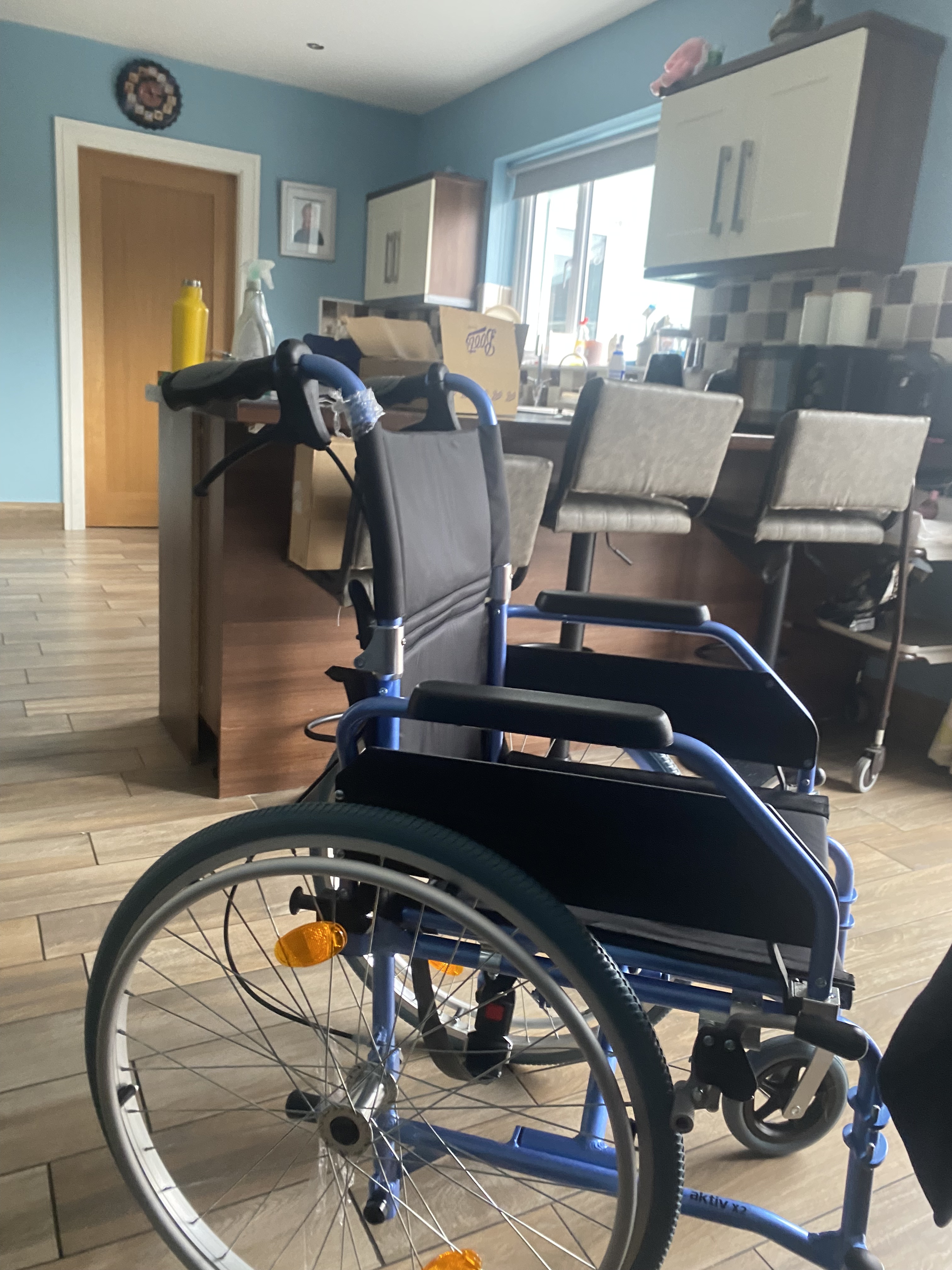
After unboxing the wheelchair, I realised that I was looking at the answer to many of my problems. I tested it out around the house, leaving the footplates off so that I could propel it with my feet. It’s light, and for me, it’s far easier than trying to use an electric chair in our house, as I’d been doing on and off for the last three months. Today (Wednesday) marks day three of using the manual wheelchair, and since Monday, I’ve done four loads of laundry, written this blog and added 1,500 words to my novel, prepped meals and swept floors. And I’m still wrecked, but at least now I’ve something to show for it, which wasn’t the case this day last week.

Photo shows a lovely blue manual wheelchair, sans footplates.

Cerebral Palsy is not progressive. However, years of unsteady gait, falls, kneeling on the floor, and pushing ourselves to do things that our bodies were simply not made to do are bound to take a physical toll. You might have noticed that I’ve had a hard time accepting this. And as a dear friend pointed out to me recently, I shouldn’t. I’ve always been fiercely independent, and deciding to use a wheelchair more often will only enhance that. Less falls will lead to less pain. It might even lend me the energy and impetus to get back on my exercise bike, and hopefully onto my tricycle in the summer. My friend’s tough love approach has prompted me to focus on the future with excitement and hope (although if she reminds me again that I am pushing forty, she may get a clip around the ear).

Today (1 March) is International Wheelchair Day (which I didn’t know was a thing until this morning, but is quite timely, all things considered), a day for reflecting on and celebrating the positive impact that wheelchairs have on the people who use them (it is estimated that over 40,000 people in Ireland alone use wheelchairs either full or part-time). It is also worth remembering that the barriers that wheelchair users encounter – steps, inaccessible buildings, undipped footpaths – can all be fixed in order to promote inclusion for us all. And although we have made great progress, there are always improvements that could be made to ensure that services and amenities are accessible to everyone.

There you have it, my first blog in months, all thanks to me using my shiny new wheelchair to conserve my energy. Now off I go to tidy my kitchen, make some dinner and hang up some clothes.

The Client (Short story)


I turn down the radio as I pull up to the house. It wouldn’t make a good impression to drive into the driveway, Jon Bon Jovi blaring as I get out of the car. Instead I choose to park just outside the gate I grab the little clear bottle of hand sanitiser that has been rattling around my dashboard all morning, wincing as I rub the stinging liquid into my skin. My first call of the day – well, my first call ever, actually. My hair is tied back and I’m wearing the freshly ironed uniform given to me by the agency. The app I’ve downloaded onto my phone informs the admin team when I’ve arrived; I wait until 8 A.M. on the dot before β€œclocking in”. There’s no point clocking in early; I won’t get paid for it anyway.


The unkempt garden looks like a magical Christmas wonderland in this heavy frost and suffocating fog. Underfoot lies a glassy red and orange leaved carpet, which could easily be mistaken for a skating rink. I navigate the driveway with caution, cursing myself for choosing these snappy-looking heels. I still wear them, even though I left the solicitor’s firm a year ago. Well, left isn’t the right word, exactly, but I never elaborate unless asked. Come to think of it, I’ve never been asked; this is my first job since packing up my small, cramped desk of nearly eighteen years.


I ring the doorbell, hearing it echoing up the hall. On inspecting my notes this morning, I read that this client has a key, hidden in a small brown box under the unruly shrub in the corner. However, I don’t think it would be appropriate to use it for our first meeting. A shadow appears in the hall. The height of the shadow doesn’t even reach my chin. I inhale sharply as the blue door opens.


β€œHello there!” I say, with as much enthusiasm as I can muster. β€œI’m Marie. I’m your carer today.”


My client merely grunts in reply, swinging her wheelchair back so I can squeeze past her in her narrow hall. The bulb overhead is far too bright; under its harsh, unforgiving light, this woman looks fifty, but I know from reading her file that she isn’t even thirty yet. Some of them are just like that though, aren’t they? Old before their time. Her mouth is fixed in a firm line, her fists are wrapped around the wheels of her chair. She isn’t impressed to see me.


I follow her into the kitchen, which was once a buttery yellow but has been made grubby with fingermarks and blackened with smoke. Over the small, white, standalone hob/oven in the corner, splatters of oil and bits of pasta cling forgotten to the walls behind. A St. Brigid’s cross hangs sideways over the door. On the kitchen door itself, as I close it behind me, there hangs a 2017 calendar from Emo Oil, on the March page. Time seems to have frozen since: it’s November 2019 now. Certainly the table looks as though it was abandoned during a zombie apocalypse: a stack of old Offaly Independents, a thick-based laptop with the screen closed down, an array of old socks. It saddens me to think that this is how any thirty-year old woman should live.


β€œSo, according to your care plan,” I say as I flick through the pages, β€œyou need a hand with getting dressed and your breakfast which is normally jam on toast. Is that correct?” I smile at her as I pull on the latex gloves, a standard issue from head office. She doesn’t smile back.


β€œWhere’s Nuala?” she says in an accusing tone.


β€œNuala?”


She’s exasperated with me already. Not a good start to the day.


β€œYes, Nuala. The woman who normally works here. I wasn’t told she was being replaced.”


This must be a test, I think. β€œYou’ll have to ask the office. I was just sent here this morning. I’m just following orders. Don’t worry, I’m fully trained. I know what I’m doing.”


β€œLevel five?”


β€œJust got my certificate last week,” I say, swelling with pride as I relive the moment I was handed the award, as well as an extra award for being top of my class. I’d always had a mind for theories, for essays. The course had been a piece of cake.


She rolls her eyes and makes a retching noise. β€œYou’re early,” she says, rummaging in her handbag. To my horror, she pulls out a black cigarette box. β€œI like to have my morning fag before I do anything.” Before I can stop her, she pulls one out of the box and lights it.


Oh hell, I think to myself. I hadn’t imagined landing head-first into a scenario like this. I wonder if the office staff are going to pop out from behind the door and shout β€œSmile, you’re on Candid Camera!” popping streamers and blowing those annoying kazoos that are thankfully disappearing from kids’ parties these days. God bless the drive to cut the unnecessary plastic.


She’s already taken three pulls before I have the courage to say: β€œSorry, this is my workplace. You can’t smoke.” I would go as far to say I hate smokers. They’re so inconsiderate and selfish, and they rarely think of anyone but themselves.


She shrugs, continuing to smoke, blowing the smoke in my direction, which I think is definitely taking the piss.


β€œYeah, well, it’s my house.”


Her obstinance is grating on me. β€œWell, according to this handbook,” I say, grabbing it out of my handbag and flicking through the pages, β€œsection fourteen says that because of the Tobacco Act 2004, all workplaces must now be work free.” I stuff the manual back into my bag. Thank God I didn’t leave it on the kitchen table; I knew that I’d be needing it. β€œAnd now,” I continue, looking at my watch, β€œI only have twenty-five minutes to get you done, so if you want a shower, you may hurry up. I have five other clients this morning.”


Her face is hurt, like a chastised child’s.


β€œYou’re not allowed shower me,” she informs me. β€œThat’s a two-person job. Didn’t they teach you that on that fancy FETAC Level 5 course? Anyway, it’s not Thursday.” Bloody newbie, I hear her mutter to herself.


She stubs the cigarette out on a saucer and wheels out past me again. I follow her, feeling the damp emanating from the walls. Her bedroom is small and dark, and the floor is covered in clothes and shoes. I can barely follow her in. Looking at the mess, I can’t help but feel sorry for her. If only I had time to tidy up for her, but I don’t. it’s only my first day but I’m determined to make a good impression; ergo, I must be punctual for all my clients. Anyway, this lady, like all the people I’m scheduled to help this morning, surely knows what the drill is by now. She knows that I’m not made of time. I wonder does she do this with all her carers: try to stretch out her time, chance her arm?


β€œCan I have my Adidas hoody and tracksuit bottoms?” she asks me. I can’t seem to put my hand to the bottoms; the room is in chaos. Though I can see why. Apart from this tiny dresser, this girl has no accessible place to store her clothes. I haven’t seen the hotpress, but I’d imagine the shelves are too high to be reached from where she sits in the wheelchair.


Time is really running out now. β€œI can’t find your bottoms. Can you wear these Reebok ones instead?”


Again, she doesn’t look happy. β€œGo on then,” she says, sitting still as I pull them up her legs.


It must be strange for her, I think, being dressed by a total stranger. Honestly, I don’t think I would like it. As I sit her back down in the wheelchair, for a second I catch a glimpse of my own future, and I don’t like it. If I’m being honest with myself, I think I’d rather be dead. That’s what Tom and I always said: if we became old or crippled before our time, we would be on a plane to the Netherlands and we wouldn’t be coming back. I personally could never burden anyone like that.


β€œNow,” I say, too brightly again. I keep forgetting that I’m not talking to a child. And yet there’s something childlike and vulnerable about her. For starters, she’s evidently unable to keep house, although I’m starting to suspect this might be because she doesn’t want to. β€œAny plans for today?”


She shakes her head, staring out the small, dirty window into her jungle-like back garden. I wonder if I’m the only person she’ll see today, at least until the night carer comes back to help her get ready for bed. A hacking cough shakes me out of the daze I’m in.


β€œI might go to the day care centre.” Her voice is indifferent. If this was the most exciting prospect in my day, I suspect that I would be equally unenthusiastic. β€œI don’t like going there too much. Bunch of auld grannies.” She looks up at me. β€œI don’t suppose you have time to straighten my hair?”
For what I think. The day care centre? I wouldn’t imagine there to be any fine young specimens in there. I worked in the Ballingar centre as part of my work experience and it was like witnessing an eightieth birthday in a care home. It was depressing to think that people the same age as I was lived like this, often only seeing the four walls of their home. I think of myself at thirty, almost fifteen years ago. John and I already had five years paid off our mortgage on our beautiful four-bed detached in Whitehall Estate. I was juggling my blossoming legal career with two kids under the age of five. I remember the odd days that I skived off work, meeting Margaret and Brenda for coffee, and sometimes the odd liquid lunch. Even at the time, I remember thinking that I would look back on those days with nostalgia. Now, I was looking down at a girl – sorry, a woman – whose excitement probably revolved around that morning fag and some inane chit-chat in a day care centre.Β  Worst of all, she seems to be resigned to this. This is her life. I feel a little deflated.


We sit in silence as I straighten her hair and I watch in satisfaction as I tame her unruly locks into a professional-looking bob. I missed my calling, I think to myself. I should’ve been a hairdresser. To my surprise, the edges of my companion’s small mouth are inching upwards towards her cheeks. I feel a lukewarm glow in my chest, a hint of a natural high. As if by magic, this lady now looks slick, elegant. If this is having such an effect on boosting my self-esteem, I can only imagine the effect that something as simple as having her hair straightened has on her.


β€œNow,” I say, looking at my watch. β€œI’ve five minutes left. Do you want something else? Breakfast? Cup of tea?”


She nods. β€œTea and toast would be great.”


We go into the kitchen and she shows me where everything is. I make her toast and cut each slice into four automatically, as I used to do for my children. This makes her smile a little.


β€œSorry. I suppose I should’ve asked you what way you cut your toast.”


β€œIt’s fine. Toast is toast,” she says.


My forty-five minutes are up, it’s time to leave and go to the next client. I pull out the care plan, and tick the boxes Personal Care and Feeding. I’ve done what I was sent here to do. I suppose there has to be some way of regulating the industry, certain standards to be met. But it must get boring for her, the same thing morning after morning. On reflection, I think she handled herself quite well, considering I’m a total stranger, rooting around her home.


β€œWell, I’m going to head,” I say, gesturing towards the door.


To my surprise, she nods and says, β€œWill I see you tomorrow?”


β€œIt depends on my rota, I’m afraid. Sorry,” I add, and I mean it. This girl obviously doesn’t know who’s coming into her house from one end of the day to the next. I could not imagine being okay with such invasions to my personal space.


I trot back towards my car, cursing myself again for wearing these damned high heels. For the first time since leaving work, I’m missing the chaos of my desk, being able to hide behind piles of unopened letters and emails, dealing with cold, hard logic instead of having to face my feelings and the realities of others.


As I drive away, I realise that the girl – sorry, woman – never even told me her name. Maybe she assumed I knew. Maybe she thought it wouldn’t matter, her being on a long list of clients waiting for my help. I glance at the file beside me – her name is Denise.


It’ll be interesting to see if I ever see Denise again. Perhaps I will, perhaps I won’t.

Either way, I’ll always have other clients.

I pull up to the next house, ready to do it all again.
Budget 2020 (Poem)

In case you are wondering what triggered thisΒ  poem, there was no further investment into Personal Assistant Services in Budget 2020.

You want us toΒ  be silent –
To just sit here and nod
While you decide what’s best for us
and play at being God.
You ignore our pleas for equality,
For a chance to show our worth,
In fact, you’ve already decided
That we’re nothing more than dirt.
Oh, are these wild accusations?
We respectfully disagree
When all people can get married
while we still struggle to be free.
You treat us like mere children
Who need to be protected
And when we ask for our rights,
Our demands are all deflected.

See, there’s no money for the cripples
To live a decent life
Everyone is struggling
And experiencing strife.
Well, nowΒ  we’re calling bullshit
On your half-assed excuses
Because, with the right support,
Us cripples have our uses.
But we’re sick of being grateful
For things we do not want,
Of having to pander to your rules
When we really want to rant.
Our predecessors fought tooth and nail
for our freedom and independence,
and yet we’ve been reduced to the hell
of care plans and needs assessments.
We’re made to be accountable,
to justify our life choices –
the sound of rustling paperwork
drown out our screaming voices.

And now, I see young people
In homes before their time –
Some only in their twenties who
Haven’t even reached their prime.
I just thought I’d give them a mention
While you wait for your fat pension.

Why aren’t people more angry, you ask,
if these issues are so bad?
Could I possibly be exaggerating
Or am I simply going mad?
But I know you know the answer –
People are paralysed by fear
And you must know, deep, deep down
That they won’t say what you want to hear.
So you choose not to listen,
to deny us basic rights
knowing that we are getting tired
of all these uphill fights.

The soft approach isn’t working,
and while I hate to curse
Your fucking lackΒ  of consideration
is making our lives worse.
You wouldn’t put up with this shit –
Why the hell should we?
The revolution is coming,
Even if it has to be started by me.

And so, I call on all my comrades
from all corners of this land
to say we deserve better
and finally take a stand.
Our lives really matter
and deserve proper investment.
We need our PA services
to make us independent.
Get rid of institutions and stop people
From being trapped in their homes.
Invest in our future
Or endure more of these angry poems.

(choice!
Oh choice!
What a luxury)


I know what I want – and I want it now!

Today is a mucky, awful day. It’s been leaking all morning, and probably will be for the rest of the week, according to forecasts. Nonetheless, I’ve been out of the house. My Personal Assistant and I have already been to the gym today, which not only helps me keep fit but also ensures that a hermit writer such as my good self does not become institutionalised within my four walls. Such a normal, mundane thing, isn’t it, going to the gym? Some dedicated people (read nutcases) even make time to go at six or seven in the morning before work. Often, if I go slightly later in the day (early afternoon) I meet other mums sweating it out before the kids barge in from school.

How wonderful it is to have that choice – to come and go as you please. To go to the gym, or to sit in a cafΓ© salivating at a large chocolate Γ©clair. To go to bed early and read, or to stay up until 4am watching the latest series on Netflix. The great thing about life is that it is full of choices. We make choices every day – mundane ones like what to have for dinner, and exciting ones like going travelling in Australia(!) – and many of us never give them a second thought.Β  And hell, why would we? Life is for living, right? We’re going to be dead long enough, aren’t we?

I have not been feeling too good in myself lately (hence all the extra exercise – it boosts my mood) because I know what I want. I want to be a writer, and even though I’ve spent hours this week applying for other jobs, I know that writing is the only profession that makes me feel whole, competent and useful. I love it because it’s a skill that can constantly be worked on, improved upon and polished. However it is so hard to focus solely on writing when I know that disabled people are collectively still fighting for the right to do what they want. And often these things do not include something as ambitious as going to Australia. I’ve heard people comment on how nice it would be to go for coffee once a week with friends, maybe go away for a night or two, breathe in new surroundings. We as a family often go for day trips, a drive somewhere, a change of scenery. It’s a must for your mental health!

During times when I myself feel low and inadequate, my mind wanders to those who don’t even choose what times they get out of bed, who can’t spontaneously decide to have a shower that morning, let alone leave the house to do their own shopping or socialise. If this was my reality, I can only imagine that my thoughts would be very dark indeed. To me, this isn’t living – it’s merely existing. And how many people in Ireland areΒ  merely existing?

I heard someone recently say that they were grateful for the services they receive. And hey, there’s nothing wrong with a bit of gratitude, eh? After all, as a parent I have instilled in my daughter that we should always be grateful for what we have, that we should always be polite and say please and thank you. I am guilty of being grateful. I am especially grateful to my Personal Assistants for the work they do in helping me be independent. In fact I am so grateful that if my service were to be cut in the morning, that I would probably say something like “well there are people out there who need it more than I do, and sure can’t I manage, and I can still get taxis and buses and stuff”. Firstly, if I didn’t have a Personal Assistant, I guarantee that I would not have the energy to write rambling blogs such as this one. Secondly, my attitude of comparing my own needs to the needs of others perpetuates ableism and creates a hierarchy of disability. Instead of using the PA Service to achieve equality, it seems that those who “need” it more, such as those who need help with personal care, are prioritised. And logically, there is nothing wrong with this. However, this perception, exacerbated by the constant talk of lack of finances since 2008, has led disabled people themselves to lower their own expectations. And talking out is dangerous because if you are perceived to be a bit of an upstart, you risk having whatever little you have being removed from you.

This is the reality within a country that does not yet recognise Personal Assistance as a right. The right to a Personal Assistant so that a disabled person can live in whatever way they choose is currently not recognised in Irish law. Now that we have ratified this famous UN Convention on the Rights of People with Disabilities (UNCRPD) that I have harped on about more than once, the absence of legislation protecting our right to access Personal Assistance is no longer acceptable. Oh, and just to clarify, home help and Personal Assistance are separate services according to Article 19, so having access to one does not justify the denial of access to the other. In case you don’t believe me, I quote directly: “Persons with disabilities have access to a range of in-home, residential and other community support services, including personal assistance necessary to support living and inclusion in the community, and to prevent isolation or segregation from the community.” (UNCRPD, emphasis mine).

A year ago, I had the absolute honour of being co-opted onto the board of an organisation called Center for Independent Living Carmichael House. Last September, we rebranded as Independent Living Movement IrelandΒ  (ILMI). Today, ILMI launched a booklet entitled “Achieving a Right to Personal Assistance in Ireland” in collaboration with the forward-thinking Centre of Disability Law and Policy in NUI Galway, as part of their Disability Legal Information Clinic. It is a positive step towards creating an Ireland that eradicates the notion of disabled person as a medical “patient” and moves instead towards recognising Personal Assistance as a social issue and a basic human right. It fills me with hope that perceptions will change, sooner rather than later.

I want my right to Independent Living to be recognised. Before I die would be brilliant. Then I can focus on living my best life, whatever that may be.

For more information on the vital work of ILMI, or to join ourΒ  #PASNow campaign, please visit http://www.ilmi.ie.

A Little Help

Dear whoever has the pleasure of reading this right now: forgive me for I have sinned; it has been almost two months since my last blog post. When I started college, I envisioned having more time to regale you all with trivial tales of my little life but being ever self-pushy and, well…me, that hasn’t happened. However I need to get this off my chest, otherwise I may implode.

I feel like I am living in a nightmare where everyone else is asleep but I am wide awake. I am slowly suffocating and there seems to be nothing I can do about it. Being in college for the last few months has confirmed to me that I live within a culture that constructs disability as a problem, that encourages us to blame ourselves for our shortcomings to deflect from the fact that we are oppressed and becoming increasingly voiceless.

Do you think I’ve lost the plot? I think so too.

For college, I decided to do my research essay on Independent Living in Ireland. May I say I wish I’d done it on something else, something I couldn’t give a crap about, because the more I read, the angrier I become. Sometimes I wonder would life be much easier if I didn’t know anything about the reality of Independent Living in Ireland. I wish I could shrug my shoulders, say ‘ah well, that’s just the way it is’.

But I can’t, so here I am.

Reader, I want you to think of your life as it is right now. Maybe you’re a student who studies hard during the week and parties harder at weekends. Perhaps you have the career you always dreamed of, one that brings you all over the world. You could be the proud parent of eight beautiful kids, secretly loving the chaos. Or maybe you’re a bit of a Lothario, with a different partner on your arm every ten minutes. It takes all sorts toΒ  make this world. People with different views, dreams, outlooks, opinions. Everyone is different; that’s what makes us so interesting.

Now, imagine you only had control over yourΒ  life for forty-five minutes a day. Yup, forty-five minutes. Imagine you were the CEO of a multi-million euro company. How would you fly around the world to all your important meetings? Imagine you were a fun-loving, party-animal college student who had to go to bed at eight o’clock in the evening and get up at eight o’clock,Β  no exceptions.Β  Imagine being fully corpus mentis and expected to put up with an ‘expert’ who doesn’t know anything about you or your life making major decisions about how often you go to the toilet, how often you shower, what you can eat for your dinner.

Welcome to being disabled and needing assistance in 2019, and it’s like a parallel universe. Often it’s like looking at the world from inside a glass bubble, but not quite being able to reach it. It can get lonely in there, and suffocating. And no-one dares break that glass bubble in case someone gets hurt. It’s a world of risk assessments, of the professionals in the white coats, trying in vain to convince people that they truly believe in empowerment and equality. Oh, you can be empowered, so long as these experts are given the power to empower you. They will decide how much assistance you need based on some ticked boxes on a long form. If you have pride, this exercise will be particularly painful. Nobody likes to admit that they can’t do things by themselves. Isn’t the measure of a man/woman the ability to do things by himself/herself?

It’s best to be as compliant and agreeable as possible. No-one likes a troublemaker. And it’s not as though you making a stink is going to make any difference. Everyone knows what happened when Winston Smith fromΒ 1984Β questioned the system. The system broke him, and in the end he was just grateful that Big Brother had saved his life, even though it was this system that made his life unbearable in the first place.

I fear I’m not making this point very well – Independent Living and freedom of choice is not a disability issue. It is a human rights issue, and one that effects every single one of us. How, you might ask. I don’t believe that ‘non-disabled’ people should support the disability movement just in case they become disabled one day, though I respect people who do have this mindset. I believe that if you don’t believe that the lives of disabled people are worth investing in, if you don’t quite think that every one of us, regardless of impairment, has something to offer, then you are perpetuating an idea of “them” and “us”.

I have postponed penning this blog for about a month now. I didn’t want to upset anyone. I don’t want to appear ungrateful for what I have. Then, this evening, I wondered how many people feel the same way I do, and are also afraid to say anything? How many of you out there are tired of fighting the system? How many of you have become apathetic because it’s really only a myth that the little people can win?

Apologies to those with screenreaders for the shouting here, but –Β  THESE ARE OUR LIVES.

We only get one life. Are we going to spend the rest of ours being told what to do, waiting to see who arrives to get us up out of bed? We don’t want to be taken care of, we want to be empowered, enabled! We are only going to live once so let’s fight for the things that really matter. Going for that cuppa and getting the cream bun that’s bad for us. Going clubbing and getting so roaring drunk that you end up with your head in the toilet at the end of the night. Taking that job in Dublin that you’ve always wanted. And above all, having the control and the assistance needed, as decided by you, to do those things that all of us should be taking for granted.

Until this is a reality, I don’t think we can afford to be complacent. After all, everyone needs a little help sometimes.


Shameless plug: Independent Living Movement Ireland are running a #PASNow Campaign, which calls for the definition and legislation of Personal Assistance. Achieving this would help bring Ireland in line with the UN Convention on the Rights of People with Disabilities. If you are interested, please visit http://www.ilmi.ie.


Silent voices (poem)

My heart is heavy, my head’s in a spin
As I try to make sense of this mess that we’re in.
Keep quiet you fool, says the voice I tend to ignore,
You’re turning into the most insufferable bore.
Droning on about rights, injustice and division
And how we still aspire to true independent living.

My high-pitched female voice grates on the ears
Of the suited pen pushers who never seem to hear,
and they even seem to relish the thought of those living in fear –
of the voices they’ve silenced down through the years.
And I wonder how long we can keep up the fight
When some of us are forced to end the day at eight at night,
And we know better than to dare to bite
The hand that feeds us.
We are so fucking grateful,
And like stupid obedient pups we will always be faithful
For the reward of the paltry scraps thrown in our direction.
While the powers that be rule our lives at their discretion.

Sometimes I think I go over the top,
And I wish I could get my racing mind to stop.
I wish I didn’t care about fairness, equality or rights
and that I didn’t feel pain in my heart day and night.
If I didn’t know better, I could live in a cloud
Where the voices in my heart wouldn’t sound so loud –
Just become a ‘yes man’ and simply nod my head
And turn off the brain that is now a mangled mess instead.

And on the worst days, when I’m exhausted through and through
I’m so tempted to shrug my shoulders and say “What can I do?”
Do my words make a difference to anything except my bruised ego,
And if we want people to listen, where should we go?
Had I known that gaining more knowledge would bring so much pain
Would I choose the same path had I my time again?

YES, YES, YES

I say yes to equality, for the right to my own mind,
To leaving the shackles of the past behind,
I say yes to being ‘the troublemaker’ who says what can’t be said,
I shout on behalf of those imprisoned in their bed.
I fear complacency and apathy, of accepting as the norm
The nitty-gritty of my life fitting on an A4 form.

My heavy heart’s on fire, my head spins with voices from the past
That say: If you want to change these things, you’d better act, and fast.
 

Questions, questions everywhere

I love writing and reading about disability but I fear that I might have done so much of it lately that it has actually melted my brain into slush. When I look at an article by Dan Goodley or Colin Barnes, my brain shuts down and I refuse to take anything in, which is an enormous concern giving the nature of the course I’m doing (in case you’ve missed it, I’m doing the Certificate in Disability Studies in NUI Maynooth. I must be mad).

But during the Study Skills seminarΒ  we had this weekend, it occurred to me that the reason I’m not taking anything in is because I’m not being critical – I’m reading but I’m not probing, not asking ‘why?’ or agreeing or disagreeing. And when I thought about it, I thought perhaps that’s why it sometimes feels that we’re moving further away from equality for disabled people – because we aren’t asking ourselves (and the powers that be) important questions about topics that need to be discussed in order for us to be recognised as equal. Questions such as:

  • Β Who has the authority to decide what you can’t do – you or other people? Do ‘professionals’ always know what’s best for you? Do they always act with your best interests in mind?
  • Who profits from your impairment? I mean, seriously, a set of four wheelchair tyres can cost over a grand whereas a set of new tyres for the car is around two, three hundred Euro. My tricycle, I’m informed is worth about four grand, whereas you can get a state of the art mountain bike for a grand. An adapted car costs far more than the same model of car, unadapted. Why?
  • Why has the head of Irish Rail not been brought to answer a case under the Equal Status Act? If you’re a regular train user you might have noticed that there is a sign saying ‘We comply with the Equal Status Act’ in the wheelchair space. Can that be true if you have to give twenty-four hours’ notice to travel?
  • If a disabled person decides that their primary aim in life is to be an absolute twat, should professionals have the right to comment? To stop them? To safeguard them?
  • These particular questions are addressed time and again without being resolved: Does the Personal Assistant Service exist now as it was originally intended? Should a Personal Assistant have the right to comment on your lifestyle choices? Do they have the right to refuse to enable you to make these choices if they’re ‘not what’s best for you’? Who knows what’s best for you?
  • Should your right to your own Personal Assistant (and the hours you receive) be affected by the availability of a spouse or family member to act as your ‘carer’? What if you don’t get on with your family or they’re just using you as an excuse to claim Carer’s Allowance? (This has happened to people I know).
  • To what extent are we ourΒ  worst enemy? How much of the oppression we experience from outside sources is actually external, and how much have we internalised?Β  And in blamingΒ  ourselves for being disabled, how much power are we willingly handing over to the powers-that-be, that make life-changing decisions on our behalf on a regular basis?
  • Is it dangerous to ignore the realities of impairment, and can we accept our impairments and limitations without handing over powers to the ‘so-called professionals?’
  • What will lead to the defining moment where disabled people can really be trusted to have full control over their own lives and budgets? I mean, why are disabled people being frightened out of trying Personalised Budgets/Direct Payments? Are they really that complicated, or are disabled people led to believe this so that (God forbid) they never truly experience any sense of control over their own lives?
  • If the UNCRPD has been ratified, why has there not been significant investment into Personal Assistance in the 2018 Budget? Why aren’t we building more houses for everyone, including disabled people waiting to move out of long-stay institutions and hospitals?

Achieving equality for disabled people lies in tackling these, and other tough questions. It means never settling, never accepting anything as a given without a logical and reasonable explanation. It means not taking equality as a given when many of us know this is far from the case.

When we stop questioning these important issues, we become complacent. And I think we can all agree that we simply cannot afford to do that.