Flying Low

Readers, this summer my husband, the little ‘in and I decided to ‘staycate’ in Ireland. We spent a lovely week in Galway and then the two of us went north for a wedding towards the end of July. It’s been a nice summer, but now my husband wants to go abroad later in the year. And while I’d love to, part of me couldn’t be bothered with the rigmarole. Believe it or not, it has nothing to do with flying with our  five year old daughter – she’s more sensible than the two of us combined – but rather the worry about bringing the wheelchair with us.

Don’t bring the wheelchair, we’ve been told before. Rent one instead. Well that’s all well and good, but the truth is I like my wheelchair. I’m used to it, I personally don’t think it’s overly bulky or heavy (125kg),and it means in the airport I can take my time, if I check in early. Admittedly, however, I’ve only brought it once, when we went to Salou in 2015.

This was with Ryanair.

I am not exaggerating when I say I rang their customer service a thousand times to give the specifications of the wheelchair – the weight, make, dimensions and the fact that it had a dry-cell battery. Oh, and the fact that the back folded down. And it was, after all the phone-calls and emails, a hassle-free experience.

I have an Invacare Kite. The same wheelchair as my friend Dani McGovern.

Dani was in my house last Wednesday. She’d called over with her husband John and son Logan and we chatted about how excited she was about little Logan’s first time on the plane (they were going to Birmingham for the weekend with her sister, her brother and their kids). They’d only been away as a couple in Lanzarote  a few months before so they had no reason to believe there’d be any issues this time either.

But when I read Dani’s sister Sharon’s Facebook status yesterday afternoon, I immediately felt sick. The story, which Dani shared with the Irish Independent today, was that there was no issue with Dani’s flight over to Manchester, but on the way home she was asked for the voltage of her battery which she was unsure of (Neither of us have been asked this before. You’re normally asked if it’s a dry or wet cell battery. Wet cell = no flysies. Ours is dry cell). She was given the option of flying without the wheelchair (Dani can’t walk, unless she’s harbouring a secret I don’t know about) or getting off the plane.

Can you imagine being told that your legs were going to be amputated or somehow decommissioned? I’m talking shite now, aren’t I? That’s how much sense flying without Dani’s wheelchair made. So really she had no option but to disembark the flight, leaving her husband and her young son (who, like any two year old, went beserk without his mammy in his eyeline) and wait for the next flight, an hour later, where by some miraculous intervention her chair suddenly wasn’t a ticking time bomb and she could fly! Makes sense, doesn’t it? (Just like my handwriting).

What wasn’t detailed in the article was that this isn’t the first time Dani’s been messed around when flying. We went to Mallorca in 2007, Dani, John Paul and I, and we’d brought Dani’s manual chair for me because taxis over there don’t take electric wheelchairs of the size Dani’s was at the time so we thought we’d have her small one for taxis (and for me if I got tired). Good thing too, because when we landed, the cabin crew arrived with the manual chair but there was no sign of the electric one! Panic is not the word, lads – it was like we’d lost a limb. Eventually it reappeared on the carousel – how it got there I haven’t a clue. In the meantime. our accessible taxi had threatened to leave without Dani, in a foreign country where we knew no-one.

Dani never went to the media about that, and she was within her right to. But if she had not gone this time around she would’ve inadvertently been saying that this treatment is ok, that it was somehow her fault. But it isn’t, and was not.

In short. Dani is more than ‘a girl in a wheelchair’. She’s a college graduate, a woman who’s been living independently since she was nineteen, a woman who’s worked hard to prove herself in every way, and in spite of some negative running commentary is a fantastic wife, loving mother, loyal friend and passionate advocate. She certainly didn’t deserve that treatment.

And in telling her story, she is reminding us that none of us do.

Shoe shopping

…AND… whatever male audience I might have had is now gone. Oh well!

I’m a rare specimen, me. One of a kind you might say. For example, I HATE shoe-shopping. Apologies to my friends with screen readers who may have just been shouted at, but you need to understand the extent to which I hate it. I think I may hate it more than a typical man does.

See,  the thing is, because of the way I walk, I tend to wear away the inside of my left sole at an alarming rate. So, at most, I tend to get two months tops out of a pair of shoes or boots. And the complications don’t end there. Because of my awkwardness I can only choose from an extremely narrow selection of shoes. I’d like to think that i’d have a selection of shoes in my wardrobe but the reality is I only own two, maximum three pairs at a time.

So when I go shoe- shopping, I have to eliminate the following categories of shoes.

  • High heels, for obvious reasons. For those who don’t know me, I walk as if I’ve been on the beer for three days straight, all the time. If you’re ever looking for a TV extra for the part of drunk randomer, look no further.
  • Mules. They slip on so easily, and also slip off just as easily.
  • UGG boots, or imitation UGGs. There is just too much room to move around in there, and my ever-moving foot likes a little restriction. When I buy imitation UGGs, there’s usually a toe-shaped hole in the left one within five days of purchase.
  • Pumps hate my feet and refuse to stay on. I usually make the mistake of forgetting this until I’m at a wedding or function of some sort rummaging in my bag for hair bobbins to put around them and my feet so they don’t come off.
  • Shoes with laces: Listen, I’m 33 now. If I haven’t mastered tying laces by now, I’m not gonna.
  • Crocs: thankfully not fashionable but also won’t stay on feet.
  • Sandals/flip flops: My toes hate being exposed. They get embarrassed, they’re shy. When wearing these my feet tend to ball up, leaving me frozen on the spot. Lovely.

So what’s left? Granny sandals with Velcro straps, sensible boots with chunky soles and slip-on runners. These are a nightmare to find  unless they’re in season. It’s horrible.

Well, okay. I admit my footwear issues are not as pressing as famine or the threat of terrorism, but having the right shoes is kind of important as far as I’m concerned. They make walking and staying upright a hell of a lot easier, meaning that come the end of the day, I’m not as fatigued as I would be with the wrong shoes.

I believe it was Atticus Finch in To Kill a Mockingbird who said you never know a person until you walk around  in their shoes. So, my friend, if you’re wearing high heels, you’d better have a camera ready to send the clip into You’ve Been Framed.

My Dystopian Life

Guys, this evening as I sit here on my laptop, I’m starting to seriously doubt myself. When I started writing a novel two years ago now, I didn’t have a clue what I was doing or how to plan it out. And man – now it’s a mess. I can still see merit in the story, and I am a hundred percent sure what I wanted to achieve. But another story has beckoned over the last number of months, and it’s a dark, dystopian fiction (but kind of similar to the one I’m writing now in many ways).

In my fourth year of college I was introduced to the world of dystopian fiction by a professor who urged us to  read the novels and afterwards to question everything, to draw similarities between the fictional work and real life. After all, dystopian novels draw from our history. Look at 1984, for example. The use of propaganda (I.e. Hitler) to brainwash the public into trusting the ‘government’, the deliberate rewriting of history to suit a warped political agenda, the destruction of language so that the ‘proles’ have no means of expressing anger towards the Big Brother regime (any of this ringing a bell? Tuam Babies? Garda Corruption?) These are all ways in which people are worn down and forced into a narrative they do not want to partake in. And of course, rebellious Winston is forced into Room 101, where he is tortured into submission when faced with his darkest fear: rats.

Watching the television adaptation of Margaret Atwood’s dystopian novel The Handmaid’s Tale has reawakened my fascination with the dystopian form, and it’s interesting to watch my husband’s outraged reaction to the show every Sunday and to point out to him, just as we did in Apocalypse Class ten years ago, the similarities between Gilead and the world we live in now. Of course, we don’t live in the nightmarish worlds of these two novels. But I definitely feel trapped in some kind of dystopian nightmare.

I live in a country that is deliberately denying me my human rights, in a world where I constantly have to prove myself in order to have any kind of credibility. A world in which disability is seen as a medical problem rather than a social one. A world where my voice and the voice of many disabled people are dismissed as trivial or unimportant. The problem is that speaking openly and honestly about disability isn’t seen as ‘cool’ or interesting unless your views are endorsed by some random celebrity or politician, who has no idea what it’s like to be viewed as an inconvenience by your own government.

I believe in something called the philosophy of Independent Living. It was originally an American concept, its birth coinciding with other major political movements originating in the US in the 1960s. Basically, many people, including disabled people, were sick to death of being discriminated against and denied their basic human rights. And so they fought. They protested. Above all, they made it quite clear that the only real authority on the subject of disability were disabled people themselves.

Fast-forward almost sixty years, and what’s changed? Sure, things have improved. Access has improved. Disabled people even have careers and families now. But don’t be fooled: these things haven’t and still don’t come easy. We still have to fight, fight, fight.

But what’s the alternative to fighting? What would happen if disabled people sat back and said ‘sure what’s the point? What can we do?’ Well, I’ll paint you a picture, shall I?

If we continue to allow organisations to represent us instead of us representing ourselves, sooner or later we won’t be trusted in our own opinions at all. We won’t ever challenge ourselves and we will become complacent, so much so that we won’t even notice our human rights being stripped away, one by one.

If we don’t actively promote the social model of disability and be adamant and unwavering in our belief that it’s the society we live in that’s the problem, we will always be seen as patients to be improved, fixed or cured, and future generations will fail to acknowledge that there’s nothing wrong with us.

Today, across Ireland, so many disabled people in Ireland do not get a say in what time to get out of bed, when to eat dinner or where they live. Many are stuck in hospitals or in their parents’ homes where they have no control over many aspects of their lives. This is not okay. Please don’t shrug your shoulders and say ‘oh well that’s just the way it is at the moment, what can we do?’

Imagine if you had to justify every single little decision in order to be able to do what you wanted.

Imagine having to prove yourself every single day in everything you do, and be expected to do so with a smile.

Imagine having to downplay your abilities, almost to the point of degradation, and having to expose your vulnerabilities before getting the basic help you need to live independently.

This isn’t a dystopian novel. This is Ireland, right now.

And for many, it’s a scarier place than any fictional dystopian world ever created.


National Carer’s Week 12-18 June

This week  (12-18 June) marks National Carer’s Week, which is an initiative designed to give recognition to the estimated 180,000 unpaid carers across the country. These people are hailed – and rightly so – as heroic. Many carers have given up dreams of marriage, having a career, maybe juggling caring with raising a family. It’s noble and admirable, yet I find something deeply troubling about the narrative surrounding carers in Ireland.

I probably don’t have any right to be writing this blog.  I’m lucky insofar as my care plan doesn’t currently involve intimate personal care, just help with things like tying up hair, doing buttons etc. I mentioned before that one of the things I value most is my independence. That, and not being labelled a burden.

As a mother of one little girl, I’m ready to plop myself on the couch by eight o’clock in the evening. I love being a mother more than I ever thought I could, but sometimes it can be exhausting – answering incessant questions, doing role plays, going to the park. And this is without having to take care of toileting needs, inserting feeding tubes or anything like that. BUT I would hate to be in that dangerous position where I would view my own daughter more as an object of care than her own little person.

Traditionally, when a disabled person has a child, it is often assumed that the child will take on the role of a carer. Well, let me tell you – Alison has her little chores for which she gets rewarded, but she is not a carer. I have an excellent personal assistant service (not carers) that enables me to be the best mother I can be. I myself direct the Personal Assistant in what I need, and doing so allows me the energy during the day to write pointless blogs like these and spend some quality time with my daughter in the evening. And it allows my husband to enjoy an existence separate from me. I don’t have to worry about him harbouring resentment for me, because I’m not completely dependent on him. We are very much an average husband and wife.

It is harmful to reduce the identity of a person who has ‘high-dependency needs’ to an object of care. Everyone has the right to personal autonomy, to choose how and where they spend their day and with who. I know if I had ‘high dependency needs’ I wouldn’t want my parents, my husband or my child caring for me. I’d want someone fresh, not so emotionally involved, someone who could appreciate my individuality as well as know how to meet my needs. These sort of people are hard to come by. A FETAC Level 5 in Healthcare Support is useful from a practical point of view, but there is a danger that service provision is becoming overmedicalised, with less emphasis on finding out what the person actually wants and more about ticking boxes and providing a basic care plan and often wholly inadequate service.

If this government really cared about the needs of disabled people and their carers, then they wouldn’t dare contemplate cutting the Personal Assistant Hours or the hard-to-come-by Respite Grant. Instead of having a tokenistic approach to unpaid carers by dedicating a measly week to them, the government could alleviate the workload of carers by looking after the needs of the disabled person themselves and, as the late Martin Naughton suggested, allocating them funds so that they (and their families if appropriate) can choose the services they need. Martin called this putting disabled people ‘in the driving seat of their own lives’.

I’ve spoken to people over the last number of years who regard the possibility of acquiring a disability or impairment as ‘a fate worse than death’ and who, like me, would hate to become a burden on their families. But this attitude is a dangerous one. Centuries of conditioning has led us to believe that it’s our impairment that is the problem, and it’s not. It’s the manner in which Irish society and our healthcare system are constructed to make disabled people feel like they’re somehow ‘wrong’, problematic, inconvenient. We are now the only EU member state that hasn’t ratified the UNCRPD. In the UK, disabled people who cannot work are labelled ‘scroungers’ and I can see that attitude creeping in here now. I now believe that positive change is not progressive, and can be undone more quickly than it happened in the first place.

To all of you unpaid carers across the country: I salute you, and keep up the good work. You deserve recognition, not only this week, but every single day. But can I ask a favour? Please join us in challenging the system. Please don’t resent your loved ones for the care they need. They are not at fault. All of our lives would be so much easier if the dignity of disabled people and their carers were upheld through the provision of basic human rights.


D-Day

It’s the first day of the Leaving Cert exams, and I can’t stop thinking about my godchild, whose christening I remember as if it were yesterday, going in to sit what she’s been told are the most important exams of her life.

I was listening to the radio yesterday (not sure who – Matt Cooper, perhaps?) who was talking to students on air and generally saying listen – the Leaving Cert is important, but not that important. Study, but don’t stress. It’s not the end of the world. The Leaving Cert is not the be-all and end-all.

That’s certainly not the impression I somehow got when I did my Leaving Cert, fourteen years ago. I did Transition Year the year before, and I had been on a respite break with seven other friends with disabilities during that year (incidentally, that’s where I met my husband). The message I got from that week was that the best prospects for disabled people was in doing a computer course or going to the National Learning Network to do an endless string of courses in job preparation. Has my journey through mainstream education been a waste of time? I thought glumly. Now don’t misunderstand me, or interpret my reaction to be borderline snobbery, but I was afraid that society was trying to mould me into something I wasn’t. These courses are great, but I do think that students with disabilities should feel that anything is possible.

So, as a statement against the status quo, and because I wanted full control over my future, I decided that the only way I was ever going to do this was to get 500+ points in my Leaving Cert (yes, I am a little mentally unstable-how did you guess?) For nearly two years, I threw myself into my studies. I don’t know how I still had friends at the end of it because I never went out to the Harriers or the Bridge House. I don’t exaggerate when I say I spent a solid six hours after school, studying. Soon I became obsessed. If I was going to spend the time studying, I had to be the best. If I got 75% or less in a class test I would openly bawl my eyes out.

I remember my dad saying to me about a month before the exams that if I didn’t slow down, I would have a massive heart attack and be dead before the Leaving came around. He was so worried that he threatened to stop me sitting them altogether. I looked at him incredulously! What did he know? How could he possibly understand how it felt to be the only person in my year with a (visible) disability and so much to prove? Didn’t he know how important these exams were to my future?

No, and he didn’t care. Neither did mum. What they did care about was the fact that I had no friends apart from John Paul, about the fact that I couldn’t relax, or take an evening off study without having a massive panic attack, about the fact that at 12 o’clock they would walk past my room on the way to bed to find me still studying, my books sprawled all over my bed and me panicking because I couldn’t memorise that Irish poem or the ins and outs of the heart in spite of studying all evening, probably on little or no food and definitely no rest (food and rest is for the weak, yo.)

And yet, it paid off. I got enough points (bang-on enough) to get into Trinity to study English (the DARE scheme may have helped a little). The relief was immense; it took a long  time to get used to not stressing out over the Leaving. And just when I became accustomed to calmness, I had my dissertation and exams to worry about! I really wanted an Honours Degree, and I did study just as hard (albeit in the final few months!) and it paid off…

…and now I am a writer, spending day after day writing and researching, blogging and editing. Did I need a good Leaving Cert to do this? Was it worth the hardship? Personally, in spite of the hellish experience that was my Leaving Cert, I don’t think it’s fair or right at this point to be dismissive of its importance. How can teachers, parents, society think it’s okay to spend two years of a student’s life drumming into students that this is the most important exam they’ll ever sit, and then turn around afterwards and say that it wasn’t that important?

Yes, it’s true, no-one ever asks how many points you got twelve months later or (unless you’re an Irish teacher) you’re never asked about the main themes of A Thig Na Tit Orm. And yes, many of us do want our children to have a strong work ethic, but at what cost? Why are we still sending out the message that your worth as a person is based on one set of examinations, and lying to our young people, saying that it could shape your future for the worst or the best?

Because I’ll let you in on a dirty secret: your worth is not how many points you get. It’s how you use your talents to shape the future, be that through medicine, teaching or volunteering to help others. And guess what? Learning is fun – it’s true! I don’t mean school – I mean the learning you choose to do. I’ve done three correspondence courses so far and it wasn’t about the marks, it was about accomplishing little challenges. I loved them and can’t wait to do more.

So do your best in your exams, and spend the summer doing some proper learning. Learn how to cook, how to use the washing machine, how to budget. How to get a week’s worth of groceries for €25 so you can go out on a Thursday night. Meet new people and learn how to tolerate their quirks and annoying habits.

There are no grades, but these are lessons you won’t forget.

And Caoimhe, best of luck. No matter how these exams go, never forget that you are a kind and wonderful person and we all love you so, so much xx

Enda the Line


Finally, after what seems like an inappropriately long wait, Enda Kenny stepped down as party Leader of Fine Gael at midnight on Thursday 18 May, and a new party Leader will be announced by the 2 June.  And predictably, many people in this country, including myself, are reflecting on the work (or damage, depending on who you’re talking to) he’s done over the course of his time as Taoiseach. Many of us will not be sad to see him go, especially the many people with disabilities that he’s let down so badly over his term.

Now, I am not saying that by any means that Enda had an easy job. Nor am I denying the fact that his predecessors, Bertie Ahern in particular, left a massive mess behind that Enda would have to clean up. However, during Enda’s time as Taoiseach, I have witnessed a frightening change in the narrative of disability in this country. Perhaps it’s merely age-acquired wisdom, because I don’t remember feeling this trapped as a disabled person during the early noughties. I went to college, I found it easy enough to find summer work and for a very brief period, I was even naïve enough to view myself as equal: willing to contribute to society and worthy of respect for it as a result.

I was just watching an interview activist Joanne O’Riordan had with Gay Byrne’s RTE series The Meaning of Life, in which Joanne discussed her experience with Enda Kenny. Kenny had promised her that the funding for P.A. (Personal Assistant) Services would remain untouched, and then turned around and delivered the blow that a whopping €130million would have to be taken from the HSE Budget, including a €10m cut to the P.A. budget. This soul-shattering announcement demonstrated how little our Taoiseach thought of our lives. This announcement drove activists with disabilities to sleep out in the cold for three days outside Leinster House until these cuts were reversed. It was both a victory and a slap in the face for people with disabilities, because although we were listened to, we realised that we would always have to take drastic measures to have our voices heard.

I worked in the area of Independent Living for seven years, and Enda Kenny was Taoiseach for four of those (since 9 March, 2011). Part of the reason I made the tough decision to leave my job in 2015 was because I found it too difficult to watch, as I saw it, the degeneration of the Independent Living Philosophy. When I joined Offaly CIL first, I was told to have passion. I was encouraged to get excited about equality for people with disabilities, to see the Personal Assistant Service as the key to achieving this equality. I was told that Independent Living was about freedom, control, choice. It was a liberating service with its own unique history and philosophy.

For me, Enda Kenny’s government destroyed all of that. Suddenly, service provision was about a hierarchy of needs, and the service became more about covering the basics rather than encouraging ability and individuality. When I spoke to people about this great ‘philosophy,’ I felt I was lying to them. I would ring my fellow Leaders and ask them to come into the office for a coffee and a chat, and they would tentatively ask me ‘are my hours going to be cut?’ I have to hand it to Offaly CIL, they did and still do resist cutbacks and they go above and beyond to protect Leader’s hours. But it infuriates me that because of Enda Kenny’s nonchalant attitude towards disability that my fellow Leaders continue to live in fear.

I’ll never forget reading the coverage of the three-day protest Martin Naughton led outside the Dáil in 2015 (unfortunately, I was out of the country at the time – yes, I really am just an armchair activist). Martin was asking for the opportunity for people with disabilities to have more control over their own lives by allowing money normally paid directly to service providers to be redirected to the experts, the person with the disability. The protest bore little results apart from a lot of negative press about Enda Kenny, with people by now being so annoyed with him that the focus from the public was more about what a complete tool he is as opposed to what Martin Naughton was asking for (the right for people with disabilities to truly experience Independent Living, in case you’re in doubt). And yet, even after talking to Martin and other disability activists, the future of our lifeline – the Personal Assistant Service – is constantly in jeopardy.

Oh, one more thing – some of you out there think that Leo Varadkar should take over as Taoiseach. And perhaps he should, but I’m personally a bit wary. Aside from the fact that our health system is currently a shambles, a report entitled ‘Make Work Pay for People with Disabilities’ recommends that people with disabilities keep their medical card, as well as raising the current cut-off point of €120 before they start to lose their Disability Allowance. Now, don’t misinterpret me – this is great progress – but given that a report from Inclusion Ireland in 2014 estimates the weekly cost of disability to be €207, it seems that there is a long way to go before people with disabilities can expect a decent quality of life. Also, there is a fear that this system could force people into work that they are genuinely incapable of, a bit like what’s happening in the UK at the moment.

So goodbye, Enda Kenny. Undoubtedly you did many great things for many people across Ireland during your time. You’ll have to forgive the disabled population of Ireland for struggling to remember exactly what they were.

And a quick message for your replacement, whoever you may be: We as people with disabilities have put up with enough shit over the last nine years to last a lifetime. We definitely are not in the mood to tolerate any more. Just thought you should know that.

Cripping Up: Useful Exercise, or a load of Crap?

Earlier today my daughter, who is growing increasingly aware that her mummy is different to other mummies, asked me if I could walk properly when I was a little girl. ‘Nope,’ I told her, ‘My walking was pretty rubbish when I was a child too, but I didn’t need a wheelchair.’ She was silent for a second, then she said, a tint of sadness coming into her otherwise unblemished face:

‘Some of the girls in my class make fun of you. They say “ha ha, your mummy can’t walk properly.”‘ For a second, my heart stopped. This is the conversation I’d dreaded having with my daughter since the day she was born.

As nonchalantly as possible, I prodded. ‘And what did you say?’

Alison shrugged. ‘I said “don’t make fun of my mummy, it hurts her feelings” but they didn’t stop. I didn’t like it mummy. I would never do that to anyone.’ She was so absolute in her defence of my that it made me want to cry. ‘Mummy,’ she continued. ‘You know I don’t care if you can’t walk properly, or you’re in a wheelchair. I love you and you’re the best mummy.’ I sat, reeling. Where the hell had all this come out of, all of a sudden?

‘School,’ my friend said when I told her the story. ‘Kids learn all sorts from each other at school. They learn to see things differently, to question things, and most worryingly of all, they trust what each other says.’ This isn’t my first encounter with schoolkids of course; once upon a time, in the very same school in fact, I had the honour of dealing with this sort of thing first hand. And while some of the comments hurt (and they did, because I was an impressionable child, just as Ali is now), others were downright hilarious. One particular time I caused grievous injury to a classmate who was enjoying imitating my walking and consequently whacked herself off a door. ‘I never do that,‘ I laughed. And bingo, humour became my new method of self-defence. To be fair, it’s lasted pretty well.

But what has always interested me, even from my prepubescent years, is how people tend to be so fixated on my impairment and how they see it as problematic. ‘Do you ever wish you didn’t have Cerebral Palsy?’ is a question I’ve been asked more times than I’ve had hot dinners. My answer has always been the same, but it’s only in recent years that I understand why I’ve always said no. Cerebral Palsy, and any other disability for that matter, only becomes problematic when others are uncomfortable with it. Impairment and disability are different things. Impairment is a condition or diagnosis, and disability is the collective term for physical and attitudinal barriers facing people in society. I’ve lost you now, haven’t I? Allow me to explain.

My impairment wasn’t the reason why gaining entry to mainstream school was a battle, but the lack of supports available was.

My impairment didn’t stop me reaching third level education because I was enabled through Assistive Technology and Personal Assistance to do so. I used these as tools to unlock my potential.

I built a ramp on both sides of my home so  that I could consequently get a wheelchair to enable me to be independent and get out of the house. A lack of ramps would hamper my freedom, not my impairment.

My heart always sinks whenever I hear the words ‘disability awareness training’ because it often involves so-called ‘able-bodied’ people ‘cripping up’ to try and get a feel for what the world is like for a wheelchair user. With all due respect to those  of you who think this is a good idea, it’s not. Often, it involves able-bodied people using oversized or unsuitable wheelchairs and trying to navigate a physical environment. It’s an unrealistic portrayal because wheelchairs for full-time wheelchair users are designed for their specific needs. While doing something like this, you get a flavour of what it’s like to use a wheelchair to get around and the physical challenges involved. However, you cannot possibly be expected to know what it’s like to carry the burden of a history of hundreds of years of neglect, discrimination and degradation.

It creates awareness, as Kathryn Thomas did on The Late Late Show on Friday 7 April. Everyone knows her face. She was selected to create awareness of the barriers facing wheelchair users in Dublin. It got a great response from many people, saying that it was great to see this issue being highlighted at last. The reality is that people with disabilities have been saying these things for years. And yet, many wheelchair users, including Louise Bruton, who reviews access in Dublin for her blog, Legless in Dublin, was not asked to participate. She wrote an article for the Irish Times before the Late Late aired in which she said: ‘These pieces are a gimmick and if they help change the minds of a few people, then that is great, but they remove us from the discussion. By doing this, we are passing the baton and the opportunity to go deep into the experiences of a wheelchair user is missed.’

Blogger John Doyle was more direct in his criticism of this approach, saying in his blog: ‘Would your celebs paint themselves black and claim the understand racism? No they would not. Did John F Kennedy mimic being a different ethnicity to highlight racism? No he did not. He acted with legislation because he lived in a country that had one rule equality for one section and a rule of inequality for others’. We still haven’t ratified the United Nations Convention of Rights for People with Disabilities, which would mean so much more than a celebrity endorsement.

And why do we need celebrities to highlight the issues that we disabled  people have been discussing for years? The answer is simply we don’t – but for some reason our voices seem to only matter when they’re endorsed by politicians, celebrities and the likes. I wonder is this because people don’t want to know about the nitty-gritty of the discrimination disabled people face, or is it because they feel they can relate to an able-bodied person better? If that’s the case, will our voices, our own voices, ever be heard?

Because I don’t want my daughter answering questions about her ‘different’ mummy forever. I hope that one day she will be wise enough to say ‘You have a question about my mummy? You ask her yourself. I don’t speak on behalf of her, or anyone else.’

Wheel Independence


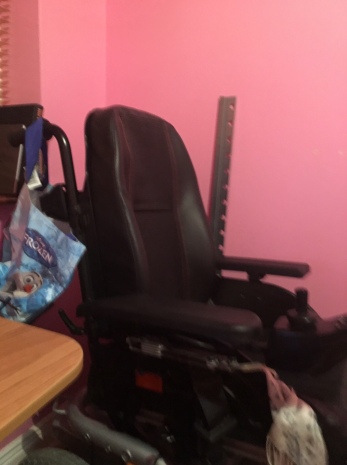
wheelchair.JPG

My poor, sad, neglected wheelchair (sad face)


I have really missed blogging here for the last two weeks (I’m back, yay), but to be honest, I just needed a break. I felt wiped, depleted and I know from hard  experience that when I feel like this it’s better to take a breather rather than having a meltdown and sobbing in my jammies at the side of the canal at 4.30am (ahem, apparently). I have been busy though with activism, and I got my submission in to Date With An Agent (I hope – I never enclosed an SAE to acknowledge my entry but I know my  future award winning novel will totally be selected), so that could account for why I’m that little bit more tired.

Or maybe it’s because for the last month and a half, I’ve been without my electric wheelchair, and the extra physical effort of walking everywhere is taking its toll. And thank God it is finally getting fixed tomorrow, because I am wiped.

My dear mother, who spent the first five years of my life doing physio with me every morning, was dead set against me using a wheelchair. We lived in a two-storey house when most of my disabled friends lived in bungalows. She wasn’t too keen on me having a wheelchair in college, although she understood the reasoning behind it. Growing up in a mainstream world led me to believe that one’s value was largely based on their physical ability to do things and to get around.

When I had Alison, my friend advised me that I wouldn’t want to miss out on doing things with my daughter, and so I got myself an electric wheelchair. Being ambulant I don’t think I’d have any chance getting one off the HSE. And for the first time since becoming a mother, I wasn’t housebound. I could take Alison for walks whenever I wanted, long walks and still have the energy to come home and do some housewifey things, and write my masterpiece. This is why the phrase ‘confined to a wheelchair’ annoys me so much. A wheelchair doesn’t confine, it liberates! Without it, I feel confined, trapped within the limitations of my body.

I firmly believe that when we are given access to tools like wheelchairs, technological aids and Personal Assistance, we are enabled to become the best us we can be. There is great strength in acknowledging that your physical impairments are not the problem, that society needs to address the needs of people with disabilities and be more inclusive. Above all, I believe that people with disabilities need to drive this change themselves.

It came to my attention over the weekend that student Kathleen McNamee, senior editor of the University Times, ‘cripped up’ or explored Trinity College campus in a wheelchair. What’s wrong with this, you might ask. Isn’t it great that people without impairments are trying to see the world through the eyes of a wheelchair user? Well firstly, Kathleen is not a wheelchair user; at the end of her article she wrote: ‘While I will be happy to hand my chair back tomorrow morning, I am also aware that not everyone is afforded this opportunity’. To me this implies that she sees the ‘problem’ as the wheelchair,  not the inaccessible environment. Also, why did she have to ‘crip up’? Why didn’t she look for the experiences of full-time wheelchair users who navigate the campus on a daily basis?

Secondly, I felt that the article was a little unfair on Trinity. When I carried out an access audit in 2004, we identified all of the problem areas and efforts have been made to fix things: the pathway through Front Square, there’s now a lift up to the Pav (the on-campus watering hole) and ramps to the buildings in Front Square. Things are far from perfect, but they’re improving.

Irish Rail, however, seems to be getting worse. A friend of mine told me recently that on principle she refuses to give any train station 24 hours’ notice of her intention to travel because she sees herself as equal. Today I had to travel by train (I had no wheelchair, just my rollator) and didn’t give notice, so I had no reason to be disgusted when assistance didn’t appear in Tullamore (even though I rang an hour beforehand), leaving me no choice but to fling my rollator and myself off the train. Had I been in my wheelchair I’d probably be writing this from Galway!

So to summarise, I’m looking forward to my wheelchair being repaired in the morning and to getting my independence and energy levels back. My normal life back. I know I should make more of an effort to get fit, and some might think I shouldn’t be so lazy. Feck that. My daughter needs a mummy who has the energy to do things and go places with her, and I need the energy to write, and that’s exactly what my wheelchair offers. It doesn’t matter how you get there, as long as you do!

How Many More Graces?

I go through phases, extremes of mood and thoughts. Sometimes I’m elated. I love writing. I know I’ve made the right choices in life. Other times I worry that I’m making myself increasingly unemployable as the days go past.

I haven’t really left the Centre for Independent Living behind, of course. I still volunteer a lot of my time to promoting the philosophy of independent living and campaigning for equal rights for people with disabilities. In fact, I’m now part of an activist group called By Us With Us. we’re still relatively new, but we recently set up a blog which is well worth a look.

Independent Living is not my job any more, my husband insists. You’re a writer now. You should be dedicating every free minute you have to writing and trying to get published.

And oh, how I would love to! How I wish life could be this simple, that I could have the luxury of locking the office door every day, focusing on nothing but putting words down on paper. My  mother used to tell me that I can’t fix all of the wrongs in the world. She was right, of course, but there are so, so many wrongs that I feel that I must try and do something;

As most of you know, I’m writing a novel at the moment, a story that initially came to me in 2007 while I was unemployed for six months. The story explores the life of a disabled woman who was tortured by a nun in a residential institution and how she copes with the aftermath of that abuse. Lately, I’ve been finding it hard to stay motivated. This is off the wall, I thought to myself as I rewrote the first chapter the other night (for the sixth time). No-one reading  this is going to believe that someone could be treated with such cruelty.

I’m not a trusting person anyway, and I’m sure I’m not alone in this distrust, particularly in the government at the moment (or, as it is starting to transpire, any government before or after this). Yesterday, the story of the abuse suffered by ‘Grace’ dominated headlines, a girl with an intellectual disability (now forty years old) who was abused while in foster care. It’s still a little unclear the extent or the nature of the abuse; some of it is of a sexual nature.

Grace has an intellectual disability and in the eyes of the Irish state at least, cannot be trusted to have her own narrative voice. And in Ireland, this is not limited to those with intellectual disabilities. The opinions and lived experiences of disabled people in Ireland don’t seem to matter to our policy makers.

I doubt that Grace is an isolated case. So why is there such little uproar about the status quo? There is mounting evidence to illustrate that disabled people should not be living in institutions, that the state cannot be trusted to provide a decent standard of care. Who can?

In December 2014, the nation was shocked by the Aras Attracta scandal, which saw people with intellectual disabilities being physically and psychologically tortured by those who were meant to care for them. People were disgusted by the RTE documentary; at one point my husband, whose stomach was turning, asked me to turn it off. I refused.

‘How can you sit there and watch that?’ he asked, bewildered by my seeming nonchalance.

‘Because,’ I replied, ‘Ireland has buried its head in the sand for too long. We have a government, and this and successive governments not only allow this abuse to happen, but by implementing cutbacks create situations such as these. We need to see this and someone needs to take responsibility.’

The Aras Attracta staff were later held accountable and given paltry sentences of community service. But what happens to those who continue to abuse people with disabilities behind closed doors, and are never questioned? I’m not talking solely about people in congregated living settings – I’m talking about people who suffer abuse at the hands of their families too.

When I started doing some research for my novel, what struck me was the lack of information available about how disabled people were treated in Ireland over the last fifty years. Apart from a few research papers, the Irish Wheelchair Association’s collection of stories, Extraordinary Lives, and this documentary on the programme ‘Horizon’ called ‘The Weakest Link’ on RTE in 1966, there isn’t a lot of documented stories about what life was like for a disabled person, particularly in a residential setting. So essentially I’m writing a story about something I have little information.

But if I can achieve this, then I will be happy. Because it’s time for disabled people to tell their stories, and to discover and reclaim their histories.

If we don’t, then our stories will be like Grace’s – spoken through the mouths of people on the outside.  Our stories should – and deserve to be – woven into the mainstream fabric of Irish society.

Just Catching a Train (in 24 hours)

I’ve a meeting in Dublin on Wednesday. It’s straightforward  getting there: if you’re going the public transport route, you simply get a train to Dublin, then regardless of whether you come into Heuston or Connolly Station, you can catch the Red Luas to Smithfield and then it’s a ten minute walk. Easy peasy. Shouldn’t be complicated at all, right?

No, it shouldn’t. But this is Ireland, and we seem to have a tendency to make things more complicated than they need to be. And for people with mobility difficulties, public transport isn’t as convenient as it is for others.

I went down to Tullamore Train Station this morning (according to the Irish Rail website, passengers needing assistance are ‘advised’ to give twenty-four hours’ notice) to let them know that I intend to travel on the 09.29 from Tullamore to Heuston on Wednesday morning. I admit I did it as a bit of joke, to make a point. The guy who works there is lovely – I’ve nothing against him as a person – but he was reluctant to guarantee that I’d have assistance on Wednesday afternoon coming home. ‘If I’m here, I will definitely help you,’ was his response. If.

The assistance I, and many other wheelchair users need, is simply the provision of a portable ramp to enable me to disembark from the train safely. That’s all. In my case my chair is electric so there’s no manual pushing involved. But without the provision of a ramp, my independence is immediately compromised.

Okay, I admit that giving two days’ notice is a tad dramatic. But my attitude isn’t without basis. Just last month, a young  wheelchair user got stranded on Platform 2 of Tullamore Train station and had to wait 30 minutes before it was decided that the train should pull into platform 1. The lift was out of order, as is often the case in Tullamore.

I’ve been stranded on a train twice before in my wheelchair because there wasn’t assistance waiting for me at the train station (and I always give as much notice as possible – okay, not always twenty-four hour notice, but I do try). It’s very annoying having to get off at the wrong station and either get a train or a taxi back. It eats into our time and financial resources. Our time isn’t viewed to be as valuable as everyone else’s, I don’t think.

Impairment doesn’t create inequality, society does. Having to give twenty-four hours’ notice to use a train is discrimination and yet, in spite of the many complaints made in relation to accessibility to Irish Rail (according to thejournal.ie, there were 12 complaints about accessibility in 2014. This 12 merely represents complaints made, not necessarily the number of passengers who experienced problems with regards to access), things seem to be getting worse, not better, for disabled passengers.

I’m not alone in experiencing these problems. Last year a friend of mine and wheelchair user, Ann Marie Champ, was denied assistance in Newbridge train station and was forced to continue to Kildare. (Ann Marie works in Dublin and commutes every day). Once in Kildare she had to wait for a taxi to arrive from Portlaoise to bring her to Newbridge. An enraged Ann-Marie remarked, ‘I flew to Australia last year and had to get six flights and had no issues. It only took five minutes over the phone to organise. Yet, I can’t get 20 minutes up the road because of the refusal to lower a piece of aluminium.’

Louise Bruton, the founder of a blog/accessibilty guide called Legless in Dublin, also had trouble with Irish Rail last November when the assistance she had requested in Heuston Station didn’t arrive, leaving her stranded on the train for twenty minutes. ‘The train was stopped further down the tracks than normal and the lights were dimmed, so I was in a scene from a 1990s teen horror flick,’ she told the Irish Independent. “I stuck my head out the door… I shouted again and again and all I could hear in return was my echo. I pressed the train’s emergency button but nothing happened. And then I tweeted. My responses gave me the emergency number for Heuston and, thankfully, Heuston’s very apologetic station manager, Liam Donegan, answered my call and rescued me.’

Ann-Marie and Louise’s experiences show that there is no dignity in travelling when you have a disability in Ireland. And now it’s been proposed by a Cork TD that travel pass holders should pay a subsidy of €6 for travel! For disabled people at least, this is outrageous. Many of us don’t drive and are solely dependent on public transport to get around. And even if was decided that €6 was reasonable, this still wouldn’t mean that disabled passengers would be guaranteed worry-free, hassle-free journeys.

I’m afraid I don’t have definite answers to these ongoing issues. There’s no doubt, however, that these practices are discriminatory. People need to continue to be vocal about this issue, because for me, as a contributing citizen, this isn’t good enough.

In the meantime, fingers crossed that I get to and from my meeting in Dublin on Wednesday, without incident!