Unknown's avatar

About sarahfitzgerald1984

Hi there! My name is Sarah Fitzgerald. I'm a mother to a beautiful daughter and a wife. I've always loved writing and recently found the courage to start again. I'm nervous but excited and I hope I can create some interesting and thought-provoking posts here.

A Letter to my Sixteen Year Old Self – Tuesday Thoughts 5

Dear sixteen-year-old Sarah,

You don’t know me, but I am you, writing this from the year 2023 (no, you have not died alone at the age of 25, as you thought you would!) In fact, you’re due to turn the big four-oh next year, and life is even better than you could ever imagine, though I know it’s hard to see it now.

Right now, Sarah, you’re the “swot”, the misfit, and you don’t have that many friends. You’re lanky, clumsy and awkward, and no matter what you do, you just can’t seem to blend in. Maybe you don’t realise it now, but it’s not your destiny to fit in, and that’s not a bad thing. My dear, you’re not a stick of foundation, existing only to cover over the cracks. You were born to stand out, and as cringeworthy as it may seem now, in time you will embrace it. You will be a rock of support for so many of your peers, disabled people who, like you, yearn to live independently. You know that you’re good at looking out for other people.

Unfortunately, you’ll always be stubborn and you’ll never really take your mother’s advice, and learn to truly look after yourself. This will always leave your mental health a little fragile, something you will struggle with over the years. However, your future is so much brighter than you could ever imagine, and contrary to what you believe, you will find someone to share your life with. In fact, you will meet the love of your life on the first of November this year, the year 2000. Where? Clochan bloody House. I swear to God, this isn’t a word of a lie. You are going to be so glad your mother forced you into respite, at the ripe auld age of sixteen?! His name’s John Paul and he’s perfect (okay, not exactly; he’s from Laois, but sadly some things cannot be helped). You think you don’t believe in love? Well, this guy is going to shatter all your illusions.

You two need each other it’ll be you and JP against the world. Against the advice of well-wishers, JP and yourself become will rather close and in fact, he will be the only partner you’ll ever need. You’ll attend your grad with your boyfriend, and he will come up to Trinity College to visit you at weekends. Yes, you read right – you’re going to university. You’re a hard worker, and you’ll study English in Trinity with the intention of pursuing a career in writer (and God bless, you’re still trying). You will live independently from your parents and after burning a few pizzas, you’ll learn that you’re actually a proficient cook, able to whisk up meals out of the measliest tins. You’ll meet Brendan Kennelly and exchange pleasantries with him in Front Square, sit in lectures given by Seamus Heaney, and write essays about Shakespearean plays, all while feeling like the biggest imposter to walk through through that wooden Front Gate. I promise you that your classmates all feel like imposters too, and how I wish I could go back and whack your heads together!

Anyway, back to JP. I know you’re baulking at the idea of marrying a disabled person for the sake of it, but that’s not what’s going on here. This guy is super supportive of your dreams, as you are of his. You want what’s best for each other, you constantly encourage each other to embrace your individuality and each other’s interests. It will surprise you, as a skeptic of the institution of marriage, that you’re going to walk down the aisle in Tullamore Church in August 2010. 

You will also have a family, even though I know you’re dubious about whether you would make a good mother. Only one person on this earth could be the judge of that. Her name is Alison, who you’ve named after your mum’s favourite bluegrass singer, Alison Krauss. She will be perfect in every way. Of course, motherhood will not be an easy path and yet again, you will find yourself having to prove your ability to everyone. If I could lend you one piece of advice at this stage, it would be not to listen to the doubts of others. There is no reason why you’re any less capable than those so-called “able-bodied” mothers who can carry their children on their hips. It’s a tired cliché, I know, but love is really all that you’ll need. And her love will carry you through, and make you a better person.

You’re afraid of what the future holds right now. Many of your disabled friends have been relegated to the modern-day equivalent of sheltered workshops, but you shouldn’t be discouraged by this; there are often different routes to our destinations of choice. Besides, just because you will be lucky enough to go to university doesn’t make you better than anyone else. If you ever become privileged enough to pursue writing as a career, then you must learn to cast those prejudices aside and truly listen to those stories around you. You’ll learn so much more than you think.

Right now, you’re contemplating writing a play for the summer, in order to secure your place in TY. Just follow your heart. It will be huge. You and your friends will become so much closer. However, one mistake you’ll make for years is taking yourself and your writing too seriously. Writing is something that you’ve done forever, but you’ll hate it for a while. You’ll jack it in to try something more mainstream: office work. Yes, you’ll abandon your dreams for a while but you’ll always be led back to writing – where you’ll belong. Just to warn you – it will never make you rich. But you’ll come to accept that money is no substitute for good mental health.

And one last thing – your biggest fear will come true in just nine short years. I’m afraid that your mum will be struck down in her prime, at the tender age of fifty-one. You will be devastated, naturally, but don’t you dare wallow in self-pity. You owe her a lifetime debt of her steadfast belief in you, for her refusal to allow you to sit around and wait for opportunities to drop into your lap, for never mollycoddling you. Only when you get older will you truly appreciate the struggle that both mum and dad faced in proving your true worth to those who advised them to dump you into a home, why they insisted that you went for extra physiotherapy sessions, and why they pushed you out into the world. Right now, it seems unfair that you have to cook every weekend, or do a mountain of chores, or cycle to school every single day, even in lashing rain. But life isn’t fair, and by the time you leave college and go on to work and starting your family, you’ll realise that. And you will be filled with an irrepressible sense of right and wrong, and the strength to fight for your rightful place in the world.

So, my child, keep pushing forward in the knowledge that although things look bleak now, they will get better. Your work ethic and charming personality will win through in the end. Just be patient and keep the faith.

All my love,

39 year old me.

The Important Conversations – Tuesday Thoughts 4

(Published Sunday 25 June 2023 due to holidays)

Let me take you back to January 2008. I’m working with the Offaly Centre for Independent Living, my first job after graduating from Trinity with an English Degree. I’m twenty-three, and I think I’m the cat’s pyjamas. I’ve landed a job here on the FAS Scheme with little to no experience. Trouble is, I don’t quite know what my role is. I want to add something, but I’m not sure what I’m adding to.

I google Independent Living and read definitions that at one stage, I could recite verbatim. I’m starting to think that my new job isn’t all that exciting. Then I come across the story of Ed Roberts, and suddenly I’m captivated. It’s the story of a very ordinary boy who, in his early teens, contracted polio and was left almost completely paradise. He’d written himself off, fervently wishing to die until he was told that if it was truly his wish, then so be it. Suddenly, Ed realised that it was freedom of choice he was craving and that he wanted to live.

I’m hooked. I need to know more. I come across another name, Judy Heumann, and my mouth falls open as I learn that she and Ed were at the centre of the establishment of an entire human rights movement. There’s more information about them both – interviews, short films – and I realise, as I waste away another day in front of my laptop, that it’s these stories that are making me more curious about Independent Living. These real, personal stories.

I gain permission from my manager, the late Michael Nestor, to capture these stories. But I’m young and inexperienced, and my overall efforts are a bit crappy. I don’t prepare the questions properly, I don’t bother to prod people or encourage them to talk. I’m going in with my preconceived ideas about what people are going to say. As a result, the finished product is a flop, and there’s no uniformity in the collection. No common theme emerges. And I convince myself that maybe I’m not as interested in Independent Living as I once believed.

Still, the idea of capturing the Independent Living Movement in some tangible way never strayed far from my thoughts. It’s said that one reason for writing a book is because as a writer, you wish to discover something, rather than to impart wisdom that you already know. In 2014, I decide that I wanted to write full-time, a decision that frightens me to this very day. I’ve always loved reading stories, and I want to capture some of my own. I start to move away from disability activism. Alas, something terrible would happen and whether I like it or not, I’m about to be roped back in.

On the 13 October 2016, RTE announces that the father of the Irish Independent Living Movement, Martin Naughton, has passed away at the age of 62. It can’t be true. Surely Martin is invincible? I genuinely believe that the bottom has just fallen out of the disability movement. Who would take over? Little do I realise that nobody needed to “take over”, that for years, several other disability activists had been coming together to bring about much-needed social change. I know that there had been a historical protest in September 2012, rallying against the eradication of Personal Assistance for disabled people in Ireland, but who had been involved? What had been sacrificed? Were they scared? Did they ever just get tired of the whole bloody racket and vowed to give up? For some reason, I need answers to these questions. I need to know that, if I’m going to join a disability movement, that it’s not going to be a waste of my time and energy. I need to know that this movement truly belongs to disabled people.

I’m being arrogant again. I know nothing. A week after Martin’s passing, a group of us are brought together to discuss a commemorative event. I’ve heard of many of these people, including Ann Marie Flanagan and Shelly Gaynor, but I’ve never met them before. I was following them in a quest to create a space to talk openly about rights and self-determination, but I was joining the motorway from a different exit. I wanted to know more. I asked permission to set up a blog to gather these stories. But it still wasn’t enough for me.

Another reason for writing a book is to create something that you’d want to read yourself. I’d always wanted to read about the history of the Independent Living Movement in Ireland, not just about dates, but I want to capture the human passion behind it. How do you nurture that inner self-belief that you truly belong in the world? Working on the commemorative event, I realise that camaraderie is a huge part of it. Activism isn’t just about marches and policies; it’s those little chats in the pub afterwards where you expose your vulnerabilities to other people. That’s how you learn to trust in each other, and come together for a collective cause. As I hear other people talking about Martin Naughton, what struck me was how many people remark “I didn’t know that I could do x, y or z, but Martin believed I could, and so I did it.” That, to me, is powerful, and I wondered how I could collect these stories and inform others about the power of the collective.

One thing I learned when I worked in the area of independent living is that people don’t always relate to academic definitions or legal jargon. They connect to each other, something that became increasingly obvious in the early days of the COVID pandemic. Independent Living Movement Ireland committed to creating online spaces where seasoned and emerging activists alike could share experiences with each other. In April 2020, with no hope or expectation whatsoever, I approach Des Kenny, Chair of Independent Living Movement Ireland (ILMI), with an idea that we could capture these stories. His support and encouragement led me to approach Damien Walshe, CEO of ILMI, with a rough proposal. To my surprise, he agreed that ILMI and the Independent Living Movement should document these histories, and would I like to have the honour of doing it?

I was thrilled. – But shouldn’t you call in a professional? I asked.

-You are a professional, I was told. You’re a disabled writer with lived experience. Now put that useless doubt to one side and get on with it. That wasn’t what I was told, of course. Damien and Des are kind, diplomatic gentlemen. What they actually said was: “We wouldn’t let you near it if we thought you weren’t up for the job.”

And so, we invited a number of activists to recount their stories to a live Zoom audience on Wednesday nights during the summer of 2020. Ellis Palmer, talented BBC journalist, suggested that the sessions should be made into podcasts, and made available on the ILMI website. 

I admit, I didn’t really give much thought about what I’d signed up for. I’d done transcription work before, but I was nervous about doing this. I wanted to capture the unique voices of those who were to be included, so the transcriptions were word-for-word, then edited so that I wasn’t tempted to include my own slant on their stories. The actual progress is laborious and time-consuming, but completely worth it. It’s the only way to capture the authenticity of these pieces, and for these activists to have ownership over their own words.

I cannot stress enough that the final product, Conversations about Activism and Change: Thirty Years of Independent Living Movement Ireland and Disability Rights is not a definitive history of the disability movement, but rather my first attempt in capturing part of it. If I had my way, I would still be interviewing disabled activists and transcribing their stories, but alas, I’m only human, and we needed to agree an end goal. These stories are intensely personal. Details of personal and political struggles can be sad to read. What shines through the entire collection is the recognition on the part of all the storytellers that they were not alone. Once they wrestled with the internalised oppression, which is a byproduct of an over-medicalised childhood, they learned how, through working together, to recognise and tackle societal and attitudinal barriers. Some stories include subtle nods to fallen comrades who influenced them as activists. There’s a consensus that although much has been achieved, we still need to keep fighting to be recognised as citizens with rights as opposed to objects of care.

Conversations about Activism and Change is the book I yearned to read when I started working in the area of Independent Living, and I am so relieved to know that younger activists coming up behind me will have some sort of blueprint for campaigning for equal rights in the future. It is my dream that the language of equality and human rights will override the long-seated discourse of pity, charity and helplessness that is so deeply intertwined with disability in Irish culture. And the only way this will ever happen is if we continue to use our own voices to create those important counter-narratives, to have the courage and conviction to speak for ourselves and own our own histories. 

Conversations about Activism and Change: Independent Living Movement Ireland and Thirty Years of Disability Rights

Available on Amazon as paperback and for Kindle:

Summer in Dublin – Tuesday Thoughts 3

(I can hear some people humming Bagtelle from here!)

I have always loved my independence. So much so, that when I went to Trinity in 2003, I made a decision to try and become self-sufficient. With two little sisters coming up behind me, I just didn’t think it was fair to go home for the summer after a year in uni and scrounge off my parents. Besides who, at the age of nineteen, wants to go back to telling their parents their every move after enjoying so much freedom during the academic year? I certainly didn’t.

Before I sat my first year exams, I gathered up the courage to ask the Trinity Student Disability Service for some ideas. To be honest, I thought they’d tell me that it wasn’t in their remit, but they seemed impressed by my determination to be truly independent, and offered me a job as Access Auditor for the summer of 2004. The Trinity Accommodation office also offered me a room out in Rathmines, within their complex on the Dartry Road. I’d never been there before. Most of the time, whenever I returned to Tullamore by train for the weekend, I would be escorted to Heuston by my lovely Personal Assistant Mary, collected from right outside my rooms in her little black Polo. Suddenly, I had to navigate Luases and buses to get from Rathmines into work in Trinity.

Working as an Access Auditor was bloody exhausting. My friend Ciara and I worked together on it, and we got a one-day crash course on what we were expected to do. And man, it was detailed. How heavy were the doors? What height were the doorhandles? Were there any plug sockets, Braille, loop systems? What were our recommendations? The level of detail expected was extraordinary, and yet it only took us a month to go around to all the different faculties in Trinity trying to gather the information. That said, we were working seven-hour days, which was quite the culture shock to an English Studies student who was only expected to attend twelve one-hour lectures/tutorials a week! It gave me the kick up the arse I needed to motivate myself to study harder in the subsequent years. Indeed, my university experience is part of the reason why I can now work consistently and independently.

I liked living in Rathmines, though. It isn’t quite a town, nor does it feel like part of the city. I remember how God-awful the footpaths were going from Trinity Halls down to Tesco. The 14A, which stopped directly outside Trinity Hall, used to bring me to work into the city every morning, but it wasn’t always reliable timewise (surprise!), nor was it wheelchair accessible, which meant I had to walk – thankfully, only a short distance (I didn’t even need a rollator in those days). I’d always aim to be at the bus stop for the 9.05, and it almost invariably drove off while I was on the other side of the road, trying to cross in the height of rush-hour traffic. Thankfully, by the time I lived out there in the summer of 2006, I had an electric wheelchair, meaning that I could whizz to the Milltown Luas Stop, then fly from the St Stephen’s Green stop down to Trinity, where I was employed again for the summer, this time uploading the results of the 2004 Access Audit up onto the Disability Services website.

Trinity is different in the summer than during the academic year. During term time, you’re always bound to bump into people you know, but the majority of my friends usually went home, or travelling, for the summer. The lines of excited Americans waiting to see the Book of Kells grows threefold in the summer months.  But even with the sudden influx of tourists, I always thought it was a beautiful place. When I was living in Botany Bay, which is located right in the heart of the campus, circling the tennis court, I awakened every morning to the poc-poc-poc of tennis balls. We were privileged to have a cleaning lady working in our block, who helped me to keep on top of the housework and to help with laundry (unless both exits of the Buttery Restaurant were open, the laundry facilities were not wheelchair accessible.) I was quite embarrassed by this offer of help (who wants the cleaning lady looking at their undies?!) but after nearly falling down the steps with a sack full of laundry, I had to concede that I needed the assistance.

Walking through the campus on a sultry summer’s evening is an experience that will always remain ingrained in my memory. I’d head out through New Square across to the rugby pitch, walking slowly as I watched people picnicking on the green in spite of the “Keep off the grass” signs, people congregating around the campus pub, affectionately known as the Pav (which, with its humungous flight of steps, was not accessible in my time) with plastic glasses in their hands. Around eight o’clock, the drone of the city surrounding us would subdue to a gentle hum, while the midges appeared and the orange sun hung low beneath the campanile in Front Square. Even then, I’d a sense that I wouldn’t appreciate those days the way I do now.

Sundays was treat day, and John Paul and I would walk around Saint Stephen’s Green park, stopping in Lemon on Dawson St for breakfast and having dinner in Café en Seine on the way back to Trinity, or the Luas to Rathmines. Poet extraordinaire, Professor Brendan Kennelly, often had brunch in Lemon on Sunday mornings, and he would always come over to us with a wide smile, a warm handshake and a “It’s so great to see you.” Looking back now, I thought it was the most normal thing in the world but now, I can’t believe I took any of it for granted. Now that Professor Kennelly has passed away, I’m so glad to have those memories.

However, one particular summer changed my life: the summer of 2005. Trinity couldn’t afford to take me on for work, and so my Personal Assistant introduced me to the Father of the Irish Independent Living Movement: Mr. Martin Naughton. I met him in Chief O’Neill’s in Smithfield, as many others had on separate occasions before. He gave me a summer job, and before I knew it, I was in the gatehouse of Carmichael House meeting other disabled activists, including Donal Toolan and Hubert McCormack (sadly all three men have left this world, RIP). That summer, I learned that it was okay to ask for help, and that being independent did not mean that I had to be self-sufficient. I also learned how to use the Luas, which was only in existence for a year at that stage. I remember telling Mum about it, and her shrieking down the phone at me: “Stay away from the Luas – you’ll be killed!” (In the early days of the Luas, there were lots of near-misses/accidents). Deliberately disregarding her instructions, I caught the Luas from Abbey Street twice a week and disembarked in Smithfield, which back in 2005, was quite a rough area. In saying that, I was never attacked or harassed, and the dishevelled men would raise their cans to me as I walked past on those sunny July mornings. That summer, I forged what has so far transpired to be a lifelong bond with the Independent Living Movement.

Those days of wandering around, coming and going as I pleased, now feel as though they happened to someone else. Just thinking about the amount of work I did during those summers make me feel sleepy. But I’m grateful for what I learned: how to budget, how to find work, how to look after myself. I bring these lessons into my life every day. It just doesn’t feel as exciting anymore.

And Dublin is different to me now that I have a child of my own. Once, the city was a treasure trove to be explored; now, I can smell the stagnant River Liffey, see the throngs of people walking on autopilot down O’Connell Street. I can see the destruction of addiction, the potential to be targeted by thieves, the dangers. But looking at the past through rose-coloured glasses, I see adventure, hope, promise. And I’m thankful for my Living in Dublin adventure, which prepared me for living in the real world.

The Lost Years – Tuesday Thoughts 2

Two weeks ago, my husband and my daughter sat me down. They’d obviously been discussing something before approaching Big Bad Mummy (yes, I’m the bad guy in this house, which is always great fun). At first, I thought there was something wrong, but then Alison turned around and said the words I’d been expecting to hear for a while:

“Mum, I want to start walking to school. Not every day, but maybe two days a week…?”

“No way,” I snapped, with no hesitation whatsoever. “Are you mad? Too dangerous. You’re far too young.” And la-la-la, etc, etc, ad nauseum. My husband looked at me in surprise.

“Hon, it’s around the corner,” he reasoned. “Plus, she is eleven. She will be walking in secondary school, which is only a year away.” (That also stung hard. My baby is slipping away!) “We need to let her do it, learn how to take responsibility.”

I didn’t want to hear it. I flew into a silent rage and went to bed early, simmering because I hadn’t gotten my own way. But then I went on Google (of course) and was shocked to discover that it’s normal for kids as young as eight to walk as far, if not further, than our daughter was proposing to walk to school. And as I lay in bed, annoyed that Google had not taken my side, I realised that deep down, I don’t see Alison as an autonomous eleven-year-old preteen. (Well, sometimes I do. The mood swings don’t leave me much choice).

I admit that I’ve always been an overprotective parent, which is a direct product of the crippling anxiety that I’ve suffered from for as long as I can remember. Lately, however, while pondering how to allow my preteen some well-earned independence and keeping her safe at the same time, I wonder whether the pandemic affected the natural evolution of Alison’s independence. Is that why this sudden thirst for independence is such a shock to me – because of the lost time during lockdowns?

In the grand scheme of my own life, the three lockdowns we had in Ireland – from March 2020 to May 2020, from October to December 2020, and January to March of 2021 – don’t really matter. I was working from home anyway, I had a project to focus on (the compilation of Conversations about Activism and Change: Independent Living Movement Ireland and Thirty Years of Disability Rights), and I was involved in so many different organisations and advocacy groups that I often had two or three Zoom meetings a day. I soon got used to talking to friends over Zoom and Google Meets, even if I missed the intimacy of having dinner or a coffee together. All of this is now a distant memory, since we’ve supposedly returned to normal.

COVID has been around for approximately 1/13th of my life. But in Alison’s case, it has dogged nearly a quarter of hers. COVID struck the year of her Communion, meaning that the occasion was postponed and the party that we had planned, complete with in-house entertainment and seventy guests, was scaled back to a family dinner in the Tullamore Court Hotel (that said, Alison has about sixty people in her extended family alone, including aunts, uncles and cousins). Even when schools reopened in 2020, things were not the same: she still had to social distance, she could only socialise outside in the cold, and she had one friend who was allowed in our house, as part of her “bubble”. 

It seems like a lot to deal with, and I assumed she was pretty angry about it all. On Saturday night, when I was tucking her into bed, I asked her how she felt about the last three years.

“You must feel like you missed out on a lot.  Like your friends.”

“Yes,” she admitted. “For the first month or two, things were pretty hard, and I did find it lonely on my own. But it wasn’t all bad. You really pushed the schoolwork.” She laughed. “Honestly, I think I did more work in those six months than I have in the whole of primary school. And I enjoyed the challenge.”

“So, are you saying that you didn’t mind lockdown?”

She laughed. “I never want to do it again, let’s get that straight. But,” she paused, “we did lots of things that we just don’t get time to do now – the art, the baking, building forts, the movie nights.”

“And you don’t feel annoyed about any of that? About the things you missed?”

“Nah,” she shrugged. “We spent time as a family, even if we did kill each other sometimes. What’s the point in being annoyed, when life is much better now?”

I went to bed on Saturday night, pondering on how her unexpected answers were going to change the trajectory of this blog. And instead of dwelling on the psychological damage she’s supposedly suffered over the last three years, I thought about the things that Covid has given her. Alison is a prolific reader, having read everything she could set her hands on during the course of the pandemic. Once I manage to wangle her Switch from her, she loves writing her own stories, going for walks and playing football and camogie on the green. Occasionally, she’ll complain that she’s bored, but I think that has more to do with the age she’s at (eleven – not quite a child, not yet a teenager). Over the next few years, she’s going to face some of her toughest challenges – fitting in, discovering who she is, dating, and growing up in a world obsessed with social media.

But I wonder now if the whole Covid experience had lasting advantages as well. Alison has become an expert at dealing with disappointment, with making do with the circumstances facing her. She’s had Covid four times: one bout resulted in her missing a gymnastics competition, and she came down with it before Christmas 2022, causing her to miss her class Christmas party. Both times, there were tears for about ten minutes, then she dusted herself down and focused on getting herself better. She isolated on her own, not wanting us her parents to be sick too, and just sat it out. Reader, could you have endured that isolation, at the age of ten? Even with all the TV, books and Nintendo Switches in the world, I know for sure that I couldn’t have.

And maybe – probably – I’m making something out of nothing, as per usual. Perhaps, I’m just using Covid to deflect from my sadness that my little baby is growing up. And truth be known, even if time slowed to a snail’s pace, I was never going to be ready for it.

Should I Be Fixed? – Tuesday Thoughts 1

Apologies folks for the long silence. I was trying to decide what to do with this here blog, whether to shelve it or archive it, and after a lot of soul-searching (and talks with my patient husband and some writer friends, including the long-suffering Ken Mooney), I’ve decided to commit for the next number of weeks to have something ready to post every Tuesday, but – full disclaimer – this may or may not happen. Watch this space!

The topic of this week’s unmissable instalment is timely, linking in with two separate things – the novel I’m hacking away at, and a new programme that will be available soon on BBC Reels featuring activist Paddy Smyth entitled Should I Be Fixed? Like myself, Paddy also has Cerebral Palsy, and like many of us, he’s had his own journey to self-acceptance and feeling comfortable with his disabled identity. I learned about the programme by accident, when I was farting around online this morning instead of writing my novel. 

Paddy did a radio interview with Ray D’arcy, discussing the upcoming programme. He spoke candidly about the aftermath of his experiences on the RTE programme, First Dates, which aired in 2019. “I thought I’d be loved,” he said, recalling that some of the comments he received following the show were quite negative. “Some people accused me of using my disability to win.” I can only imagine how hurtful that was.

Paddy’s journey to self-acceptance shares some parallels with mine, and also with Rachel’s, the character who I’ve been trying to write a novel about for the last eight years(!!!) Lately, I’ve managed to gather some momentum with telling Rachel’s story (nearly back up to 60k, yay!), but only because I took some time out to do some real self-reflection. I had to learn to be comfortable with some heavy realisations. The first one is, crucially, that I seem to have a penchant for punishing myself for my impairment. Since starting to use a wheelchair, my output and productivity has gone through the roof. My sleep has improved, I’m writing every single day, and I also manage four sessions a week on my exercise bike. And once I sort out the flat tyre on my tricycle, I’ll be back on that as well, especially in this good weather. My life has become so much richer, and yet I still berate myself for not walking more, because the overarching message from society continues to dictate that I am somehow worth less if I’m not at my physical best.

I caught a glimpse of a programme the other night, This Time Next Year hosted by Lorraine Kelly, where one of the guests were a wheelchair user and more than anything, she wanted to relearn how to walk using a prosthetic limb. And of course, that was the happy ending of the programme. That was her wish, and she worked long and hard to ensure that wish was realised. Healthwise, it is better for this lady to be walking than to be sitting in a wheelchair all day long. But this particular message – of fixing one’s body or hiding or minimising one’s impairments – seems to be more palatable to a wider audience than the idea that disabled people/people with impairments are perfectly acceptable as they are, and that self-acceptance is more productive and healthier than becoming obsessed with cures.

Technological advances aren’t always the blessings that they appear to be. For example, AI (Artificial Intelligence) can now write content for websites, threatening my job (nooooo!) and the jobs of many other content creators across the globe. Think about it: why should a company pay me for content articles when they could save money and use an algorithm instead? No proofreading needed there, because there is no human error. Similarly, prosthetics and robotic limbs have helped many disabled people regain their independence, but they aren’t for everyone. To ask a disabled person if they have considered prosthetics may come across as offensive, given the struggle that many of us have with our bodies. Technology has advanced to a point where there is now a wheelchair that can scale a flight of steps (not available from the HSE though, I’m sure). Some people think that’s beyond cool. 

But this obsession with finding ways for people to overcome physical barriers puts the responsibility back on the disabled person, which isn’t right. Surely making our world accessible to everyone is a more sustainable and measured approach? Isn’t it weird that we live in possibly the most accepting time in history in terms of sexuality and identity politics, and yet it’s still an act of rebellion to embrace and love one’s disabled self? If a venue doesn’t have ramps or lifts, it’s a safe bet that there’s no Braille, or induction loops for hearing aid users, or easy-to-read menus and promotional material. In the absence of provisions, disabled people are forced to adapt to a world that was not built with them in mind. Because of the inaccessible environment, we are often left on the outside.

We are all getting older. People are living longer, making them susceptible to illness and disability. COVID have left many people wrestling conditions like Fibromyalgia; it’s estimated that 20% of those recovered from COVID have Long COVID or lasting effects from the illness. The pandemic reminded us of the frailty of the human condition. Why are so many people obsessed with finding a “fix” or a “cure” for disabled people in a world that is so broken? And in an age of social media, will it always be an act of rebellion to be our true selves?

Should I Be Fixed will be on BBC Reel on 21 June 2023.

A Wheely Wise Decision

(Don’t worry, I’m groaning at the awful pun. too).

Three weeks ago, I finally reached my breaking point. It had been coming for a while, and I had dodged it successfully all this time, but I couldn’t avoid it any longer. I had been awake with pain for two nights in a row, and was so painfully tired that I thought I would vomit. I actually did no less than ten Covid antigen tests, thinking that there was another explanation. There wasn’t.

I was just tired. Tired of pretending that my pain didn’t affect me. Tired of trying to keep myself mobile, without having the energy to do anything else. I hadn’t written anything in days, and consequently I was snapping at my daughter over the slightest thing. I was crying at the smallest, insignificant inconvenience. Three weeks ago, I’d had enough, and so I sat at my laptop and opened the pinned tab that had been saved since October, and I said fuck it, and I bought the wheelchair that I’d been himming and hawing over since I received my long-term pain diagnosis in November.

Then I cried. Big, ugly, wailing tears. What had I done? Was I admitting defeat? Holding up my hands and saying that I was giving up hope of getting my mobility back? I wondered what my mum and dad would think, after all my years of physiotherapy and cycling to school. I only started to use a wheelchair in my twenties. Would they be disappointed, or would they understand?

When I calmed down and thought about it rationally, I knew my parents wouldn’t mind as long as I was happy (besides which, I’m almost thirty-nine, so I have to stop worrying about what they, and indeed other people, think). And I also had to consider my priorities. I need to write more than what I’m currently producing, and I also need to look after my family, physically and mentally. I won’t be able to achieve any of this if I am exhausted. Those I love deserve better – hell, I do, too. For too long, I have been obsessed with proving my worth, a worth tied up in the traditional mantra of lots of output and productiveness. But even a machine cannot work to its full potential if its parts aren’t working properly.

I’m not a machine, I’m a person. And the wheelchair isn’t a part of me – it’s a tool.

The wheelchair arrived at last on Monday morning, in a big cardboard box. Initially, I was going to put the box straight into the spare room, but my husband stopped me.

“You’ve not spent all that money on a wheelchair just to have it gathering dust,” he said, hauling the box into the kitchen. 

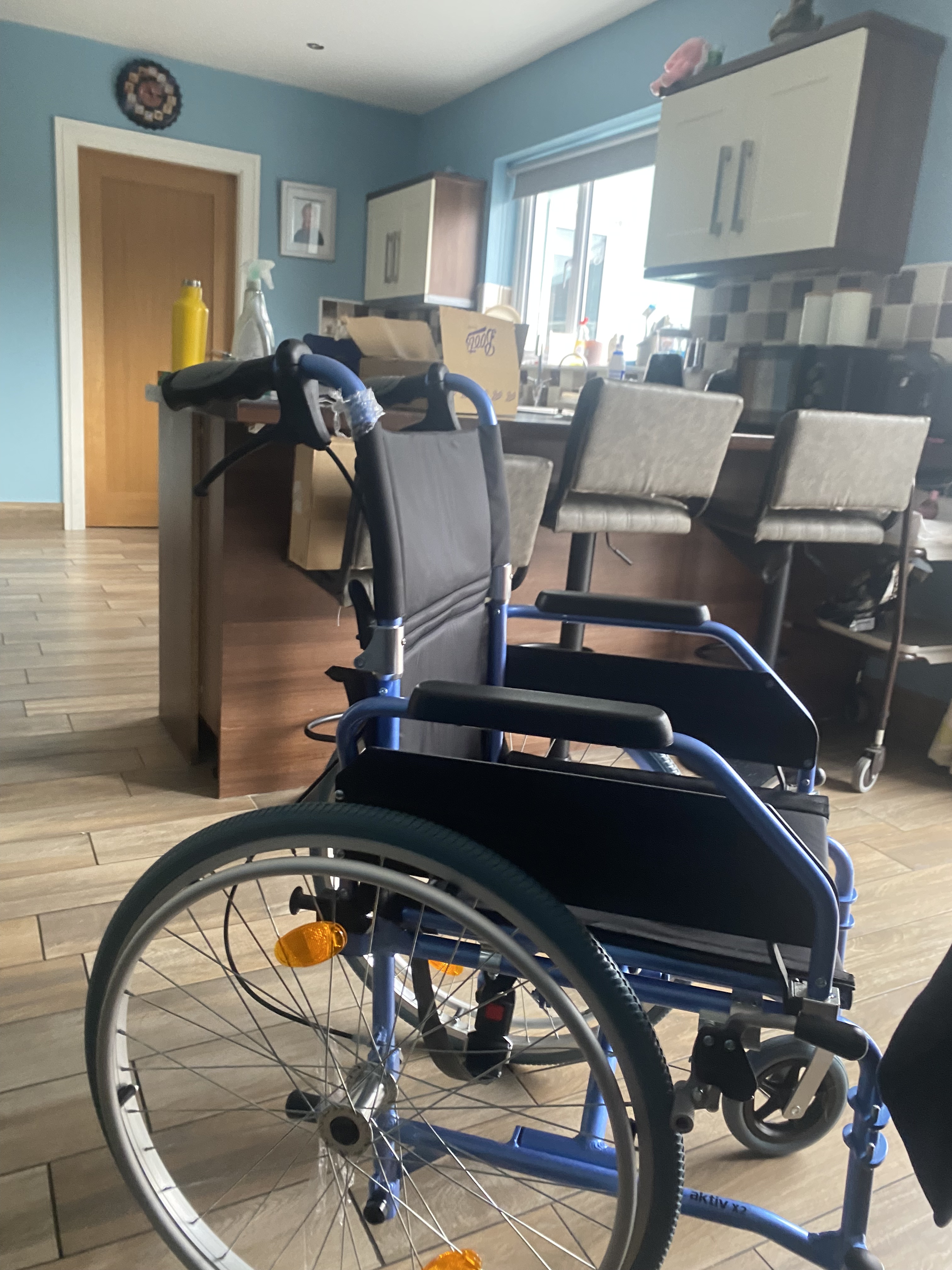
After unboxing the wheelchair, I realised that I was looking at the answer to many of my problems. I tested it out around the house, leaving the footplates off so that I could propel it with my feet. It’s light, and for me, it’s far easier than trying to use an electric chair in our house, as I’d been doing on and off for the last three months. Today (Wednesday) marks day three of using the manual wheelchair, and since Monday, I’ve done four loads of laundry, written this blog and added 1,500 words to my novel, prepped meals and swept floors. And I’m still wrecked, but at least now I’ve something to show for it, which wasn’t the case this day last week.

Photo shows a lovely blue manual wheelchair, sans footplates.

Cerebral Palsy is not progressive. However, years of unsteady gait, falls, kneeling on the floor, and pushing ourselves to do things that our bodies were simply not made to do are bound to take a physical toll. You might have noticed that I’ve had a hard time accepting this. And as a dear friend pointed out to me recently, I shouldn’t. I’ve always been fiercely independent, and deciding to use a wheelchair more often will only enhance that. Less falls will lead to less pain. It might even lend me the energy and impetus to get back on my exercise bike, and hopefully onto my tricycle in the summer. My friend’s tough love approach has prompted me to focus on the future with excitement and hope (although if she reminds me again that I am pushing forty, she may get a clip around the ear).

Today (1 March) is International Wheelchair Day (which I didn’t know was a thing until this morning, but is quite timely, all things considered), a day for reflecting on and celebrating the positive impact that wheelchairs have on the people who use them (it is estimated that over 40,000 people in Ireland alone use wheelchairs either full or part-time). It is also worth remembering that the barriers that wheelchair users encounter – steps, inaccessible buildings, undipped footpaths – can all be fixed in order to promote inclusion for us all. And although we have made great progress, there are always improvements that could be made to ensure that services and amenities are accessible to everyone.

There you have it, my first blog in months, all thanks to me using my shiny new wheelchair to conserve my energy. Now off I go to tidy my kitchen, make some dinner and hang up some clothes.

Grasping the Nettle

I believe in the importance of words. I’m a writer, someone who tries every day to forge a career by stringing words together. I know that some words can have more impact than others. Some words are deliberately provocative, while others can hurt as silently as a nettle’s sting – irritating, but unnoticed by the nettle itself. The nettle’s sole purpose isn’t to hurt; it’s to protect itself, to grow. In fact, nettles have fantastic healing properties. And though I’m not an adventurous eater, one day I hope to accumulate enough courage to try nettle soup.

It’s also said that if you grasp a nettle, tight in your hand, it won’t sting, or at least not as badly as it might if you just brush against it gently. And of course, the good old dock leaf is a tried and proven antidote to that peppery red rash. But, I needed more than a dock leaf to draw out the sting of the consultant’s words in Tallaght two weeks ago.

I’ve had pain on and off for over two years now. I’ve been on a strict physio regime, which I’ve obediently adhered to, but some nights, the cramping in my leg keeps me up for hours. Which means that I’m tired the next day, too tired to use my exercise bike or do any writing. My physio said that I have to choose my tasks carefully, and frankly, I detest being told what to do. Granted, some of the things I’ve been known to do is downright ridiculous. I used to dust my skirting boards on a regular basis. I like hoovering on my knees because it’s easier to keep my balance, also, it’s easier to spot the dirt on the floor. The physio has forbidden me from doing these things, which only makes me do them more. Surprise, surprise!

So, when I went to see the consultant in Tallaght, after travelling all the way up on the train, I was devastated to hear him say the words “long-term chronic pain condition.” I hadn’t been calling it that; I’d been referring to it as “a bit of leg pain,” “sciatica” at worst. (They don’t think it’s sciatica, but they reckon the nerve is trapped inside the periformis muscle). The thought of having broken sleep indefinitely was devastating, but there’s nothing they can do. I’ve refused the medication offered because I’ve read about the side effects, and owing to the involuntary movements, I’m not a candidate for pain injections. Go home, and do physio. It may improve, it may not. Nobody knows.

The guilt I felt was overwhelming. Despite all of my best efforts, I was now feeling like a burden to my husband and daughter, something I’d never wanted to happen. I felt like I’d failed my parents as well, after they’d invested so much time in making me mobile and independent. Chronic Pain condition. A different CP, another label used to define me. Hadn’t I enough of those already?  The consultant said that all I could do was go home and do my own research. I’ve changed my diet, and I’m starting to come around to the idea of pacing out more onerous tasks. One thing that my husband and I discussed was getting a manual chair for knocking around the house in, on days when the pain is particularly bad. But I can’t bring myself to do it. Every time I look online for chairs that might be suitable, or asking the HSE for one, I end up folding the laptop screen down and saying not yet. I’m not ready. I might become lazy, or overdependent on it. I’m tired of being tired, though, and something’s gotta give.

Yesterday, I was trying to write, when a friend of mine called in unexpectedly. I was so excited to see him, having not seen him in person since the beginning of Covid. We had a good chat about various things, and suddenly he smiled and said, “Do you realise that something you said changed my life?”

I laughed. “Something said? Take all my advice with a grain of salt.”

He recounted the incident. It was about seven years ago. We’d been at a personal development day together, and the facilitator asked us to set out our short term, medium term and long-term goals. My friend’s long-term goal was to be able to walk from his house to his gate, without his stick. And in front of everyone, I’d asked him why this was so important to him.

I relived that horrible feeling of shame. “I regretted it the minute I said it. I’ll never forget how hurt you looked.”

He smiled at me. “It was the best thing you could have said to me. After that, I decided to concentrate on what was important, and what I could do.  And to re-evaluate my relationship with my stick. This stick enables me to walk and keep my independence. Because of the stick, I can stay mobile. I can go to meetings and get involved in local activism. It’s nothing to be ashamed of. You taught me that.”

It’s true – I did. I really wanted my friend to understand how the social model liberates us from blaming ourselves for our disabilities.  And yet, here I am now, having to wrestle with a whole new meaning of what independence means for me.  A definition that, for much of my life, focused on my physical abilities and strengths. I’ve always been fit. I used to cycle everywhere. I’m still walking a bit, something I didn’t think I’d be doing when I fell and acquired my injury, two years ago. But as difficult as it is, I need to reassess my priorities. Is it really important to be able to scrub the grouting of my tiles with a toothbrush? Can I successfully balance the roles of mother, wife and writer while avoiding as much pain as possible?

If I had the answers to those questions, I’d be laughing. The only way I’ll know is trial and error. Isn’t that how we make all our greatest personal discoveries? I wish I could be a little easier on myself. If I can find the courage to grasp that nettle, maybe it won’t sting too much in the long run.

“No Magic Pill”: A Perfect Tribute to our friend Martin Naughton

Screenplay/Writer: Christian O’Reilly

Producer: Raymond Keane

Performed by: Sorcha Curley, Mark Fitzgerald, Peter Kearns, Ferdia MacAonghusa, Julie Sharkey and Paddy Slattery

Dramaturg & Disability Consultant: Peter Kearns

Set Design: Ger Clancy

Lighting Design: Sarah Jane Shiels

Costume Design: Deirdre Dwyer

Music and Sound Design: Trevor Knight

Movement Director: Rachel Parry

Voice Coach: Andrea Ainsworth

It takes a special kind of person to inspire the writing of an entire play. And only an extraordinary person would have his role in the play performed by someone who knew him and held him in the highest regard. Having seen No Magic Pill in the Civic Theatre, Tallaght on 9 October last, I know that I am not alone in my gratitude for being able to witness such a fitting celebration of Martin Naughton’s life.

Writer and playwright Christian O’Reilly has always been an important ally and friend to the Independent Living Movement. From his very first encounter with Martin Naughton twenty-seven years ago, his ambition has always been to capture Martin’s story in a way that would appeal to and educate a wider mainstream audience. His critically acclaimed film, Inside I’m Dancing (known as Rory O’Shea Was Here in the US), marked his first attempt in bringing Martin’s story and, by default, disabled people and the philosophy of Independent Living into the public consciousness. It’s a film that he is rightly proud of: the story of two young men who escape the confines of institutional living and use their freedom to screw up their own lives as they see fit. I remember seeing it in the cinema myself at the age of twenty-one, when I would’ve been clubbing and partying and making mistakes. I remember how grateful I felt that Christian had taken the time to consider the realities of what it was like to be disabled in Ireland.

In recent interviews, Christian has admitted that while he was (and still is) proud of Inside I’m Dancing, it wasn’t the story that he wanted to tell. A month before Martin passed away, Christian promised his friend that he would complete a dramatic telling of Martin’s story. This promise culminated into the production of No Magic Pill, a piece of theatre that has been twenty-six years in the making – and it shows. Each line of dialogue was carefully crafted, each scene beautifully woven together with the threads of human emotion. It’s also ground-breaking insofar as all the disabled characters are portrayed by up-and-coming disabled actors, and this performance truly showcases the talent of these actors.

No Magic Pill opens poignantly with the story of a young Martin being unwillingly sent to St. Mary’s in Baldoyle “as he is not getting any better.” Nine-year-old Martin is depicted on stage as a small puppet with splints. He has no say or control over the day-to-day mundanities of life: he is literally a puppet on a string. He wants to get better; he wants to walk.  Like many young disabled people, his sense of value is equated with his physical abilities. As he gets older, however, he surprises himself: he sets up his own garage and he teaches the younger residents of St. Mary’s how to swim.

Filmmaker-turned-actor Paddy Slattery effortlessly embodies the spirit of the Martin we know and love. Slattery doesn’t just act; he pours his soul into the role. His ability to empathise with Martin’s character is very special. Outwardly, Martin is persuasive; he knows how to get what he wants. However, inside he is crumbling under the expectation that he will be some sort of saviour for his disabled peers. The ghost of Brendan is constantly haunting him, whispering to him about the new life he could have in America. It’s more accessible, there are more opportunities, he could live independently. But when the first Centre for Independent Living is funded for two years (by the EU Horizon Project), his peers realise that their independence could be whipped away in an instant.

Sorcha Curley embodies the spirit of the late Ursula Hegarty. She’s spent her life in an institution, and she’s not going back. She’s feisty, argumentative, but also afraid; this gamble that she’s taking – trying to live independently – needs to work out, or she risks spending the rest of her life in a home or, best case scenario, dependent on her partner Jimmy.  She points out that Martin will be okay, but that the rest of them need the Personal Assistant Service to continue if they are to escape a fate of institutionalisation, with no choice of when to get up or go to bed. It becomes clear that they will have to fight for their freedom, as a united collective. Martin’s decisions are suddenly universally relevant: whatever he decides to do with his own life will inevitably affect Ursula’s, Dermot’s and, it is implied, the lives of disabled people across the country. 

On stage, Paddy embodies this unfairness in a realistic and poignant way. He’s torn between his dreams of a life without inhibitions and a sense of duty to his disabled peers. To complicate matters, he’s fallen for his P.A. Josie, played beautifully by Julie Sharkey. She’s shy and lacking confidence, something Martin makes it his mission to remedy, just as the real Martin did for many of us throughout his lifetime. Josie doesn’t take any shit from Martin, and Sharkey and Slattery have an undeniable chemistry onstage that feeds seamlessly into their characters. Once again, as in Inside I’m Dancing, writer Christian explores the complexity of the PA/Leader relationship when Martin falls in love with Josie. Inappropriate as this may be, it reminds us of the importance of giving disabled people the permission to mess up and make mistakes, just like everybody else.

Unsurprisingly for those of us privileged to know him on a personal level, Peter Kearns as Dermot steals many of the laughs of the show. Because of his speech impairment, Dermot often isn’t taken seriously and his opinions are overlooked or dismissed. He relies on Martin to translate for him, a role that Martin tires of. Martin encourages him to use his PA to communicate, which lends Dermot his freedom. Peter was also the Disability Equality Dramaturg for the production, bringing his years of experience in lecturing in Disability Studies in St. Angela’s, Sligo to ensure that the entire cast had an equal and deep understanding of the history of disability and the social model.

Kearns cleverly plays on the mechanics of his own impairment when portraying Dermot.  As he pointed out during a post-show discussion, one of the benefits of using disabled actors in this production is that they are free to explore and portray their characters as only these actors can; there’s no “cripping up” which means that more attention is paid to the characters and the world they inhabit. Ferdia MacAonghusa’s physical performances, particularly where he drags himself across the stage, acts as a physical reminder to us all of the uniqueness of the crippled body.  It can also be seen as a call to action: disabled actors will no longer be silent while non-disabled actors assume our roles and sanitise the perceived “unsavoury” realities of our impairments.

No Magic Pill is so much more than a play about disability. It’s a play that explores the sacrifices required by those involved in activism. I found myself wondering: to what extent did Martin sacrifice his own happiness to secure a better quality of life for the better of the collective? Was he frightened? Lonely? Bitter? Martin was far from a saint, but he certainly was an aspirational human being who wanted to make the world more accessible for himself and his peers. Without him and the others who came together to establish the first Center for Independent Living, many of us would be living in institutions or in the back rooms of our parents’ houses.

No Magic Pill has set an exciting precedence for future productions about disabled characters in Ireland. Seeing the powerful performances by the disabled actors should lead producers and casting directors to question why, historically, disabled actors have not been encouraged to assume acting roles. As Selina Bonnie, Independent Living Movement Ireland’s Vice Chairperson commented, this production has proven that with thought, awareness training and innovative set design, barriers that often prevent disabled actors from availing of acting opportunities can be removed.

I am so grateful that Christian O’Reilly persevered in his mission to bring this heartwarming story into the public consciousness. It certainly gives me hope as a writer that one day I, too, will write a story that represents the reality of living as a disabled person. Thank you to Christian, to the producers and cast for bringing Martin’s spirit back to life. It was such a timely and fitting tribute to a remarkable man, activist and friend, whose sixth anniversary we remember on 13 October. I have no doubt that everyone involved in this unique and memorable production has made our old friend proud.

Hero or Villain?

So, I just thought I would give you all a little update into how the writing is going. Well, at this exact moment in time I, like so many of you, am fit to melt into a puddle, which isn’t helping. Before this week, however, I was plodding along until once again, I found myself disappearing into a cul-de-sac. Interestingly, I know in my head where this is going – finally! – but it’s not translating to paper as well as I’d like. This is a common predicament for writers, not unique to me. After hacking away for a while, and adding words purely to beef up the word count, I decided to take a break. I gave myself permission to step away, justifying my decision with advice from writer Sam Blake (The lovely Vanessa Fox O’Loughlin) that sometimes you need to allow your subconscious the space to put elements of the story together. I’ve spent the last week or so doing just that.

A number of things have rubbed me since reading in Cork nearly a month ago. I began thinking about the advice my brilliant mentor David Butler gave me during our last session. “You’re really being too hard on Rachel,” he said, which annoyed me a bit, because I think Rachel deserves it. My protagonist can be lazy, selfish and quite frankly, a bit manipulative. She uses events of the past to justify her shitty behaviour towards those around her.  Some days she annoys me so much that I want to shake her. Why doesn’t she just try a bit harder?

The funny thing is, David is absolutely right, of course. Everyone in my writing group loves Rachel and is rooting for her to overcome her demons. They think she’s feisty and assertive in all the right ways, and they seem to look forward to the next instalment, which is flattering. Rachel even got a few laughs at the West Cork Literary Festival, which was such a good feeling. My daughter didn’t go to the reading, but she read the extract in the back of the car afterwards. Her eagle-eye spotted every detail; she is an avid reader who I’m sure can memorise many of Jacqueline Wilson’s or David Walliams’ books. After she finished, my daughter asked me “Mammy, why does everyone hate Rachel?”

“Did you not hear what her boss said to her? She’s been missing appointments, coming in late and hungover. She’s not a reliable employee.”

“Yes, but she seems to care about her clients. I know she’s not perfect, but I can see where she is coming from too. People need to back off her.”

My eyes narrowed. “Hmmm. Have you been talking to David?”

After taking a break for a week, I went back and read over the story again. I could see what David and Alison were saying; I am quite hard on Rachel, and she deserves some happiness. Because Rachel and I are similar in many ways (the Cerebral Palsy, the struggle to fit in at work, and hating being called “inspirational”), I’ve been trying to detach myself from her a bit. I did a one-day course with Michéle Forbes in April on creating characters, and now I understand why all my characters act the way they do. Including my antagonist, Sister Anthony.

For years, I’ve said that I base Sister Anthony not on a person but rather an attitude that I as a disabled person have encountered all my life. That voice that tells us as disabled people that we are less than (I’ve written about internalised oppression before), that in order to be accepted, we need to change and conform. These ingrained beliefs – personified in my story through Sister Anthony – can be difficult to challenge unless we question them, where they come from, and how damaging it can be to believe them.

I know you probably don’t know what I’m on about, so let me explain. (Oh, please reader, be kind; this is so hard to write and admit to). The reality of aging with impairment is something that is seldom talked about. I was lucky to have availed of services throughout my childhood – physio-, speech- and occupational therapy. However, in Ireland, once you turn eighteen, access to these services becomes restricted, if you’re lucky enough to have access in the first place. I’ve always been lucky in accessing services, but only because I’ve pushed for them.

In recent years, I’ve experienced aches and pains beyond anything I ever had in my childhood or teenage years. I still do my physio and exercise, but my body is starting to fight back against some of the things that I used to regard as normal. For example, I used to hoover and mop on my knees, because that way I didn’t need to worry about balance and coordination. I love ironing – my mother taught me the importance of perfectly ironed clothes – but now an ironing session might warrant an hour’s rest afterwards. I’m not giving up. I’ve always been independent and that’s not going to change. But I have to admit that sometimes I worry that this decision will have unsavoury consequences.

And on Friday, I had a very upsetting moment of realisation. Upsetting to the point where I cried – a lot. Yes, I am like Rachel – stubborn, imperfect, obstinate and determined. But I have also become my own Sister Anthony. And Anthony is not a pleasant person. She’s pushy, and often extremely cruel. Her expectations of Rachel are unrealistic and the by-product of living in an ableist society, one where the medical model dictates that self-improvement and conformity are key to being accepted as an equal. 

I’m glad I recognise this in myself, because it means that I can heal. I need to give myself, and Rachel, a bit of a break. Heaven knows we’ve both put up with enough to last us a lifetime, and for the first time since I started working on this story seven years ago, I’m starting to think that we both deserve a happy ending. And for Rachel, this will just be a matter of writing a couple of thousand words. Mine will only come with an acceptance of my limitations, and this will take a lot more work. But I will get there, and hopefully finish this godforsaken novel in the process.

(Not today, though. It’s far too hot!)

The Play It Forward Experience

It was Friday, 16 July 2021. We were temporarily residing in a first-floor apartment in Tullamore while waiting for some much-needed renovations to be completed in our house. I remember that it was the middle of the heatwave, because I was watching Alison, our daughter, playing outside from the apartment window. Suddenly, my phone rang. I saw Damien Walshe’s name, the CEO of Independent Living Movement Ireland, flashing on the screen. My mind was cast back to the occasions where I’d applied for jobs with ILMI and he had the unenviable duty of ringing me, telling me that I hadn’t been successful.

So when I answered, and Damien asked, “Can you talk?” I’d already played out the spiel in my head: Don’t lose hope. Keep writing. You are good at what you do. In fact, I was so busy steeling myself against disappointment that I almost missed what he was actually saying to me.

“Did you just say that I’ve been chosen?”

“Yes! Well done, Sarah!”

I was flabbergasted. “Are you sure it’s not a mistake?”

This went on for quite some time, much to Damien’s exasperation I’m sure, but later that evening, an email from the gorgeous Nidhi confirmed the good news: I was an official Play It Forward fellow. More significantly in my head, I was a writer who had been awarded a bursary, a real bursary.

I’m sure many artists who apply for bursaries feel the same way I do. It wasn’t about financial gain for me (although I’ve never been known to refuse a few quid). Writers, like other artists, don’t pursue this kind of work because they have visions of rolling around in mountains of cash like J.K. Rowling. In terms of money, I don’t earn enough to keep food on the table or to afford anything remotely luxurious. Most people write alongside their day jobs. 

What being awarded a place on the inaugural “Play It Forward” programme did for me was it validated what I do on a daily basis. I’ve always been reluctant to use the word “writer” to describe myself. It feels a bit arrogant to be putting myself in the same category as the likes of Marian Keyes and Margaret Atwood. Yet, when I was awarded the place on the programme, suddenly I felt that I had permission to identify as a writer. 

It was strange, because in reality, my creative process has remained largely the same. I still endeavour to spend three to four hours at my laptop a day, churning out words, as I have done for the last seven years. The difference was now there was accountability. Suddenly there was no time to sit around daydreaming, because my mentor David Butler would be expecting to see approximately ten thousand words of my novel every couple of months. This forced me to pay closer attention to the words I put on the page, meaning that I have to produce the best quality work I can. Being on the Programme allowed me to write a small piece for the prestigious literary magazine, The Stinging Fly. It also enabled me to avail of a number of one-day online courses, as well as two longer ones: “Novel Writing” facilitated by David Butler and “The Confidence Booster” by Anne Tannam. I learned so much on these courses, and in fact we all enjoyed the Novel Writing one so much that when David’s teaching ended, we all came together and so the group continues to meet to discuss and critique each other’s work every two weeks under our new name “People’s Republic of Writing.”

Perhaps the most significant part of being a Play It Forward fellow was having the opportunity to read our works-in-progress at the West Cork Literary Festival. I remember when I was sent an overview of the programme last July and saw that we would be reading to a real-life audience, my first thought was “Okay Sarah, you have a year to try and think of an excuse to get out of this.” I’d never been to the Festival, but I’ve followed it on social media since I first started writing and thought of it as somewhere for established writers. Real writers. You know, writers who actually know what they’re doing. Published writers. Before I knew it, the day was upon me and instead of making excuses, I found myself in the car beside my husband, navigating our way to the beautiful Bantry.

We’d been holidaying in Trabolgan in East Cork, but it was still a two-hour drive. When we arrived in the hotel on Wednesday evening, we were both fit to collapse into bed. I was unpacking my bag when a white envelope caught my eye. It was sitting on the table and it had my name on it. Inside was a bookmark, a lanyard with “artist” written on it, and a copy of the programme for the week. My photograph was in it, alongside my other Play It Forward fellows, Gonchigkhand Byambaa, Neo Gilson, Sara Chudzik and Majed Mujed. There were also details of other events featuring authors including Lucy Caldwell, Louise O’Neill, E.R. Murray and Marianne Lee. The name dropping could go on and on. I only wished I could’ve stayed for the week!

A photo of a map of Bantry, a West Cork Literary Festival bookmark, a lanyard saying “West Cork Literary Festival – Artist” and the West Cork Literary Festival Programme Brochure

Finally, on Thursday 14 July 2022, almost a year to the day that I was offered my place on the Play It Forward programme, I was preparing to introduce “Rachel” to the world. Gráinne from Skein Press told me not to be nervous, that I was reading to friends. Usually I would have someone read on my behalf because of my speech impairment, but that wasn’t going to be accepted as an excuse to weasel out of reading! The words were behind me on the screen. As I read, I became Rachel. People laughed, which was such a relief. It was such a pleasure to hear my fellow writers read about their experiences of marginalisation and belonging. Stories of cultures combining, memories of home and family members, themes of difference and trying to fit in. I was in awe of the talent of my fellow writers, and I hope to see more of their work in the future.

In five months, the Play It Forward Programme will come to an end, but I will always be grateful for this wonderful journey. I would like to thank all at Skein Press, particularly Nidhi, Mahito, Grainne and Fionnuala; the Stinging Fly, particularly Declan Meade; my outstanding mentor David Butler; the Irish Writer’s Centre; Independent Living Movement Ireland and the West Cork Literary Festival for affording me this unique opportunity. I will never forget it as long as I live.