Unknown's avatar

About sarahfitzgerald1984

Hi there! My name is Sarah Fitzgerald. I'm a mother to a beautiful daughter and a wife. I've always loved writing and recently found the courage to start again. I'm nervous but excited and I hope I can create some interesting and thought-provoking posts here.

How Many More Graces?

I go through phases, extremes of mood and thoughts. Sometimes I’m elated. I love writing. I know I’ve made the right choices in life. Other times I worry that I’m making myself increasingly unemployable as the days go past.

I haven’t really left the Centre for Independent Living behind, of course. I still volunteer a lot of my time to promoting the philosophy of independent living and campaigning for equal rights for people with disabilities. In fact, I’m now part of an activist group called By Us With Us. we’re still relatively new, but we recently set up a blog which is well worth a look.

Independent Living is not my job any more, my husband insists. You’re a writer now. You should be dedicating every free minute you have to writing and trying to get published.

And oh, how I would love to! How I wish life could be this simple, that I could have the luxury of locking the office door every day, focusing on nothing but putting words down on paper. My  mother used to tell me that I can’t fix all of the wrongs in the world. She was right, of course, but there are so, so many wrongs that I feel that I must try and do something;

As most of you know, I’m writing a novel at the moment, a story that initially came to me in 2007 while I was unemployed for six months. The story explores the life of a disabled woman who was tortured by a nun in a residential institution and how she copes with the aftermath of that abuse. Lately, I’ve been finding it hard to stay motivated. This is off the wall, I thought to myself as I rewrote the first chapter the other night (for the sixth time). No-one reading  this is going to believe that someone could be treated with such cruelty.

I’m not a trusting person anyway, and I’m sure I’m not alone in this distrust, particularly in the government at the moment (or, as it is starting to transpire, any government before or after this). Yesterday, the story of the abuse suffered by ‘Grace’ dominated headlines, a girl with an intellectual disability (now forty years old) who was abused while in foster care. It’s still a little unclear the extent or the nature of the abuse; some of it is of a sexual nature.

Grace has an intellectual disability and in the eyes of the Irish state at least, cannot be trusted to have her own narrative voice. And in Ireland, this is not limited to those with intellectual disabilities. The opinions and lived experiences of disabled people in Ireland don’t seem to matter to our policy makers.

I doubt that Grace is an isolated case. So why is there such little uproar about the status quo? There is mounting evidence to illustrate that disabled people should not be living in institutions, that the state cannot be trusted to provide a decent standard of care. Who can?

In December 2014, the nation was shocked by the Aras Attracta scandal, which saw people with intellectual disabilities being physically and psychologically tortured by those who were meant to care for them. People were disgusted by the RTE documentary; at one point my husband, whose stomach was turning, asked me to turn it off. I refused.

‘How can you sit there and watch that?’ he asked, bewildered by my seeming nonchalance.

‘Because,’ I replied, ‘Ireland has buried its head in the sand for too long. We have a government, and this and successive governments not only allow this abuse to happen, but by implementing cutbacks create situations such as these. We need to see this and someone needs to take responsibility.’

The Aras Attracta staff were later held accountable and given paltry sentences of community service. But what happens to those who continue to abuse people with disabilities behind closed doors, and are never questioned? I’m not talking solely about people in congregated living settings – I’m talking about people who suffer abuse at the hands of their families too.

When I started doing some research for my novel, what struck me was the lack of information available about how disabled people were treated in Ireland over the last fifty years. Apart from a few research papers, the Irish Wheelchair Association’s collection of stories, Extraordinary Lives, and this documentary on the programme ‘Horizon’ called ‘The Weakest Link’ on RTE in 1966, there isn’t a lot of documented stories about what life was like for a disabled person, particularly in a residential setting. So essentially I’m writing a story about something I have little information.

But if I can achieve this, then I will be happy. Because it’s time for disabled people to tell their stories, and to discover and reclaim their histories.

If we don’t, then our stories will be like Grace’s – spoken through the mouths of people on the outside.  Our stories should – and deserve to be – woven into the mainstream fabric of Irish society.
Just Catching a Train (in 24 hours)

I’ve a meeting in Dublin on Wednesday. It’s straightforward  getting there: if you’re going the public transport route, you simply get a train to Dublin, then regardless of whether you come into Heuston or Connolly Station, you can catch the Red Luas to Smithfield and then it’s a ten minute walk. Easy peasy. Shouldn’t be complicated at all, right?

No, it shouldn’t. But this is Ireland, and we seem to have a tendency to make things more complicated than they need to be. And for people with mobility difficulties, public transport isn’t as convenient as it is for others.

I went down to Tullamore Train Station this morning (according to the Irish Rail website, passengers needing assistance are ‘advised’ to give twenty-four hours’ notice) to let them know that I intend to travel on the 09.29 from Tullamore to Heuston on Wednesday morning. I admit I did it as a bit of joke, to make a point. The guy who works there is lovely – I’ve nothing against him as a person – but he was reluctant to guarantee that I’d have assistance on Wednesday afternoon coming home. ‘If I’m here, I will definitely help you,’ was his response. If.

The assistance I, and many other wheelchair users need, is simply the provision of a portable ramp to enable me to disembark from the train safely. That’s all. In my case my chair is electric so there’s no manual pushing involved. But without the provision of a ramp, my independence is immediately compromised.

Okay, I admit that giving two days’ notice is a tad dramatic. But my attitude isn’t without basis. Just last month, a young  wheelchair user got stranded on Platform 2 of Tullamore Train station and had to wait 30 minutes before it was decided that the train should pull into platform 1. The lift was out of order, as is often the case in Tullamore.

I’ve been stranded on a train twice before in my wheelchair because there wasn’t assistance waiting for me at the train station (and I always give as much notice as possible – okay, not always twenty-four hour notice, but I do try). It’s very annoying having to get off at the wrong station and either get a train or a taxi back. It eats into our time and financial resources. Our time isn’t viewed to be as valuable as everyone else’s, I don’t think.

Impairment doesn’t create inequality, society does. Having to give twenty-four hours’ notice to use a train is discrimination and yet, in spite of the many complaints made in relation to accessibility to Irish Rail (according to thejournal.ie, there were 12 complaints about accessibility in 2014. This 12 merely represents complaints made, not necessarily the number of passengers who experienced problems with regards to access), things seem to be getting worse, not better, for disabled passengers.

I’m not alone in experiencing these problems. Last year a friend of mine and wheelchair user, Ann Marie Champ, was denied assistance in Newbridge train station and was forced to continue to Kildare. (Ann Marie works in Dublin and commutes every day). Once in Kildare she had to wait for a taxi to arrive from Portlaoise to bring her to Newbridge. An enraged Ann-Marie remarked, ‘I flew to Australia last year and had to get six flights and had no issues. It only took five minutes over the phone to organise. Yet, I can’t get 20 minutes up the road because of the refusal to lower a piece of aluminium.’

Louise Bruton, the founder of a blog/accessibilty guide called Legless in Dublin, also had trouble with Irish Rail last November when the assistance she had requested in Heuston Station didn’t arrive, leaving her stranded on the train for twenty minutes. ‘The train was stopped further down the tracks than normal and the lights were dimmed, so I was in a scene from a 1990s teen horror flick,’ she told the Irish Independent. “I stuck my head out the door… I shouted again and again and all I could hear in return was my echo. I pressed the train’s emergency button but nothing happened. And then I tweeted. My responses gave me the emergency number for Heuston and, thankfully, Heuston’s very apologetic station manager, Liam Donegan, answered my call and rescued me.’

Ann-Marie and Louise’s experiences show that there is no dignity in travelling when you have a disability in Ireland. And now it’s been proposed by a Cork TD that travel pass holders should pay a subsidy of €6 for travel! For disabled people at least, this is outrageous. Many of us don’t drive and are solely dependent on public transport to get around. And even if was decided that €6 was reasonable, this still wouldn’t mean that disabled passengers would be guaranteed worry-free, hassle-free journeys.

I’m afraid I don’t have definite answers to these ongoing issues. There’s no doubt, however, that these practices are discriminatory. People need to continue to be vocal about this issue, because for me, as a contributing citizen, this isn’t good enough.

In the meantime, fingers crossed that I get to and from my meeting in Dublin on Wednesday, without incident!

Throwback Thursday: The Others

I’m going through a bit of a writer’s block situation at the moment, trying to work through the messy middle of my novel and fix it into something that ties in with the ending. My concentration’s letting me down though, so instead I thought I’d look up the animation my sister did for her final year project, nearly six years ago, The Others.

The message behind The Others is that it is society that disables us and moulds us into a state of dependency. The piece is voiced by my good self and Dani McGovern, a friend of mine who also has Cerebral Palsy. Note how the negative narrative of the piece disables the two women, and distorts the physical form.

This is the exact message I want to portray in my novel, if I can ever get it written!

Anyhoo, enjoy!

Credit for this piece belongs to Laura Maye.

#CripLivesMatter

Over the last few years, there have been a number of bizarre occurrences in Ireland, a lot of which coincided with the recession of 2008. Suddenly, what was once one of the most prosperous countries in the world collapsed as housing prices plummeted, and unemployment and emigration soared. Headlines of doom and gloom swept the nation. And in the disability sector where I worked at the time, the most feared words were ‘cutbacks’.

The narrative at the time was that Ireland was on its knees, at the mercy of Europe. Everyone was expected to pay in some shape or form for ‘the good Celtic tiger days’ that the whole of Ireland enjoyed (read: the elite few). That period was almost identical to the dark world depicted in George Orwell’s 1984, where people believed everything that the media told them, where the written word controlled the psyche of a nation, keeping them in fear. None more so than people with disabilities.

It is estimated that disabled people in Ireland have lost 17% of total funding to vital services during recessionary times. The supplementary cost of medicines to medical card holders rose from fifty cent to two euro fifty overnight. The threat of cuts to Personal Assistant Services moulded us into a state of fear, undoing the good work of the activists who had fought tooth and nail almost instantly. It seems that the needs of disabled people are only important when there’s an overflow of money or a photo opportunity to be had by some politicians. (I hasten to add, not all politicians. Here in Tullamore our elected councillors are doing great work with us and bringing about real change).

Today, we live in a country where we don’t trust our elected leaders, where we have been screwed to the wall time and again. We look across the pond and condemn Trump’s behaviour, shocked when footage of him mocking a disabled reporter emerged during his election campaign. We despair at his behaviour and fear that he is creating irreparable divides between people.

But at least he’s open about his controversial policies. He’s not pretending to be a nice guy, conning people with his smarmy charm like Enda Kenny does. At a disability protest nearly a year and a half ago in September 2015, Enda went to ‘speak’ with the protestors and avail of some publicity. Offering Martin Naughton a cup of coffee when Martin was clearly unable to hold a cup independently was a clear illustration of how out of touch this government are with the realities of disability.

Having a disability these days is a little like  living in a dystopian novel. We live in a world where we are expected to conform to the ‘norm’. Our voices are either taken away from us, or distorted to make us seem either piteous or courageous. What we are fighting for are equal rights. At the moment we are not equal because we are different; we are the problem. However, the United Nations Convention of the Rights of People with Disabilities(the UNCRPD) recognises that our society has a duty to enable us to make a real contribution as equal citizens. Unfortunately, Ireland has not yet ratified this, even as a tokenistic gesture, and the uproar about this is real, but somewhat sporadic.

That’s why when I read this blog about the Women’s Rights Marches and the support it had from so many people that it saddens me that disabled people in Ireland have yet to do the same. Don’t get me wrong – there are so many activists out there who are genuinely trying to change things – but it seems to me that we are all a little fragmented right now. Part of this may be due to the fact that we face our own challenges every day, and sometimes these seem so insurmountable that we forget that others face the same challenges.

Only we have the power to change this depressing narrative. I’m sick of talking about it, and sick of living it.

Our lives matter. We matter. Achieving true equality in Ireland matters. As I wrote in an earlier blog, we have marriage equality, so equality for those with disabilities should follow.

And the time is now. No more excuses.

We matter, and deserve to have our voices heard.

Be my Valentine …

Love it Karen – direct and from the heart x

beatingmyselfintoadress's avatarBeating Myself Into a Dress

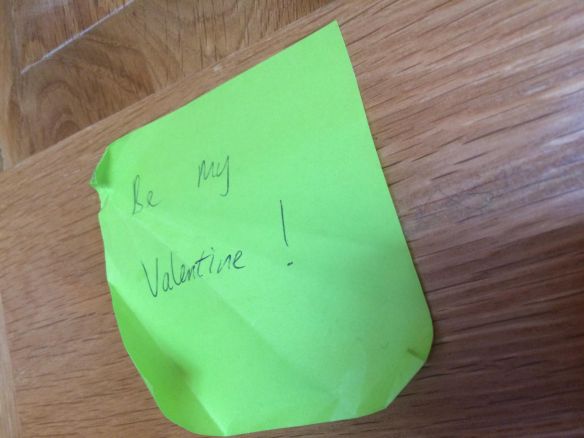
valentine-post-it A Valentine’s love post-it from about six years ago my husband left for me on the inside of a press so I’d see it when I opened the cupboard to make my breakfast. It’s still there!
I think I write a variation of this post every year on here, or if not here on my Facebook page, so you’re probably all sick of me waffling on, but hey, tradition is tradition so here it is.

I like Valentine’s Day.

It seems it’s a bit of a novelty these days to admit that you like Valentine’s Day, that you get some pleasure out of the day. In every newspaper and blog, in online forums and in real life people poo poo Valentine’s Day, giving out about commercialism and overpriced tat and forced love.

And you  know, I get it. I do. Because in a way they’re right. Nobody needs a six-foot…

View original post 488 more words

Memories on a Birthday


alis-first-birthday

Alison’s first birthday. Not pictured: me blubbering like a baby


At 11.52am on Thursday 9 February 2017, Alison will be five years old. I can’t believe that my not-so-little girl will be five today. I also cannot believe that I, a total dummy when it comes to kids, have been a mummy for the last five years.

Every year since Alison’s first birthday, I’ve always used the ninth of February to look at the year gone by, to marvel at how Ali has grown and what she’s learned. This year has been a particularly busy year in Ali’s life. She started primary school in September and is currently excelling in Irish and reading. In the evening she sits down the minute she comes home from school, anxious to get her homework done. She then spends the rest of the evening churning out some ever-impressive artwork at her desk, each picture better than the last. It makes me so proud to be her mummy.

In truth, it’s only really in the last two years that I’ve started to believe that I deserve to be her mummy.

When the words ‘disability’ and ‘care’ are thrown into a sentence together, it’s often wrongly assumed that the disabled person is the one being cared for. If you google ‘disabled parenting’ there is very little support or advice out there for disabled parents. On top of that, there is a narrative that disabled parents are inadequate, that their children are more susceptible to abuse and neglect, and that they cannot be trusted to make sensible decisions regarding their children’s welfare. Just this week I had a lady write on my Facebook page that she had no idea that people as disabled as I am were capable of raising children and admired my bravery in sharing my story. (She had seen the documentary I did a few years ago, Somebody to Love). Undoubtedly she meant well but it was a stark reminder of how hard our family has had to work to be accepted as part of the fabric of our community.

I find Alison’s birthday hard for many reasons. Firstly, because the sense of gratitude I feel is overwhelming: there are so many women out there who would love children and yet I, the absolute baby dummy, was blessed with the most beautiful daughter. Secondly, because I don’t really want her to get any older and lose all the wonderful innocence she has now. But mostly because it’s been such a struggle to achieve the relative normality that we enjoy now. And thankfully, she has no comprehension of how this family has struggled.

Every year, I’ve always cried as Alison blows out her birthday candles. This is because at Alison’s first birthday party, she grabbed the flame with her little hand, only crying for a split second with pain. She had faced danger, and overcome it. I had faced doubts and ongoing criticism for the first year of Alison’s life from so-called ‘professionals’, and I was not brave enough to challenge them. Instead, I stayed quiet, pandering to whatever I was told in the belief that if I didn’t, my child would be taken from me. I believed I was useless. I believed that I was a danger to my own child. I believed I was not the mother she deserved.


alis-third-birthday-cake

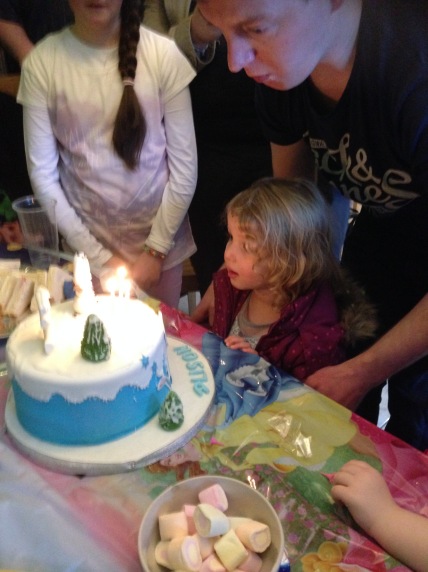
Alison with her daddy on her third birthday blowing out her candles. Not pictured: me blubbering like a baby.


But in spite of myself, the years have flown by and I have managed to get her to five reasonably happy and healthy. I’ve managed to gain credibility as a semi-respectable parent in my hometown and in Alison’s school. And Alison is so intelligent, witty, kind and beautiful that I feel honoured to be her parent. She makes both JP and I proud every day, and for the most part we don’t take for granted the richness she’s brought to our lives. Our world revolves around her, as it should. We just love her so much.


alis-fourth-birthday-minion-cake

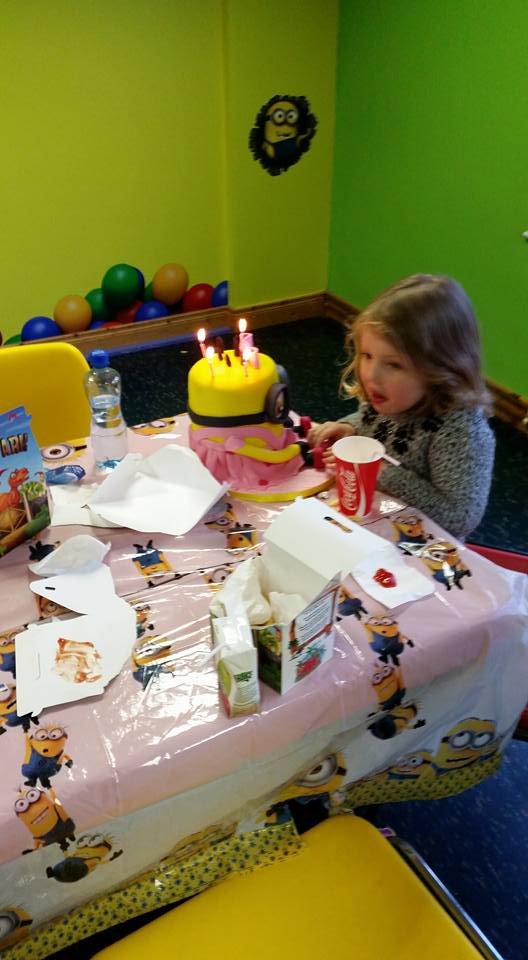
Alison on her fourth birthday – you all right in the corner there mummy?! So embarrassing….


I’ve no doubt that Alison will have a lovely birthday, and all that I can hope is that the emotional scars continue to fade. But please don’t judge me if you see me sniffling over her birthday cake again. This girl is the centre of our world, and by God, we’ve fought so hard to keep our little family together. And, without doubt, it’s been a struggle, but so worth it.

Musical Inspiration

Video

I hate days like yesterday when, no matter what you do, you just don’t feel like writing. Even the thought of reading over stuff you’ve already written feels  exhausting. On days like these, I find that putting in my earphones and listening to some music always helps to get the juices flowing. It’s time-efficient; you can listen while doing the cleaning, and I spend the time daydreaming  about what my characters are going to do next.

Here are five of the songs that motivate me to do some writing:

  1. Pompeii – Bastille:

This is a song that my sister Alex introduced me to back in 2013, and it really struck a chord with me. At first it was painful to listen to because I associated it with her (she’s living in Australia and I miss her every day), but when I listened to the lyrics I realised that this song aptly encapsulates the message of my ‘novel’ – the notion of a society that is reluctant to change: (‘If you close your eyes, does it almost feel like nothing changed at all?’) Every time I hear it, I think of the Independent Living Movement and how it sometimes feels that we are getting no closer to achieving equality for disabled people.

   2. Talking ’bout a Revolution – Tracy Chapman:

Thanks to my friend Orla, I’m still a shameless Tracy fan. Almost thirty years later, ‘Talking ’bout a Revolution’ is still as relevant as it ever was. Our government continues to create social divide and while we are all furious, we can’t seem to change anything; revolution in Ireland sounds ‘like a whisper’. My love affair with Tracy Chapman started shortly before I read To Kill a Mockingbird. and for me this song – and indeed all of her music – demonstrates the importance of denouncing discrimination. All of her music is slightly uncomfortable, and again reflective of a society that is slow to change.

3. Dear Mr President – Pink:

This song is so different from Pink’s usual ‘in your face’ style, which makes it even more poignant. Although the song is addressed to former President George Bush, it could also be directed at Donald Trump or even Enda Kenny (‘How do you feel when you see the homeless on the streets? … How do you sleep while the rest of us cry?’) The line ‘how do you dream when a mother has no chance to say goodbye?’ hits me every time as I think of all the women across Ireland who were forcibly separated from their babies over the last century (including the protagonist of my novel and her mother). A history that, in Ireland, we are still too embarrassed to talk about.


4. Just a Girl – No Doubt:

The tone of this song is slightly more upbeat – and more angry. It’s the ultimate feminist song, a call for women to be treated equally. It’s sarcastic from start to finish (‘don’t you think I know exactly where I stand?’ ‘I’m just a girl, guess I’m some kind of freak.’) It’s a song about being tired of being defined and controlled within a patriarchal society. And I can relate to how annoying this is (‘Oh I’ve had it up to here’).


5. Turning Tables – Adele:

This is an important song to me because the music and lyrics capture the relationship between Rachel (the protagonist of my story) and Sister Anthony (the antagonist). Anthony is Rachel’s carer but she abuses her power, and her words and actions mould Rachel into a person who believes she is worthless. As Rachel moves away from residential care, Anthony’s words continue to haunt her (‘under haunted skies I see you, and where love is lost your ghost is found’). Rachel needs to forgive Anthony her mistakes in order to move forward, but has built an emotional wall (‘I won’t let you close enough to hurt me’).


Admittedly, these aren’t the cheeriest of songs, but they really help to get the creative juices flowing. Don’t worry, I’ll use headphones, I promise.


Source of all videos http://www.youtube.com. Copyright of artists named

I hate to be a burden, but…

Anyone who knows me at all knows that the most important thing to me, apart from my family, friends and laptop, is independence.

As long as I can remember, I’ve always wanted to do things my way, to be control of my own life. I don’t ever remember my parents beating me out of the house or having to sit me down and tell me that my decisions were bad ones. And for the last twenty years, I’ve worked hard on developing this persona of being independent, capable of running my own life. Most importantly, I needed the freedom to make my own mistakes. Lord knows, I’ve made many.

When I reached my mid-teens, I realised that I never wanted to be a burden on my parents by virtue of my disability. I was raised in a country that wanted me to fit into a particular box, and when I didn’t, I was problematic. I felt that I wasn’t allowed to make mistakes, which resulted in me studying like crazy in school. By the time I was eighteen I didn’t want to be seen as a burden in any sense of the word. And I hope that I was no more a burden to my parents than my siblings

As I grow older and wiser, I learn more about the way the world works. For example, I now understand that progress isn’t linear. We as a society are in fact regressing in how we view disability. The ‘nineties marked revolution in Ireland, and people were encouraged to leave residential settings behind and embrace the big, bad world with a Personal Assistant by their side. The Independent Living Movement in Ireland brought promise of freedom and equality to disabled people. Most importantly, disabled people themselves are seen to be the experts in what they themselves need.

An important result of a disabled person having a Personal Assistance Service is that it relieves families of the ‘burden’ of ‘caring’ for their disabled relative. Language of dependence and inability becomes language of empowerment, enablement, choice.

And yet, twenty-five years on from the beginning of the Independent Living Movement, disabled people (so defined because we are disabled by society) are no closer to achieving equality in Ireland. Instead we continue to live in fear of cutbacks, in the hope that more vital services are not taken away from us. We stay quiet, hoping not to draw attention to ourselves. Our pleas and petitions to ratify the United Nations Convention of the Rights of People with Disabilities (the UNCRPD) disappear into an unknown wilderness.

In my opinion the reason why this hasn’t been ratified is not because of legislative changes that need to be addressed. It’s because we live in a country where disability has always been synonymous with charity and this enables government to continue to keep the ‘grateful cripples’ in their place. We shouldn’t need to sigh with relief when we  travel by train and there’s someone with a ramp, waiting to help us. We shouldn’t have people living in institutions whose peers are going  to Copper’s on a Thursday night. I remember the fun I had in my twenties, and the nearest I got to sitting in an institution was in the IWA’s Carmel Fallon Centre in Clontarf (even these were not sober times). Many would view my life as privileged, whereas I view it as an entitlement. One that admittedly has not come easily.

We shouldn’t need to accommodate and change our lifestyles and miss out on our true potentials, be this through education, employment or raising a family. Nor should we have to justify these choices to the HSE in order to get the proper supports we need to do these things.

Of course a single group or blogger cannot single-handedly change the current narrative of disability. We can all contribute, though. For example, the next time you throw coins absent-mindedly into a charity bucket, don’t resent disabled people or pity them; we don’t want to be objects of charity anymore, but we have been forced into this position because of government cutbacks. When you read a story about somebody with a disability in the media, look at the narrative voice: is it theirs, or someone else’s?

It seems that there are more pressing issues for the government at the moment: the US, homelessness, Brexit, the drug crisis. In the grand scheme of things, the rights of disabled people might not seem to be a priority. But if we don’t speak up, it never will be.

Because quite frankly, it’s disgusting that we live in a country that actively refuses to ensure equality for all its citizens. And none of us want to be seen as a burden.

Especially when, with a little consideration and respect, for both ourselves and our families, as well as granting us basic human rights, this burden could easily be lifted.

I am a WRITER!

win_20170126_13_24_05_pro


‘So, what do you do?’

This is a question I get asked all the time, and although it’s nearly been two  years, I’m still embarrassed by it

Yesterday I agreed to do an interview with an undergraduate studying for her final year in Psychology in DCU. She was a lovely girl, ambitious, and easy to talk to. She reminded me of myself in my younger days.

She wanted to examine the factors that influence or hinder people with disabilities in accessing employment. I knew it would be a little cringey; I’m ten years older than her, practically a relic, and I’ve voluntarily thrown myself back down the career ladder (not that I was far up to begin with, but anyway).

She asked me if I’m actively looking for work, and I said yes. (Three rejection letters this month alone, in fact). I know what kind of angle she was looking for: my employer’s premises wasn’t accessible, I needed extra technological accommodations, I would become fatigued if I had to work full-time (there’s an element of truth to all of these). But these were not my sole reasons for not looking for work.

Puzzled by the end of the interview, my companion asked me again, ‘So, is there anything else I need to know? Like what do you do in your spare time?’

I shrugged. ‘I’m pretty active in the Independent Living Movement,’ I said, then I lowered my voice, as if I was divulging a dirty secret. ‘I’m also trying to write a novel.’

My companion perked up. ‘You what?’ she stammered.

‘I’m working on a novel. I don’t know how it will turn out, but it’s taking up a good deal of time at the moment.’

My companion shook her head. ‘Fair play. That sounds like a lot of work.’

‘Well, it’s certainly not as easy as I thought it’d be when I started it!’ She  laughed, and I relaxed.

I think nowadays as mothers, a lot of us feel pressure to prove that we can do and be it all. I’ve been  at home with Alison for two years, and working on my writing in this time. This way I can have the best of both worlds. I can work as much or as little as I am able. I’m pretty happy, but still wary of how people perceive my choice to do this.

And to be honest, I don’t know why I care. For now, I’m doing something that is working out well for me and my family.

I don’t know if this will work out, if my novel will ever get published or if writing will ever be the career I’d imagined it to be.

But for now, I am a writer, and a mother, and delighted to be able to do both.

My 2016 Appraisal

win_20151109_171341

Because I’m now my own boss, I have to monitor my own progress. This can be a disaster. Sometimes I think I’m doing much better than I actually am, while other times I think I have failed miserably at life. So, in trying to determine whether 2016 was a success or a flop, I did what any smart self-employed* person would do: I made a list of my original goals and did a realistic assessment of how I performed and where I need to improve. Here goes:


(1)    Get into shape

Ah yes, this old chestnut. I joined Aura Leisure Centre in Tullamore in November 2015 and for a while went twice a week, once a week, once a month… I’m doing my physio twice a week/when I remember but I recently purchased a treadmill which I use at least four times a week. Or I was, until I came down with this horrible virus thing that is doing its best to wipe out the Irish population. I admit the last time I used it was two weeks ago. DON’T LOOK AT ME!

Verdict: Fail, I know, fail. But I’m trying. God loves a trier, right?


(2)    Write a novel

I saw how award winning novelist Louise O’Neill wrote two novels in as many years and thought hey, we were in the same class once upon a time, so logically that should mean… Nothing. It means nothing. I will not be publishing two novels in two years, or possibly ever, for that matter. This novel is my baby, so much so that I hate telling people about it for fear that they’ll say it’s unpublishable. I also have to write the middle of it which I’ve been procrastinating by writing shitty little blogs like these.

Verdict: Well, I’ve worked on  the same project for eighteen months, and I haven’t deleted it – that counts for something, right?
 

(3)    Give up chocolate

Yeah, this hasn’t happened. I will be the embodiment of Death by Chocolate. I have zero self-control. In order to be successful at this in 2017, I must somehow get rid of the four remaining boxes of chocolates lying around the house first. Once these are gone, I’ll have a fighting chance. It’s only logical.

Verdict: Fail.
 

(4)    Update this blog regularly:

Firstly, I ask you to discount the first six months of the year. I was blogging elsewhere, on a far less accessible website (all hail WordPress). July and September were not great, admittedly, but considering I’ve been working on a novel as well, I don’t think it’s been too shabby… right?

Verdict: Pass (Yay! Go me)
 

(5)    Find a new job:

(Job as in paying job) No I haven’t done this yet. Bad Sarah. But I have done a job interview skills course and a CV preparation course so, you know… Hopefully in another twelve months… (Of course part of the problem is that I should be trying harder. I know, I know, my husband is so lucky to have me)

Verdict: Meh…


(6)    Do a Creative Writing Course:

Yes, I did this, and got a Distinction Diploma in Creative Writing. That’s something I suppose….

Verdict: Pass.
 

(7)    Start driving:

No this hasn’t happened yet, but I’ve passed my theory test, so it’s probably advisable to stay off the road in 2017.
 

(8)    Learn how to cook a meal for the freezer that doesn’t involve mince:

Yup, I’ve done this. Beef stew! (With beef pieces, not mince). And……… shepherd’s pie (oops, that involves mince). I know, my culinary skills are just fantastic.
 

(9)    Cut down on social media:

Aw, but then how would I share my literary genius with you all? I did close my Facebook account for like half an hour. In my defence I permanently deleted my page a few weeks ago, (or so they claimed) but when I signed back in I was back online, no questions asked. I think it’s time to admit that social media owns us.


(10)Be the best goddamn armchair activist I can be: 

I’ve passed this with flying colours I think. When I was researching the progress of the disability movement in 2016, I had to look no further than my own Facebook page. It looks like my old job (which included raising awareness of disability issues on social media) is going to take longer to leave me than previously thought. The difference between sharing stuff on my own page and work’s page is that I don’t hold back in giving my tuppence on what I read. I suspect people are bored of me but I don’t care. I’m committed to the perusal of equality for people with disabilities. No more, no less. We’ve also made progress in ensuring that the recommendations as outlined in our Access Review (that is, the Laois/Offaly Leader Forum’s Access Review) has been implemented. I’ve also committed to helping the National Independent Living Movement in any way I can.


Overall verdict: Not a bad auld year. Must try harder** in 2017. Happy new year!


*desperate, approval-seeking writer

**way, way harder